
Livraison le jour même ou le lendemain

Qualité garantie

Débloquez vos offres de bienvenue: Livraison GRATUITE | Jusqu'à -80 % | 30 jours d'essai gratuits à JoyPlus
Téléchargez l'application
New parent? Juggling a baby in your arms with a never-ending to-do list is a real challenge. The ergonomic baby carrier is the ideal solution to keep your baby close, strengthen your bond, and most importantly, regain your freedom of movement. But with so many options on the market, how do you choose the right one?
This guide is here to help you navigate the choices. We'll break down the essential criteria and present our selection of the best models, all designed for your baby's comfort and safety—and yours!
A good baby carrier is, first and foremost, one that respects both your body shape and your child's. Here are the crucial points to check before you buy.
The non-negotiable criterion: it must support your child's natural posture. A physiological baby carrier ensures:
This dual posture ensures the child's weight is not resting on their crotch but is ideally distributed across their bottom and thighs.
Carrying your baby, even a light one, can quickly feel heavy if the weight isn't distributed properly. To protect your back and shoulders, these features will make all the difference:
A baby's skin is delicate. A 100% cotton baby carrier is often the safest choice for its softness and breathability, which helps reduce sweating for both you and your child. Be sure to check if the fabric is certified free of harmful substances (like Oeko-Tex).
Finally, convenience is key. A carrier that is easy to put on and take off by yourself, and is machine-washable, will make your life much simpler. This detail also makes it an excellent gift idea for new parents.
To guide you, we have selected three models that excel in ergonomics and comfort.
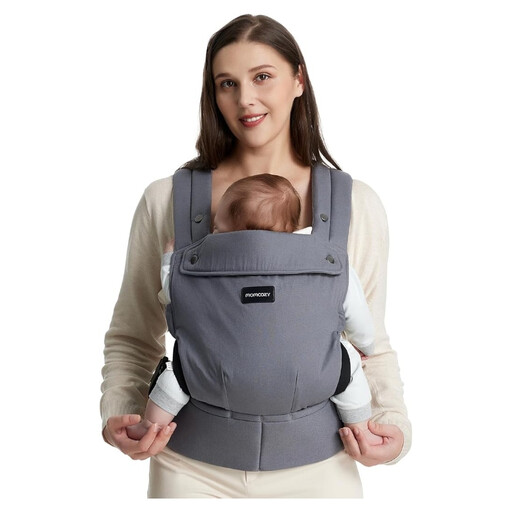
Why it stands out: This Momcozy model combines an ergonomic design with the user-friendliness of a front carrier. Made from breathable 100% cotton, it features a three-point support system with an EVA panel in the waistbelt to relieve pressure on the wearer.
Highlights:
Who is it for?: Parents looking for a reliable and comfortable solution for daily outings that will grow with their child.
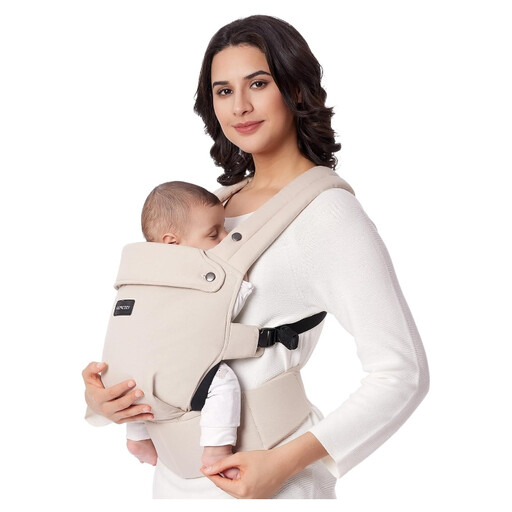
Why it stands out: This version places special emphasis on lumbar support. Its 3-point support system, featuring an EVA waist pad and crossable back straps, minimises strain on the wearer's shoulders and back.
Highlights:
Who is it for?: Parents who plan to carry their child frequently or for long periods and for whom back comfort is a top priority.
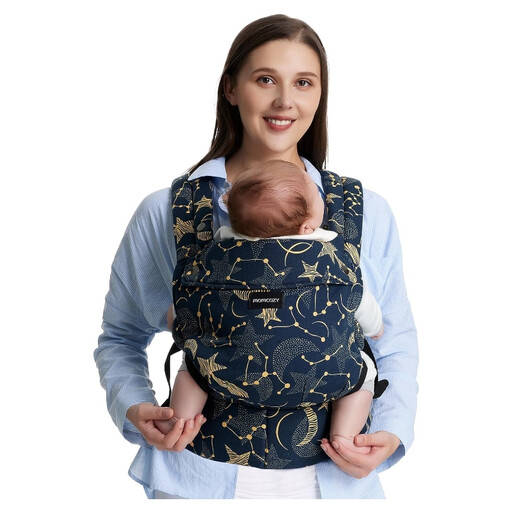
Why it stands out: This model includes the fundamental features of the Momcozy range (ergonomics, comfort, 100% cotton) while adding a touch of style with its starry pattern. It makes no compromises on safety and well-being.
Highlights:
Who is it for?: Parents who want a carrier that is functional, ergonomic, and has a stylish design for everyday use.
This selection represents solid options for comfortable and secure babywearing. But because every family is unique, you may want to explore other styles, colours, or features.
Discover our full range of baby carriers to find the one that perfectly meets your needs.
Most models are designed for use from birth, provided the minimum weight requirement is met (usually around 3.2 kg). For a newborn baby carrier, ensure it offers excellent head and neck support and allows for a perfect fit for a newborn's small frame.
Always check these key points: your baby's face should be visible and clear of fabric, their chin should not be touching their chest, their back should be naturally curved in a "C" shape, and their knees should be higher than their hips (the "M" position). The golden rule: you should be able to kiss their forehead without straining. This is known as being "close enough to kiss"!
Yes, as long as the front carrier is well-designed. Unlike older models that placed all the weight on the shoulders, modern baby carriers with a wide waistbelt and good lumbar support distribute the load onto the hips. This makes carrying much more comfortable, even for long periods.