
Livraison le jour même ou le lendemain

Qualité garantie

Débloquez vos offres de bienvenue: Livraison GRATUITE | Jusqu'à -80 % | 30 jours d'essai gratuits à JoyPlus
Téléchargez l'application
A Momcozy ergonomic baby carrier can make life easier when travelling around town, doing the shopping, going for walks or travelling with a baby from around three months old. However, terms such as “ergonomic”, “breathable” and “enhanced lumbar support” are not enough to determine whether a model will really be comfortable for your build and suitable for your child’s age.
Before placing your order, three common mistakes are worth avoiding:
An ergonomic baby carrier should allow what is known as the M position: your baby’s knees should be higher than their bottom, while their legs are supported without being compressed. This position should be checked every time you put the carrier on, not just the first time you use it.
Your baby’s face must remain visible, their airways clear and their body close enough to the wearer. The models featured here are advertised for children weighing approximately 3.18 to 19.96 kg, or roughly 3 to 24 months, depending on the product listings. Always follow the age, weight and usage conditions stated in the instructions.
For a baby carrier for newborns from 3 months, check in particular that your child can hold their head properly without assistance and that the adjustments provide suitable support. The manufacturer’s stated weight limit does not replace these precautions.
For everyday use, look for a waistband with lumbar support, adjustable straps and a design that distributes the load between your shoulders, back and hips. Depending on the version, the Momcozy models in this selection feature an EVA panel around the waist, as well as an X-shaped back or cross-back straps.
These features may improve weight distribution, but they cannot guarantee that you will be free from aches and pains. Take time to adjust the baby carrier gradually: the waistband should stay securely in place, the straps should be tight enough and your baby should sit high enough without making it harder for you to breathe.
Depending on the model, the baby carrier weighs approximately 760 to 771 g. These are therefore lightweight baby carriers for this category, but your child’s weight and that of any accessories you carry will also have a significant effect on overall comfort.
A 100% cotton baby carrier may suit parents looking for a soft fabric against the skin that is easy to care for. The cotton models featured here are advertised as machine washable, provided you follow the instructions in the care guide.
For summer outings or frequent travel, a breathable baby carrier made from Air Mesh fabric may be more suitable. Mesh versions are designed to encourage air circulation and feature fabric described as cooling around the neck. However, they do not eliminate the risk of overheating: never cover your baby’s face and check their temperature regularly.
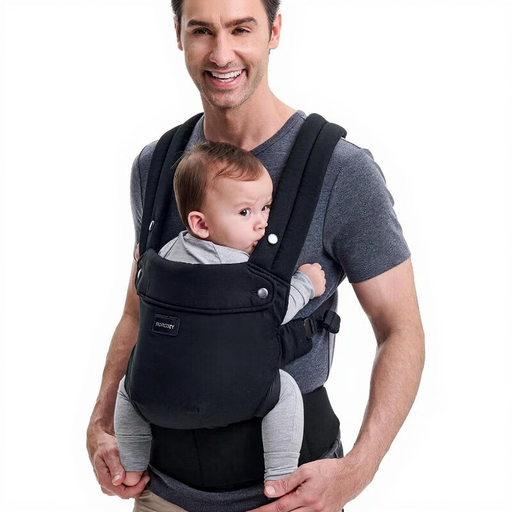
Why this choice suits this profile : Its cotton construction and front-carrying design are well suited to your first everyday journeys. It is advertised for children weighing approximately 3.18 to 19.96 kg.
The product listing details the material, machine-washing instructions, dimensions and weight range. This gives you practical information for comparing models, rather than relying on a simple marketing promise.
100% cotton, EVA lumbar panel, advertised M position and foldable neck support.
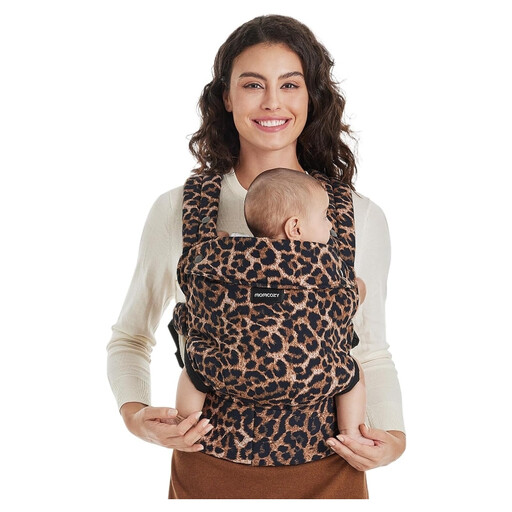
Why this choice suits this profile : Parents who value adjustability and support may prefer this cotton version, which is fitted with a three-point support system.
The adjustable straps, foldable neck support and padded leg openings allow you to adjust several areas. Comfort does not depend solely on the waistband.
100% cotton, advertised M position, EVA back panel and a weight range of 3.18 to 19.96 kg.
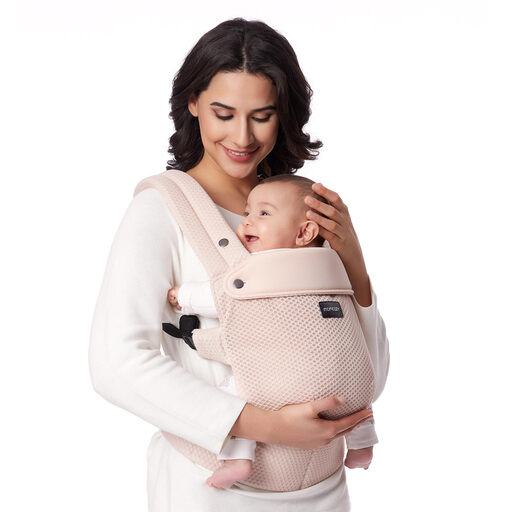
Why this choice suits this profile : For frequent journeys, holidays or hot days, the Air Mesh fabric and cooling contact fabric directly address the challenge of managing heat.
The material is clearly distinguished from cotton and machine washing is specified. You can therefore choose according to the season without confusing softness with air circulation.
Air Mesh panel, three adjustment positions, EVA lumbar support, front carrying position and a design created to keep your hands free.
Even with a suitable model, fitting it correctly is essential:
A baby carrier does not protect against falls. Do not use it for running, cycling, cooking near a flame or taking part in any activity that involves a risk of falling. For the model’s precise limitations, refer to the instructions provided.
We have brought together a complete, real-time selection of products that meet these demanding criteria, as well as European safety regulations.
The product listings for the models featured generally state that they can be used from approximately 3 months, for a weight between 3.18 and 19.96 kg. However, your child must be able to hold their head in accordance with the manufacturer’s instructions. Always read the instructions and check that the adjustment is suitable for their size.
There is no universal time limit: it depends on both the child and the wearer. Start with short periods, monitor your baby’s breathing, posture and any signs of discomfort, and give them regular breaks. If you are in pain or your child appears to be uncomfortable for an extended period, stop carrying them and check the adjustments.
The Momcozy models featured in this selection are advertised as machine washable. Follow the programme and conditions specified in the instructions, make sure the baby carrier is completely dry before storing it and inspect the stitching after every wash.