
Livraison le jour même ou le lendemain

Qualité garantie

Débloquez vos offres de bienvenue: Livraison GRATUITE | Jusqu'à -80 % | 30 jours d'essai gratuits à JoyPlus
Téléchargez l'application
An ergonomic baby carrier can make life easier when walking, shopping, travelling or simply when your baby wants to be held. Product descriptions sometimes use reassuring language without explaining the specific conditions of use. Comfort depends on your child’s weight, the wearer’s body shape and how precisely the carrier can be adjusted.
Before making your decision, it is worth avoiding three particularly common pitfalls.
The M position means that your baby’s knees are higher than their hips, while their thighs remain properly supported. A wide seat alone is therefore not enough: it must be adjusted to suit your child’s size and must not put pressure on their legs.
Also check that your baby’s face remains clearly visible, their airways are unobstructed and they are close enough to your body. When carrying your baby facing inwards, you should be able to monitor them easily, particularly if they are very young.
A lightweight baby carrier is convenient to carry when not in use, but comfort mainly depends on how the weight is distributed. Straps with insufficient padding, a belt that is too narrow or limited adjustment options can quickly create pressure points.
For carrying your child for longer periods, choose a baby carrier with lumbar support, adjustable straps and a design that can distribute the load between your shoulders, back and hips.
With a baby, little accidents and stains are part of everyday life. Even when a model is described as machine washable, follow the manufacturer’s instructions to protect the stitching, buckles and fabric’s shape.
Do not focus solely on the stated age range: the minimum weight, maximum weight and your child’s ability to hold their head up are three different criteria. Inspect the product before every use and stop using it if a strap, buckle or seam shows signs of wear.
An ergonomic baby carrier should adapt as your child grows. Look for an adjustable seat, good thigh support and a position that keeps the knees slightly raised. The specifications for the models featured below state that they offer an M position and a usage range of approximately 3.18 to 19.96 kg, or roughly 3 to 20 kg.
Check the position every time you put the carrier on: an adjustment suitable for a baby of a few months may not work for an older child. Always refer to the manual supplied with the product.
An ergonomic cotton baby carrier can be suitable for everyday use thanks to its soft material and generally simple care requirements. Open-mesh models provide even better air circulation. They are particularly useful for summer walks, public transport or well-heated homes.
However, a breathable baby carrier does not eliminate the risk of overheating. Avoid excessively thick clothing, check your baby’s temperature regularly and never cover their face with a blanket or fabric.
An adjustable baby carrier should be able to accommodate different body shapes, particularly when parents take turns carrying the child. Crossed or X-shaped straps, a waist belt and lumbar support can help distribute the weight more effectively, although they cannot guarantee that you will avoid tiredness or pain.
Before going on a long outing, try it at home with another adult nearby. Your baby should be sitting upright and securely supported, without excessive pressure on their chest or legs.
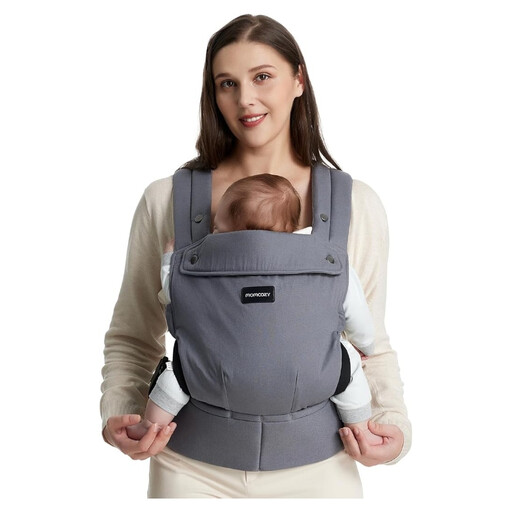
Why this choice suits this profile : this cotton model is designed for carrying children facing inwards, weighing approximately 3.18 to 19.96 kg. Its various adjustment options and stated weight of 771 g make it a practical companion for everyday outings.
The product description specifies the weight range and machine-washing instructions, and highlights the need to check the buckles and straps before every use.
100% cotton, adjustable straps, an EVA lumbar panel and foldable neck support.
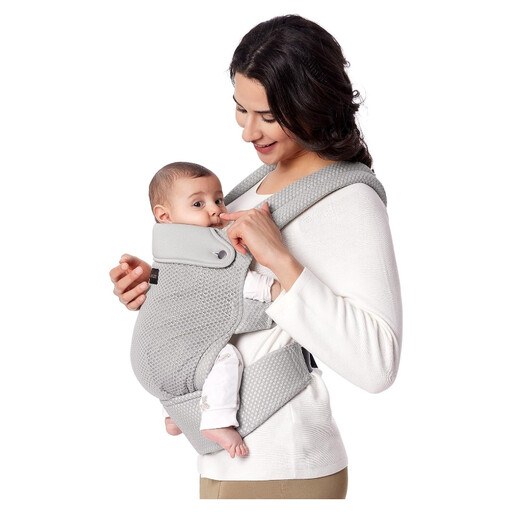
Why this choice suits this profile : its breathable mesh is ideal for parents looking for a breathable baby carrier for warm-weather walks, frequent journeys and travel.
The Air Mesh material helps limit heat build-up, while the stated range of 3.18 to 20 kg makes it easier to check compatibility with your child.
Mesh panels, cooling fabric against the nape of the neck, M position, X-shaped back and EVA lumbar support.
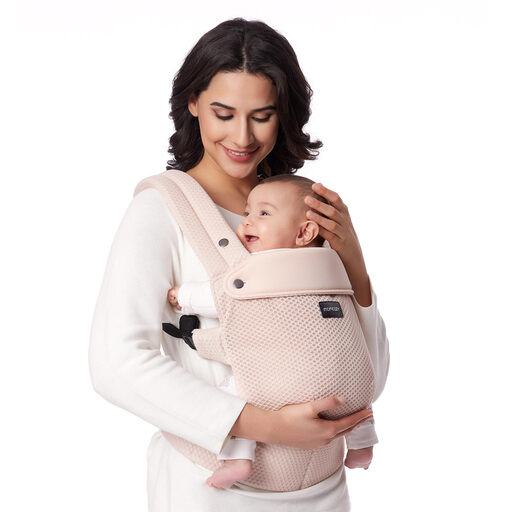
Why this choice suits this profile : this model is designed for parents who carry their child regularly and want straightforward care so they can get ready for one outing after another.
The product description mentions machine washing and reminds you to carry out safety checks before every use.
Three adjustment positions, padded leg openings, head support and a stated capacity of up to approximately 19.96 kg.
We have brought together a complete, real-time updated selection of products that meet these demanding criteria as well as European safety standards.
If your child cannot yet hold their head up, only use a model and configuration explicitly designed for this purpose in the manual. If the wearer experiences pain or the baby seems uncomfortable, stop carrying them and readjust the carrier.
It depends on the model. The products featured here generally state a minimum weight of around 3.18 kg, but this does not replace the manufacturer’s instructions. Your baby’s age, ability to hold their head up and size must also be taken into account.
There is no universal length of time that is suitable for every child. Start with short periods and monitor their breathing, leg position and signs of tiredness. For longer carrying sessions, take regular breaks and check the adjustment after each journey.
Remove detachable parts when recommended by the manufacturer, fasten the buckles and use the specified wash programme. Then allow the baby carrier to dry completely before storing it. After washing, inspect the seams, padding and fastenings: clean fabric does not make a damaged component safer.