
Livraison le jour même ou le lendemain

Qualité garantie

Débloquez vos offres de bienvenue: Livraison GRATUITE | Jusqu'à -80 % | 30 jours d'essai gratuits à JoyPlus
Téléchargez l'application
Juggling a baby's needs with daily chores is a constant challenge for all parents. The ergonomic baby carrier emerges as a lifesaver: it promises to keep your child snug and secure against you, while leaving your hands free. The problem? The market is saturated with models making confusing marketing claims, and the perfect purchase can quickly turn into a regret.
To prevent the baby carrier of your dreams from ending up in the back of a closet, here are the three main pitfalls to avoid before you buy.
To navigate the jungle of baby carriers, it's best to focus on a few technical details that make all the difference. These objective criteria will guide you to the model that is truly right for you and your baby.
The term physiological baby carrier isn't just a marketing buzzword. It refers to a carrier that respects the child's morphology and development. The key indicator is the renowned "M" position:
This posture ensures the healthy development of the hips and spine. Conversely, a carrier that lets the child's legs dangle straight down is not physiological and should be avoided at all costs.
A good baby carrier should be as comfortable for you as it is for your child. The secret lies in weight distribution. Two elements require close attention:
The choice of fabric directly impacts comfort and how often you'll use the carrier.
Rather than an endless list, we've matched parent profiles with models that check all the boxes for safety, physiology, and comfort.
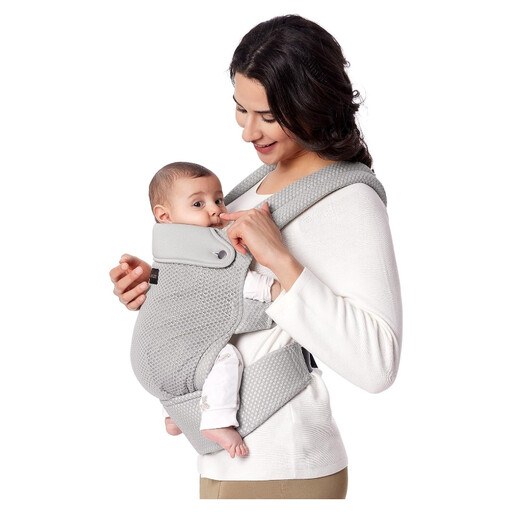
Why we chose it: The perfect ally for parents who refuse to let the heat ruin their outings. Its airy mesh design is perfect for summer walks, travel, or simply for homes where the heater is on full blast.
This model directly tackles the wrong-fabric trap. Its breathable mesh structure optimises air circulation, preventing both baby and wearer from overheating.
It combines a breathable design with integrated lumbar support and X-shaped straps, ensuring ideal weight distribution, even during extended use.
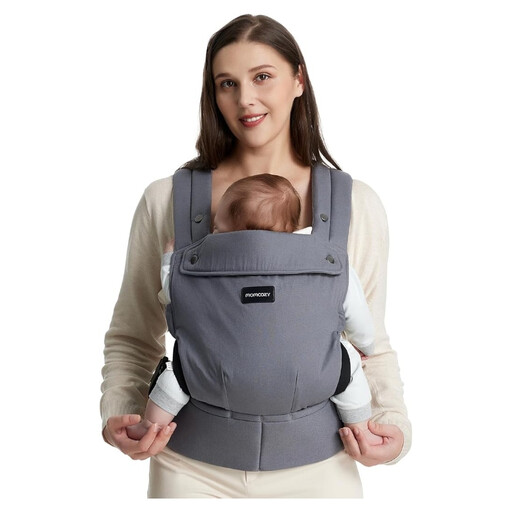
Why we chose it: The ultimate all-rounder for parents seeking a daily companion, from running errands to walks in the park. Its 100% cotton fabric is as soft on baby's skin as it is comfortable in any season.
It tackles the trap of sacrificing the wearer's comfort. Its three-point support system, with an EVA panel, is designed to limit strain on the back and shoulders, even after several hours.
It offers excellent comfort for your back while guaranteeing the physiological "M" and "C" positions for the baby. Bonus: it's machine-washable for hassle-free maintenance.
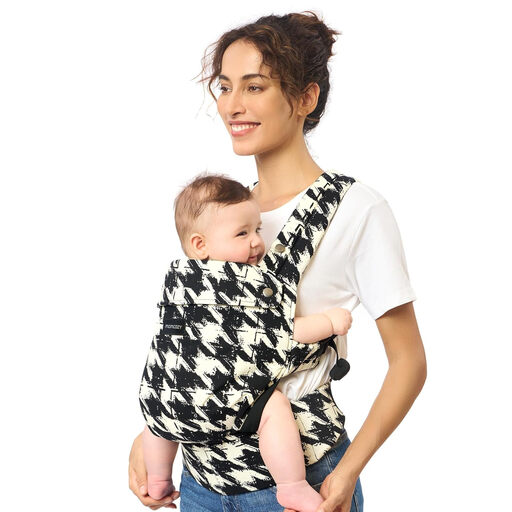
Why we chose it: Designed to grow with your child, this model can be used from 3.2 kg. Its three width adjustment levels ensure a custom fit as the months go by.
It avoids the trap of a poorly-fitted carrier for a newborn. Its adjustments guarantee a perfect physiological position, even for the smallest babies, without them "floating" inside.
Its scalability makes it a smart and sustainable investment. The OEKO-TEX Standard 100 certified cotton is an added guarantee against harmful substances, ideal for a newborn's fragile skin.
Explore our full selection of products that meet our strict criteria for safety and comfort.
Most ergonomic baby carriers can be used from birth, or more specifically, from a minimum weight of around 3.2 kg. It is imperative to always check the manufacturer's recommendations. The crucial point is to ensure the carrier maintains the infant in a perfect physiological position (rounded back, knees higher than bottom) without ever forcing their hips too far apart.
You can feel good back support immediately. Your baby's weight should rest mainly on your hips via the lumbar belt, not pull on your shoulders or neck. The belt should be snug and positioned on your hips (or lower back). If tension appears in your shoulders after a few minutes, the lumbar belt is likely poorly adjusted or the shoulder straps are not tight enough.
Some physiological models offer a forward-facing position. However, this position is not recommended until the baby has perfect head and neck control (around 5-6 months). It is also less ergonomic than the parent-facing position, as the natural curve of the back is no longer maintained. It's best to reserve it for short, active periods to satisfy your baby's curiosity, while remaining vigilant for any signs of overstimulation or discomfort. The models in our selection prioritise the parent-facing position for optimal support.