
Livraison le jour même ou le lendemain

Qualité garantie

Débloquez vos offres de bienvenue: Livraison GRATUITE | Jusqu'à -80 % | 30 jours d'essai gratuits à JoyPlus
Téléchargez l'application
For new parents, choosing the right baby gear can quickly become overwhelming. The ergonomic baby carrier is on every baby registry, but how do you sort through the options to find one that’s truly suitable and not one that fails to deliver? Too many products make claims that prove disappointing in practice.
This guide is here to help you navigate the most common pitfalls and choose a baby carrier that ensures both your comfort and your child's.
To make the right choice, focus on a few objective technical points. These are the real guarantees of quality and comfort for you and your child.
The number one criterion is respect for your baby's anatomy. A physiological baby carrier must support the "M-position," also known as the "frog-leg" position.
Your baby's comfort is essential, but so is yours. A good baby carrier must distribute the child's weight evenly.
The carrier's fabric has a direct impact on comfort and temperature regulation.
To help you see how these criteria apply in practice, here are a few models that meet specific needs.
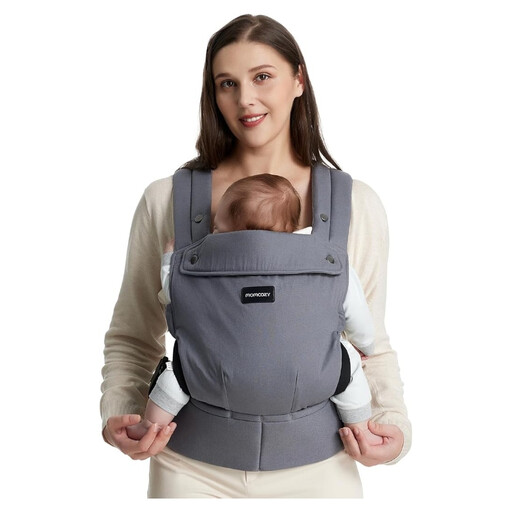
Why we love it: Ideal as a first purchase, this carrier focuses on the essentials: safety, ergonomics, and simplicity. It's perfect for daily outings and for keeping baby close at home while leaving your hands free. An excellent gift idea for a new mom.
Its design guarantees the "M-position" for the hips and the C-shaped curve for the back, avoiding the "fake ergo" trap.
Fabric: 100% cotton, soft and breathable. Support: Three-point support system with an EVA panel to relieve strain on the wearer's back.
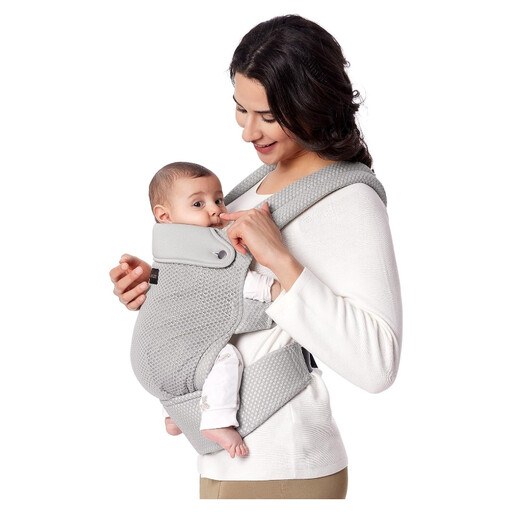
Why we love it: Designed for parents on the move, whether for a light hike or a city stroll in warm weather. Its airy structure ensures that neither you nor your baby will overheat.
It directly tackles the problem of non-breathable fabrics. Its Air Mesh panel maximizes airflow, preventing discomfort from sweat.
Ultra-breathable fabric: Perfect for summer and warm climates. Integrated lumbar support: The belt with EVA reinforcement and the X-shaped back design distribute weight for long-lasting comfort.
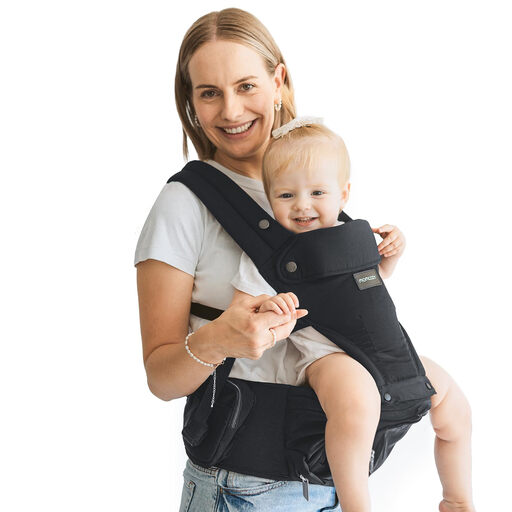
Why we love it: For parents looking for a long-term investment. This adaptable model grows with your child, from a newborn carrier (from around 3 months) to a toddler carrier, thanks to its detachable hip seat and multiple positions.
It solves the problem of wearer discomfort over long periods. The hip seat provides a stable base that significantly lightens the load on the back and shoulders.
2-in-1 Versatility: Use as a complete carrier or as a simple hip seat. Six carrying positions: Front, back, and hip carry options to adapt to any situation.
A baby carrier is a great start, but there are countless ways to care for a new mom. We've compiled a selection of gifts focused on wellness and relaxation.
Most structured carriers are recommended from 3 or 4 months, or once the baby weighs around 3.2 kg (7 lbs) and has good head control. For a newborn carrier, it's crucial to verify that the model is specifically designed for this purpose (sometimes with an infant insert) to ensure perfect head and neck support.
Always check these points: the fabric should reach the back of their knees, their knees should be higher than their bottom (the "M-position"), their back should be slightly rounded, and their face should be visible and clear of fabric. You should be able to kiss their forehead without straining (the famous "close enough to kiss" rule).
Yes, provided it is well-designed and perfectly adjusted. A model with a wide lumbar belt and shoulder straps (either crossed or in an H-shape) distributes the child's weight across your hips and torso, instead of concentrating it all on your shoulders and upper back. Proper adjustment is the key to comfortable carrying.