
Livraison le jour même ou le lendemain

Qualité garantie

Débloquez vos offres de bienvenue: Livraison GRATUITE | Jusqu'à -80 % | 30 jours d'essai gratuits à JoyPlus
Téléchargez l'application
Becoming a parent is an incredible adventure, but it's also a marathon of decisions. Among the most important is choosing a baby carrier—an essential tool for keeping your baby close while keeping your hands free. But with an overwhelming number of options, how do you avoid falling for marketing traps? This guide is here to help you cut through the noise and choose THE ergonomic baby carrier that supports your child's natural posture and protects your back.
The market is flooded with models making tempting promises. However, a few design flaws are all it takes to turn the dream into a nightmare. Here are the most common pitfalls:
To make the right choice, ignore the marketing jargon and focus on these few technical points that make all the difference.
A carrier worthy of the name must absolutely guarantee the famous "M-position" (or frog-leg position). In practical terms, this means your baby's knees are higher than their bottom, and their back maintains its natural C-shaped curve. This posture is crucial for healthy hip development and prevents any unnecessary strain. The carrier's seat must be wide enough to support the baby's thighs from knee to knee.
Even a newborn weighing just a few kilos feels heavy after an hour. A good baby carrier must therefore distribute this weight intelligently. To ensure this, two checkpoints are essential:
A baby's skin is delicate. Opt for natural, breathable materials. The cotton baby carrier is a safe bet: soft, hypoallergenic, and it allows air to circulate. Also, consider practicality: a machine-washable model will be a lifesaver. Finally, check the weight range. An adjustable model, like a 3-20 kg baby carrier, is a more sustainable investment.
To illustrate these criteria, here are a few models that check all the boxes, each meeting a specific need.
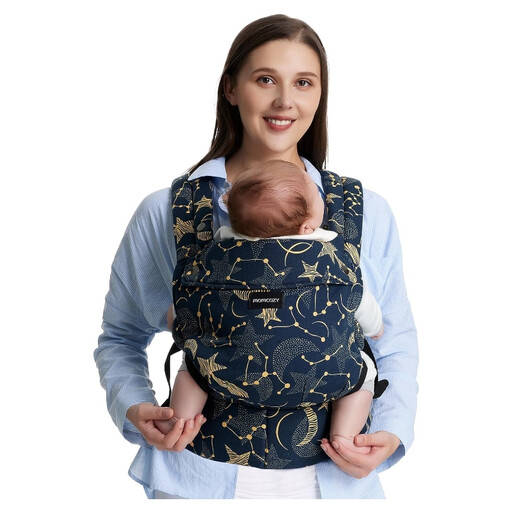
Our take: Perfect for beginners, this model combines an ultra-simple setup with essential ergonomic guarantees. Its 100% cotton fabric is soft on the baby's skin, and its lightweight design makes it perfect for daily outings. It's an excellent entry-level option or a great baby shower gift.
Its design ensures the "M-position" for the hips and "C-curve" for the back. Its EVA lumbar support is effective and prevents back pain for the wearer.
The immediate comfort of the breathable 100% cotton and the ease of adjustment for a secure front carry. And of course, it's machine-washable.
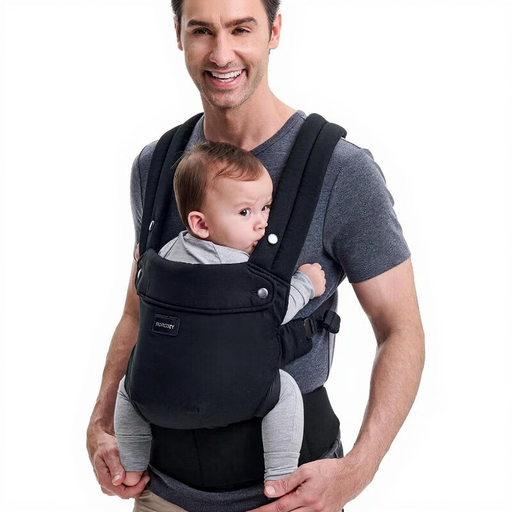
Our take: Designed for parents who go on long walks or need to wear their baby for extended periods daily. This model focuses entirely on optimal weight distribution thanks to its crossable shoulder straps and reinforced lumbar support. The result: fatigue is minimized.
It directly tackles the pitfall of wearer discomfort. Its support system and lumbar reinforcement are specifically designed to lighten the load on the back and shoulders.
Reinforced lumbar support for longer, pain-free wearing. Understated and effective, it's a durable and unisex choice.
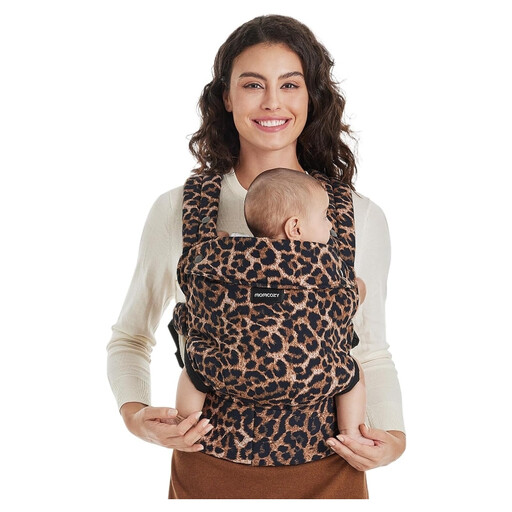
Our take: This model proves you don't have to sacrifice style for the sake of ergonomics. It includes all the technical qualities of the range (support, M/C position, 100% cotton) and adds a fashionable touch with its trendy print.
It debunks the myth that a stylish product must be less technical. It incorporates the same support system and back reinforcement, ensuring uncompromised comfort and safety.
A bold design that sacrifices nothing on the technical side. And since it's machine-washable, it's as practical as it is stylish.
Explore our full selection of baby carriers that meet our selection criteria and current safety standards.
Most models can be used from birth or shortly after, starting from a minimum weight of 3 to 3.5 kg. It is crucial to always check the manufacturer's specific recommendations. Adjustable models (often 3 to 20 kg) are a good investment as they will grow with your child for several years.
It's very simple: check for the "M-position." Their knees should be higher than their bottom, and their thighs should be supported from one knee to the other. Their back should remain slightly curved, and their head should be "close enough to kiss." Finally, ensure their face is always visible and that nothing obstructs their airway.
The front carry position, with the baby facing you, is the most common and recommended position, especially for newborns. It promotes bonding and allows you to keep a constant eye on your child. For older babies, some models allow other positions (hip, back), but a good ergonomic front carry is the foundation and is more than enough for daily use.