
Livraison le jour même ou le lendemain

Qualité garantie

Débloquez vos offres de bienvenue: Livraison GRATUITE | Jusqu'à -80 % | 30 jours d'essai gratuits à JoyPlus
Téléchargez l'application
A cluttered entryway can quickly create an impression of disorder: shoes piling up by the door, coats draped over chairs and small items scattered across the console table. An entryway cabinet with shoe storage can bring several functions together, provided you choose a model suited to your home’s layout and your household’s habits.
Looks are not everything. Some cabinets promise generous capacity, yet their compartments are too low for ankle boots. Others appear compact in photos, only to obstruct a door or narrow the passage through a hallway. Here are the key points to assess before placing your order, along with four models worth considering in 2026.
The stated number of pairs depends on shoe size, footwear shape and whether dividers are fitted. Thick trainers, high-top shoes and boots inevitably take up more room than a pair of ballet flats.
A shoe cabinet with doors protects footwear from dust and keeps its contents out of sight, but be sure to check the usable depth and the door clearance. In a narrow hallway, a shallow tilt-out cabinet can be especially practical. A traditional wardrobe, by contrast, requires more clearance in front.
Before ordering, measure the available width, maximum depth and ceiling height. Also allow for the space required to open doors, drawers or angled compartments.
In a busy passageway, a narrow shoe cabinet measuring 24 to 25 cm deep can make circulation easier. An entryway hall tree with a bench and hooks takes up more space, but it may replace several separate pieces of furniture.
A tall cabinet loaded with shoes or bags must remain completely stable. Check whether it includes an anti-tip device and secure it to the wall whenever recommended in the instructions. This precaution is particularly important in family homes or wherever children use the entryway.
Load limits also vary by component: the weight capacity of a seat is not the same as that of a shelf or hook. Follow the values listed on the product page and choose fixings suited to the type of wall.
For shoe storage in a hallway, depth is often the first specification to check. A 24 cm cabinet may suit a compact entryway, but make sure you verify the usable length of its compartments. A width of around 60 cm is sufficient for a small space, while a cabinet more than one metre wide offers greater capacity at the cost of a larger footprint.
Height also deserves attention. A low cabinet can double as a console, while a taller model frees up floor space. However, the latter should be wall-mounted if required by its design.
Adjustable or removable shelves make it easier to accommodate different types of footwear. They are especially useful in households that alternate between low shoes, trainers, ankle boots and tall boots. Drawers are better suited to keys, laces, shoe-care products and accessories.
A multifunctional entryway cabinet can combine closed storage, a top shelf, mirror, hooks and seating. This versatility helps avoid filling the space with multiple pieces, provided each function genuinely meets a need.
MDF and particleboard are widely used in this category. Examine the edge finishing, panel rigidity, handle quality and ease of care. In an entryway, the cabinet may be exposed to moisture from wet shoes or coats. Air out the compartments and avoid storing items that are still damp.
A white shoe cabinet creates a lighter feel, while a wood-and-metal finish works naturally in an industrial-style interior. Colour is ultimately an aesthetic choice: it does not replace the need to check the dimensions and structural strength.
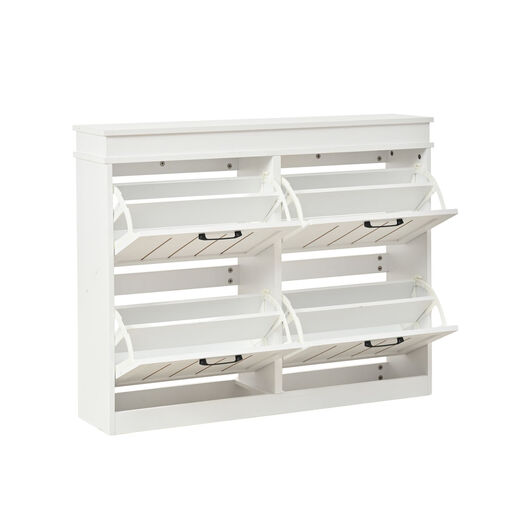
Why this model suits this profile: at just 24 cm deep, it fits neatly into entryways where every centimetre matters. Its eight compartments are arranged behind four hinged doors.
The external dimensions are clearly specified, and the dividers can be removed to create more usable space.
Its low, wide format provides four doors, eight compartments and a practical top surface for additional storage.
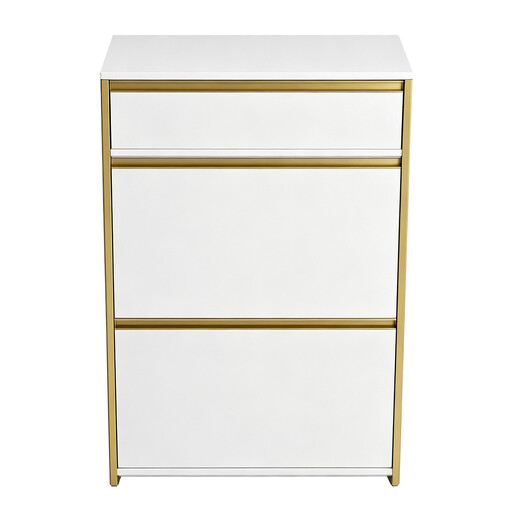
Why this model suits this profile: measuring approximately 60.5 x 24.5 x 105 cm, it fits comfortably in an entryway, hallway or even living room.
Adjustable, removable shelves prevent wasted space when footwear varies in height.
The product specification includes two doors, four shelves, one drawer and an anti-tip device.
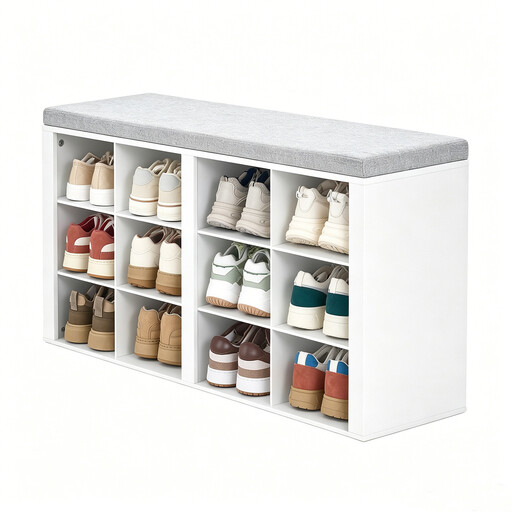
Why this model suits this profile: the bench makes changing shoes in the entryway more convenient, while the adjustable shelves accommodate different footwear sizes and shapes.
The shelf height can be adjusted, so the entire cabinet is not limited to low-cut shoes.
Its 30.5 x 104.5 x 49.5 cm dimensions, removable cushion cover and stated 150 kg load capacity make it a practical seat.
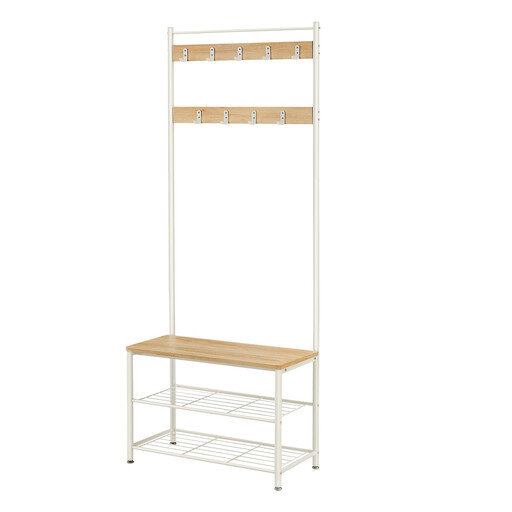
Why this model suits this profile: it brings hooks, a bench and shelves together in a 32 x 70 x 177 cm structure designed for entryways that need to accommodate coats, bags and shoes.
The load limits are clearly differentiated: 3 kg per hook, 10 kg per wire shelf and 136 kg for the bench, according to the supplied information.
Nine metal hooks, adjustable feet, an anti-tip kit and a natural wood-and-white finish.
Before finalising your purchase, check the assembly instructions, package contents, delivery terms and whether the cabinet can be secured to the wall. To compare other formats, also browse our selection of entryway coat racks and shoe cabinets.
Explore a regularly updated selection of furniture designed to organise entryways, coats and shoes, whatever your space constraints.
A depth of 24 to 25 cm may be sufficient for a narrow passage, but also measure the length and orientation of the compartments. Bulky footwear may require a deeper cabinet or open shelving.
It depends entirely on the maximum load specified by the manufacturer. Never apply the load rating for a shelf to the seat. For the HaluPeit model featured here, the product information states a 150 kg capacity for the bench. This load should be distributed evenly, and the cabinet must be assembled according to the instructions.
Allow shoes to dry before storing them, clean the compartments regularly and avoid cramming footwear inside without leaving room for air to circulate. Closed storage protects against dust, but it still requires regular ventilation.