
当日/次日达

品质保障

开启新人专享福利: 全场免邮 | 低至 2 折 | 免费试用 30 天 JoyPlus 会员
下载 Joybuy
A cluttered hallway can quickly create an impression of disorder: coats piled on a chair, bags left on the floor and shoes scattered by the door. Yet choosing an entrance coat rack is about more than simply selecting a style or colour. Stability, dimensions and storage options all have a direct impact on everyday convenience.
The Joybuy Product Recommendation Officer’s selection is based on practical criteria to help you avoid models that are ill-suited to the layout of a flat, family home or compact space.
A model described as compact can take up considerably more room once coats are hanging from it. Check its width, depth and height, and remember to allow enough space to move around the furniture. In a narrow hallway, a wall-mounted coat rack and a freestanding model have very different space requirements.
A freestanding model measuring 49 × 49 cm can fit perfectly in a clear corner. By contrast, a unit with a bench and shelves needs more clearance so that you can sit down comfortably.
A 9-hook coat rack or a 12-hook coat rack may seem sufficient for the whole family. However, the number of hooks alone says nothing about the rack’s stability or maximum load. Also check the permitted load per hook and how the weight is distributed across the structure.
Heavy coats, backpacks and scarves can quickly place considerable pressure on the whole unit. Evenly distributed weight reduces the risk of tipping.
A tall industrial hall tree must be assembled carefully. The presence of an anti-tip device is an important point to check when one is supplied with the product. It must be secured to the wall according to the instructions, particularly in homes with young children.
Assembly also deserves some attention: numbered parts, clear instructions and included tools help prevent mistakes and speed up set-up.
Measure the available area before ordering. Leave enough room to open a door, walk through with bags or take off a coat without bumping into a wall. Height also matters: a freestanding clothes rack measuring almost 1.80 m provides useful vertical storage, but can quickly feel imposing in a small hallway.
In a narrow corridor, an entrance unit with integrated storage can replace several separate pieces of furniture. This allows you to combine hooks, shoe storage and, if required, seating in a single structure.
Steel provides a rigid structure, while particleboard is commonly used for benches and shelves. Check the stated maximum static load:
These figures cannot predict the unit’s lifespan in every situation, but they make it easier to compare different models objectively. Always follow the limits specified by the manufacturer.
A coat rack with shoe bench is in a different category from a simple clothes rack. The bench makes changing shoes easier, while the shelves prevent pairs from being left on the floor. However, check the seat depth and the maximum load for each level.
To organise shoe storage in the hallway, sort pairs according to how often they are worn: keep everyday shoes on the most accessible level and place the others on the upper shelves or in a dedicated space.
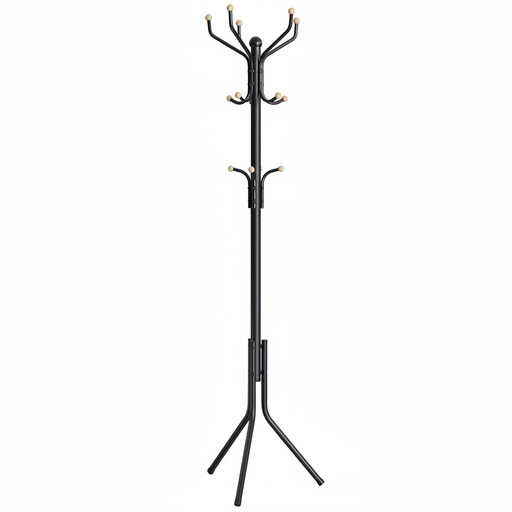
Why this choice suits this profile: This freestanding coat rack is ideal for anyone looking for a simple way to hang coats, bags and hats, without additional bench or shelving.
Its stated dimensions of 49 × 49 × 182 cm make it easy to check how much space is available. The load should be distributed evenly to reduce the risk of tipping.
A steel structure, 12 hooks and a stated maximum static load of 36 kg. The smooth surface is easy to clean with a cloth.
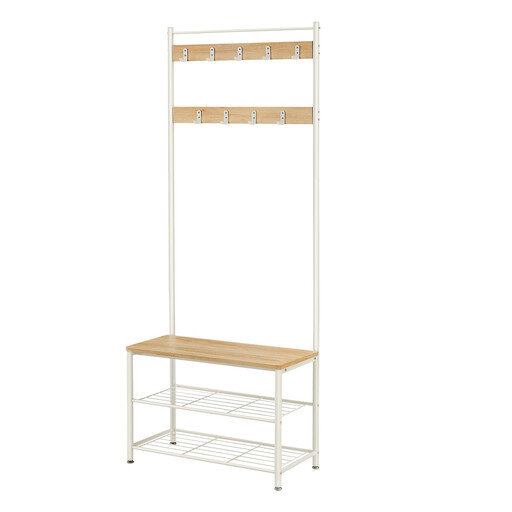
Why this choice suits this profile: Its 3-in-1 design is ideal for households wanting to combine storage, seating and coat organisation in a well-structured entrance unit.
The 9 hooks are arranged in two rows and an anti-tip kit is included. Wall fixing is still required, in accordance with the instructions.
A bench with a stated maximum static load of 136 kg, shelves supporting 10 kg each and adjustable feet.
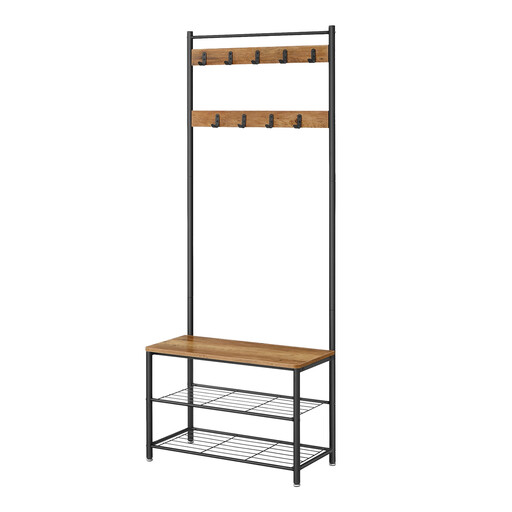
Why this choice suits this profile: This version combines a walnut and black finish with comprehensive storage, making it suitable for a family or a particularly busy hallway.
Load limits are specified for each hook, the bench and the shelves. This information helps prevent overloading a unit used every day.
9 metal hooks rated to support up to 3 kg each, a bench supporting up to 136 kg and a steel structure with particleboard panels.
We have brought together a complete, real-time-updated selection of products that meet these demanding criteria while complying with European safety regulations.
Before starting assembly, check that the floor is level and that all parts match the details in the instructions. Tighten the screws gradually without forcing them into the panels. For a tall model, fit the supplied anti-tip kit whenever recommended in the instructions.
Place heavy items on the lower levels and distribute coats between the two rows of hooks. For care, a slightly damp cloth is generally all you need for smooth surfaces. Avoid abrasive products, which could damage black, white or wood-effect finishes.
Measure both the available width and the depth of the passageway. A shallow freestanding model may fit in a corner, while a unit with a bench needs enough clearance to sit down and stand up easily. Make sure the area in front of the entrance remains clear for movement.
Distribute the load between the different hooks, place heavy items at the bottom and follow the stated limits. If the unit is supplied with an anti-tip kit, secure it to the wall according to the instructions. Never hang a load heavier than the one specified by the manufacturer.
Routine care generally consists of using a cloth and occasionally cleaning the shelves. The cost mainly depends on the products used and whether a part needs replacing. Careful assembly and respecting the specified load limits help preserve the unit and its functionality over time.