What should you check on the label?
To choose between two appliances, start with what matters for the way you use them, then compare figures for the same category and based on the same unit of measurement.
| Criterion |
What to check |
Who it matters to |
| Energy consumption |
For washing appliances, compare kWh per 100 cycles and litres per cycle; for refrigeration, compare annual kWh; for an oven, compare kWh per cooking cycle. |
If I’m replacing an appliance, I want to understand what kind of use its energy consumption relates to before choosing between two models. Around 36% of consumers would prioritise comparing energy consumption this way. |
| Capacity and noise |
Check the capacity in the unit used for that appliance, then look at the noise level and, if shown on the label, its noise class. |
In an open-plan kitchen or when my loads vary, I want a suitable size without overlooking noise. Around 29% of consumers would prioritise usable capacity or quieter operation. |
| Repairability and durability |
Look for the relevant indicator: the durability index for a washing machine, the repairability index for a dishwasher or the repairability class for applicable tumble dryers. |
If I plan to keep an appliance for a long time, I want to consider information about its repairability or durability as well as its energy consumption. This would be the top priority for around 21% of consumers. |
| Scale and test conditions |
Check the scale for that appliance category and the programme or mode shown: the eco cycle, cooking mode or cooker hood’s normal speed. |
Before comparing letters or figures, I want to know whether they describe the same type of use. Around 14% of consumers would prioritise understanding the scales and modes. |
Brands to explore
There are no brands to feature in this section.
Appliances to consider on Joybuy
These two appliances illustrate different ways to read an energy label: for the dishwasher, look at the figures linked to its cycles; for the fridge-freezer, check its annual energy consumption and storage volumes. Compare each only with models in the same category.
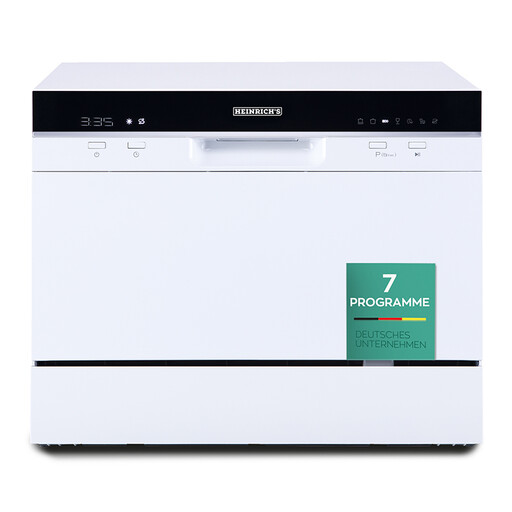 Image unavailable
Heinrich's HTG 8840 Weiss, tabletop dishwasher, 6 place settings
Worth considering if you’re looking for a tabletop dishwasher with space for 6 place settings. The product name lists an energy class of D and a noise level of 47 dB. Check the model’s energy label to compare consumption, the reference programme and noise class with those of another dishwasher.
View on Joybuy
 Image unavailable
Sonlu CC-520WE, 444 L fridge-freezer
Worth considering if you need a stated total capacity of 444 L. The product name mentions frost-free technology, energy class E and a noise level of 40 dB. Before comparing this model, check the energy label for its annual consumption, the capacity of each compartment and its noise class.
View on Joybuy
Frequently asked questions
Can you compare energy classes across two appliance categories?
No. The same letter isn’t enough to compare different categories. The European Commission uses scales and measurements specific to each appliance type. Start by comparing products in the same category, then check their energy consumption using the same unit and reference conditions.
What should you look for on a washing machine’s energy label?
Check the energy class alongside kWh per 100 cycles, litres of water per cycle, capacity, eco programme duration, spin efficiency and spin noise. ADEME and the European Commission link these figures to the reference programme “eco 40-60”, so bear this in mind if your usual washing habits are different.
Should you still look for a washing machine repairability index in France?
For applicable washing machines, look for the durability index instead. It replaced the repairability index on 8 April 2025, according to the ministry responsible for ecological transition. This indicator complements comparisons of energy consumption, capacity and noise; it doesn’t replace them.
Does a hob have the same energy label as an oven?
No. The European Commission states that the energy label for ovens doesn’t apply to hobs. When comparing ovens, check their capacity and energy consumption per cycle for the cooking mode shown, and don’t apply these figures to a hob.


