
Livraison le jour même ou le lendemain

Qualité garantie

Débloquez vos offres de bienvenue: Livraison GRATUITE | Jusqu'à -80 % | 30 jours d'essai gratuits à JoyPlus
Téléchargez l'application
As the first chill of winter arrives, an electric space heater seems like the go-to solution. But be warned: finding the right model to keep you warm without sending your electricity bill skyrocketing can be a daunting task. The market is flooded with products promising "low energy consumption," but the reality is often disappointing. As a product expert at Joybuy, my mission is to help you cut through the marketing noise and make a truly informed decision that fits your needs.
Marketing claims are slick, but the real-world performance can be less impressive. Before you decide, here are the three most common traps to sidestep to ensure a savvy purchase doesn't turn into a costly disappointment.
To choose an energy-efficient electric space heater that lives up to its promises, it's crucial to examine a few technical specifications.
Not all technologies are created equal, nor do they serve the same purpose.
The power output must be appropriate for the area to be heated. As a general rule, you need about 100W per square metre for a well-insulated room with a standard ceiling height (2.50 m).
Pairing this power with an adjustable thermostat is key. It allows the device to shut off automatically once the set temperature is reached and restart as needed. Models with a remote control for energy-saving heating often include a more precise electronic thermostat and offer far greater user convenience.
We've selected a few gems for you that tick all the boxes (performance, comfort, safety) and meet specific needs.
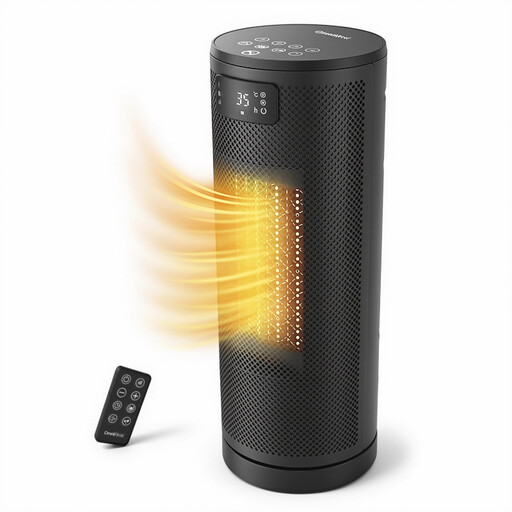
Why it's perfect for this profile: Ideal for an office or small living room, it provides fast, targeted heat. Its quiet operation (as low as 38 dB) and remote control let you stay focused and comfortable without getting up. The ECO mode automatically adjusts the power for optimized energy use.
Its adjustable thermostat (5°C to 35°C) prevents energy waste (pitfall #3), and its quiet modes combat noise pollution (pitfall #2).
The smart ECO mode and 24-hour timer make it a true ally for managing daily energy consumption.
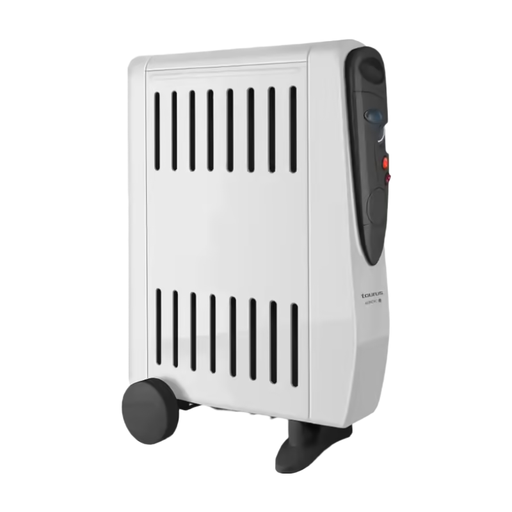
Why it's perfect for this profile: Safety and silence are paramount in a child's room. This oil-filled radiator is completely silent, and its thermal inertia ensures constant, steady heat without fluctuations. The built-in humidifier is a major bonus for maintaining healthy air quality.
Its inertia-based operation is inherently silent (pitfall #2). The adjustable thermostat maintains a gentle, stable temperature all night without over-consuming (pitfall #3).
The combination of gentle radiant heat and a built-in humidifier creates a true cocoon of well-being for the night.
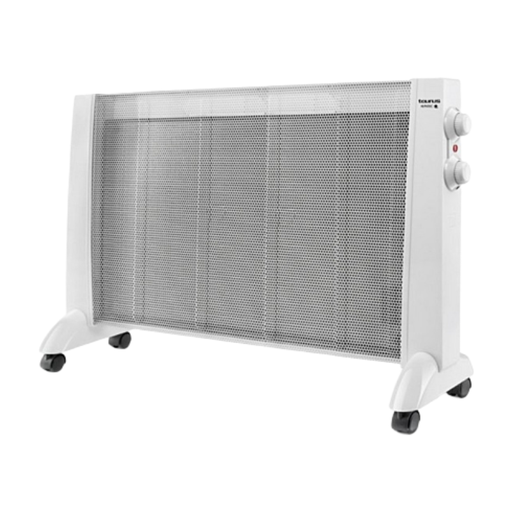
Why it's perfect for this profile: To heat a living room or living area over 20 m?, you need power. With its 2400W and MICA radiant technology, it distributes fast, even heat. Mounted on wheels, it remains easy to move despite its size.
Its high power is correctly sized for a large space, avoiding the trap of an undersized unit that runs constantly (pitfall #1). The mechanical thermostat ensures regulation (pitfall #3).
MICA radiant technology provides an express heat-up time and uniform heat distribution, ideal for immediate comfort in a large room.
We have curated a complete range of products that meet our demanding selection criteria and French safety standards.
1. What is the actual consumption of an electric space heater?
Consumption depends on three factors: the device's power (in watts), its duration of use, and the thermostat setting. To give you a rule of thumb, a 1500W (or 1.5 kilowatt) heater running at full power for one hour will consume 1.5 kilowatt-hours (kWh). Using a thermostat significantly reduces overall consumption, as the device only activates to maintain the desired temperature.
2. Is an oil-filled radiator more economical than a fan heater?
It all depends on the use case! To put it simply, a fan heater (or ceramic heater) is a sprinter, while an oil-filled radiator is a long-distance runner. The former is perfect for a very quick, short-term heat boost (e.g., 15 minutes in a bathroom). The latter, which takes longer to heat up, retains heat thanks to its thermal inertia. For prolonged use, like in a bedroom, its inertia makes it more economical because it continues to radiate heat even during the thermostat's off-cycles.
3. How do I choose the right power for my room?
The golden rule is to allow 100W per m? for a normally insulated room. Consider increasing this figure (to around 120-125W/m?) if the room is poorly insulated, has large windows, or has a high ceiling.