
Livraison le jour même ou le lendemain

Qualité garantie

Débloquez vos offres de bienvenue: Livraison GRATUITE | Jusqu'à -80 % | 30 jours d'essai gratuits à JoyPlus
Téléchargez l'application
An enamel-coated cast iron casserole dish can be used for simmering, braising, roasting, making soup or finishing a dish in the oven. Yet some purchases quickly disappoint. The weight, compatibility with induction hobs and the fragility of the enamel are often underestimated when comparing models.
Here are the criteria to check before choosing a cast iron casserole dish, along with a selection of sizes suited to different everyday uses.
A 3-litre casserole dish won't necessarily let you cook 3 litres of food. You need enough space to stir, avoid spillovers and replace the lid properly. For two to three people, a volume between 2.5 and 3.3 litres is generally suitable for soups, stews and small poultry. For a family, a diameter of 26 to 28 cm offers more leeway.
The phrase "suitable for all hobs" must be verified on the product page. An induction-compatible casserole dish needs a suitable base, while the maximum oven temperature may depend on the knob, handles or coating. A casserole dish that goes in the oven should also be handled with appropriate oven gloves: the cast iron and lid retain heat strongly.
Enamel simplifies cleaning and eliminates the need for seasoning required on some raw cast iron. However, it remains sensitive to thermal shock, metal utensils and abrasive products. Plunging a still-hot casserole dish into cold water can crack or chip the coating. To keep it for a long time, the quality of construction matters just as much as your care habits.
Enamel-coated cast iron combines a heavy body that retains heat effectively with a vitrified surface that is easier to clean. Check for the precise mention "enamel-coated cast iron", the presence of an enamel interior and any recommendations about utensils. A light-coloured surface makes it easier to see how food is browning, while a dark finish may show less marking from certain dishes.
Resistance to staining, loss of shine, chipping and cracking is a feature highlighted by some manufacturers. However, it does not protect against impacts or mishandling. It's best to regard these indications as information about the product's design, rather than a promise of unlimited durability.
For versatile use, look explicitly for the following details:
A casserole dish with a lid that fits well limits evaporation and is ideal for slow cooking. Some models have a domed or ridged lid designed to encourage condensation to drip back into the dish. Nevertheless, lift it carefully to avoid steam burns.
The diameter affects both the searing surface and the space taken up on the hob. A round casserole dish of 22 to 24 cm suits many everyday dishes, while a 28 cm model is better for family portions. The total weight, including the lid, also deserves your attention: a full enamel-coated cast iron casserole dish can be difficult to move from hob to oven, and then from oven to table.
Also measure the width of your hobs, the available height in your oven and your storage space. These simple checks prevent you from buying an enamel-coated cast iron pot that is too large for your kitchen.
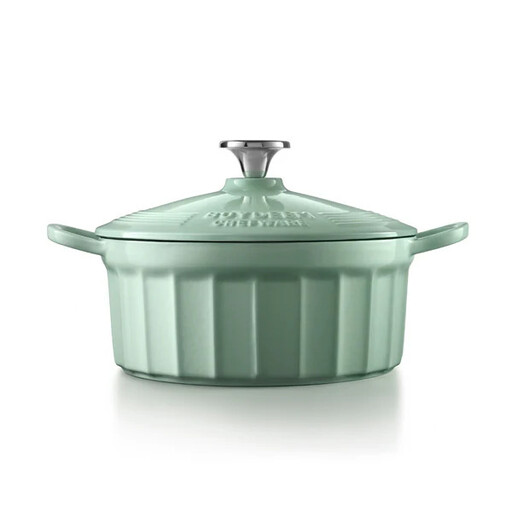
Why this choice suits this profile: Its 2.9 L size is ideal for standard portions and makes a great first casserole dish for simmering, braising or roasting without taking up too much space on the hob or in the cupboard.
The product page states compatibility with gas, induction, electric, halogen and ceramic hobs, as well as oven use. This information reduces unpleasant surprises related to different heat sources.
Enamel-coated cast iron, 18/8 stainless steel knob, well-fitted domed lid and claimed dishwasher-safe cleaning. Hand washing is still recommended to preserve the finish.
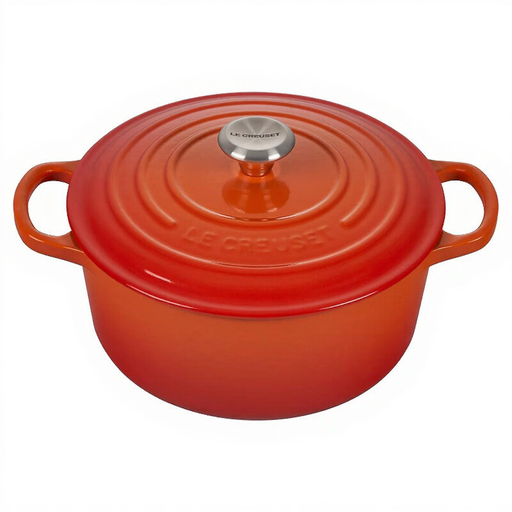
Why this choice suits this profile: With its 3.3 L capacity, this model is aimed at those who want to cook and then serve directly at the table, with a refined finish and claimed manufacture in France.
The available information specifies the diameter, capacity, weight, heat sources and the presence of a heat-resistant stainless steel knob. This allows you to compare concrete data rather than just an attractive appearance.
3.3 L capacity, claimed compatibility with induction and oven, large handles and light-coloured enamel interior. The stated weight is 3.932 kg.
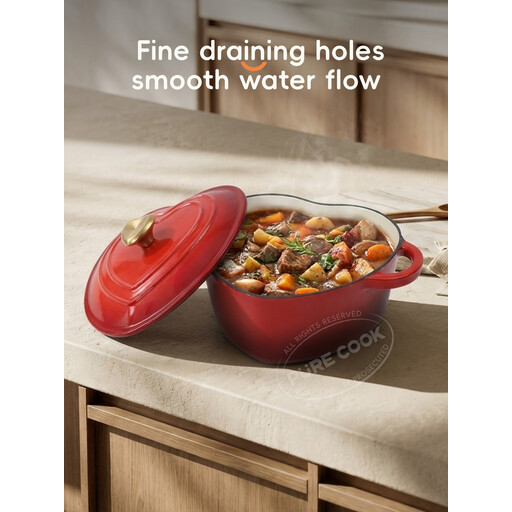
Why this choice suits this profile: Its heart shape and stated 3.1 qt capacity are ideal for dishes served straight to the table, gratins, oven-baked desserts and slow-cooked preparations.
The product page specifies care instructions: hand washing, soft sponge, no abrasive products and prevention of thermal shock. These guidelines are particularly important with frequent use.
Enamel coating, claimed compatibility with gas and induction, oven-safe and matching lid. The manufacturer states the casserole dish can be stored in the refrigerator.
The dishwasher may be permitted on some models, but hand washing generally helps preserve the appearance of the enamel. Always consult the instruction manual and the temperature limits stated on the product page.
Yes, some models are designed for induction, but this compatibility must be explicitly stated. Also check that the base diameter matches the heating zone on your hob.
For two or three people, a capacity of 2.5 to 3.3 litres is suitable for soups, sauces and stews. For four people or more, a 4 to 6 litre model offers more room, particularly for preparing a roast or a dish to serve the next day.
Its lifespan depends on the quality of manufacture, frequency of use and care. The cast iron itself is robust, but the enamel must be protected from thermal shock, scratches and drops. Regularly checking the interior surface allows you to spot any damage quickly.