
Livraison le jour même ou le lendemain

Qualité garantie

Débloquez vos offres de bienvenue: Livraison GRATUITE | Jusqu'à -80 % | 30 jours d'essai gratuits à JoyPlus
Téléchargez l'application
When tightening a bicycle part, motorcycle component or automotive fitting, hand-applied force is not always enough. An electronic torque wrench displays torque in real time and can indicate when the programmed value has been reached through vibration, an audible alert or an LED indicator. The key is to choose a suitable measurement range and format for your needs.
A wrench with a very wide range is not necessarily comfortable to use at low torque settings. For handlebars, stems or seat-post clamps, the required values are often at the lower end of the scale. A model designed mainly for high torque may therefore be less suitable for routine bicycle maintenance.
Conversely, a wrench limited to 12 or 20 N·m will not be suitable for tightening wheels, engine parts or automotive fixings. Check the full range, but focus particularly on the area in which you will work most often.
1/4-inch, 3/8-inch and 1/2-inch drives are not interchangeable without an adaptor. The 1/4-inch drive is generally used with small sockets and moderate torque settings. The 3/8-inch drive is a versatile size for bicycle and motorcycle maintenance, as well as some automotive tasks. The 1/2-inch drive is better suited to sockets and fixings that require high torque.
An adaptor can broaden compatibility, but it adds an intermediate component and must be used in accordance with its instructions. An electronic torque adaptor does not automatically turn a small ratchet into a tool capable of handling heavy loads.
A vibration, audible and LED alert can make a real difference in a noisy workshop, a dimly lit area or whenever you are not constantly watching the display. However, it does not remove the need to stop applying force immediately when the signal is triggered. Continuing to pull may cause you to exceed the set value.
Statements such as ‘±2% accuracy’ should be viewed as a specification stated for the product and the relevant tightening direction. They are not a universal guarantee valid in every situation, at all temperatures and throughout the tool’s entire service life.
A digital torque wrench may display several units, including N·m, ft·lb, in·lb and kgf·cm. To avoid conversion errors, use the unit specified in the technical documentation for your bicycle, motorcycle, car or the relevant part.
The range should include the prescribed value without forcing you to operate continually at its limit. For example, a wrench covering 4.2 to 85 N·m is suitable for many intermediate tasks, while a model covering 0.6 to 12 N·m is better suited to smaller fixings.
The 1/4-inch drive makes it easier to reach small screws and confined spaces. The 3/8-inch drive offers a good compromise for a variety of jobs. The 1/2-inch drive is better suited to automotive sockets and tasks requiring substantial torque.
Also check whether it has a reversible ratchet, the handle length, the type of compatible sockets and the display’s overall size. In a professional setting, a storage case and memory function can also simplify the tracking of completed work.
The Track and Peak modes are designed for different uses. Track mode displays the torque as force is applied, while Peak mode stores the maximum value reached. Presets are useful if you regularly switch between several torque settings.
Before first use, fit the battery or batteries specified in the instructions, select the unit, set the value and check the tightening direction. Apply pressure gradually and avoid sudden movements. Once the job is complete, return the wrench to its minimum setting when recommended in the instructions, remove the batteries for long-term storage and keep the tool in a dry place. Do not use it as a striking tool or with an impact wrench unless the manufacturer explicitly permits this.
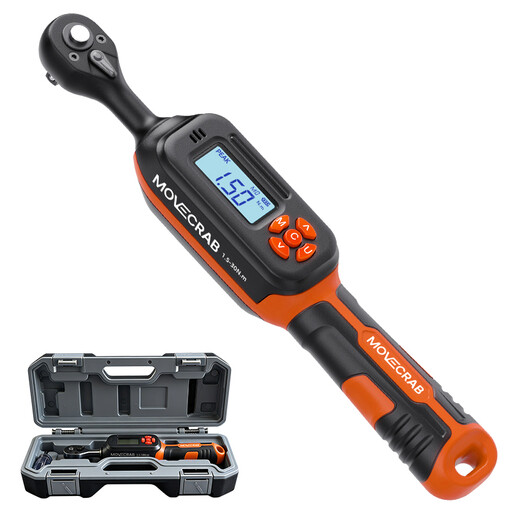
Why this choice suits this profile : Its low range is aimed at small fixings and occasional work on a bicycle, motorcycle or household equipment. The digital display reduces guesswork when making initial adjustments.
It avoids choosing a range that is too wide and poorly suited to low torque settings. Its vibration, audible and indicator-light alerts show when the programmed value has been reached.
Range of 0.6 to 12 N·m, 1/4-inch drive, multiple unit displays and Track or Peak modes, according to the product details.
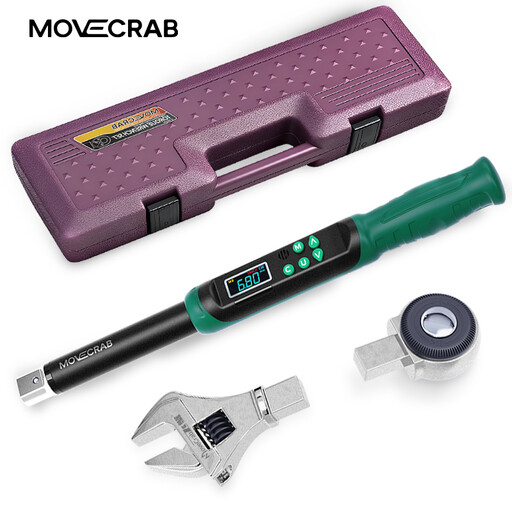
Why this choice suits this profile : Users looking for a versatile solution can make use of its ratchet and open-ended heads for working on different nuts, bolts and pipes.
The interchangeable heads reduce the need for multiple tools, while Track, Peak and Preset modes let you adapt the control method to each job.
Stated accuracy of ±2% clockwise, four units, six presets and memory capable of storing up to 500 values.
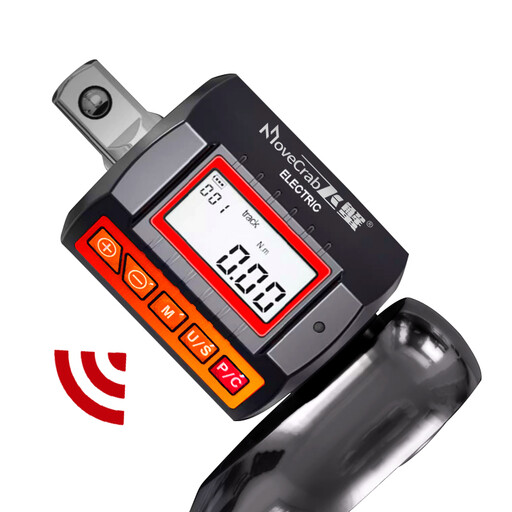
Why this choice suits this profile : This adaptor is designed for users who already own a ratchet or breaker bar and want to add electronic torque measurement for their different socket sizes.
It avoids buying a complete wrench when you already have a socket set. The 3/8-inch and 1/4-inch adaptors extend its range of uses, provided you follow the instructions.
Range of 6 to 200 N·m, audible and visual alerts, three operating modes and memory stated to store 1,000 values.
We have put together a complete, real-time updated list of products that fully meet these strict selection criteria, as well as European safety requirements.
For a bicycle, look for a bicycle torque wrench with a low range, a 1/4-inch drive or suitable bits. The values specified by the component manufacturer should always take priority. A range of 0.6 to 12 N·m may be suitable for some small fixings, but check each value in the bicycle’s documentation.
The frequency depends on how often it is used, storage conditions, any impacts and the manufacturer’s recommendations. Avoid overloading, moisture and high temperatures. If the tool is dropped, behaves unusually or becomes difficult to adjust, stop using it until it has been checked or recalibrated in accordance with the appropriate procedure.
The main costs to allow for are battery replacement and, in a professional environment, periodic accuracy checks. Removing the batteries during long-term storage and keeping the wrench in a dry place can help prevent premature deterioration. The total cost therefore depends as much on maintenance as on the purchase price.