
Livraison le jour même ou le lendemain

Qualité garantie

Débloquez vos offres de bienvenue: Livraison GRATUITE | Jusqu'à -80 % | 30 jours d'essai gratuits à JoyPlus
Téléchargez l'application
Improperly calibrated tightening, whether on a carbon bike frame, a cylinder head, or a simple wheel nut, can have unfortunate, even dangerous, consequences. For both amateur and professional mechanics, precision isn't an option: it's a requirement. This is where the electronic torque wrench comes in—the essential tool for ensuring every bolt and nut is tightened to the exact torque recommended by the manufacturer.
This guide is designed to help you select a precision tightening tool that fits your needs. We review the essential technical criteria and present our selection of the best models to help you make the right choice.
Before diving into our top picks, let's review the criteria that define a quality tool. Here are the key points to check for your mechanical work on cars, motorcycles, or bicycles.
The torque range, expressed in Newton-metres (N.m), is the most fundamental criterion.
For optimal accuracy, choose a wrench with a torque range that matches your most frequent applications.
Most reputable electronic torque wrenches offer an accuracy of ±2% in the clockwise direction (tightening). This is the standard that ensures the safety and longevity of your parts.
Their real advantage lies in the alert system. Unlike mechanical click-type wrenches, electronic models signal when you are approaching the target torque and then confirm the exact value. These alerts can be:
The combination of these three signals is incredibly effective in a noisy or poorly lit workshop.
A good electronic torque wrench offers several operating modes:
The ability to easily switch between different units of measurement (N.m, ft-lb, in-lb, kgf-cm) is also a major advantage, especially if you consult international technical manuals.
We have selected several models that check all the boxes for performance and versatility for demanding users.
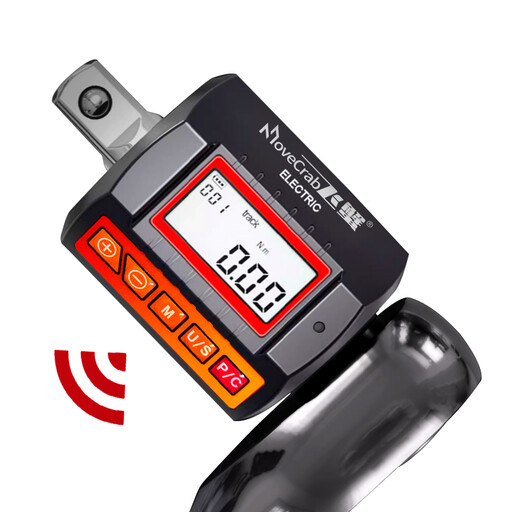
The Concept: This digital torque adapter transforms any standard ratchet into a precision measurement tool. A clever, cost-effective, and compact solution for those who are already well-equipped with manual tools.
Advantages:
Who is it for? The advanced hobbyist or mechanic who wants to get equipped for torque-specific tightening without investing in a whole new wrench. Ideal for work on motorcycles and cars.
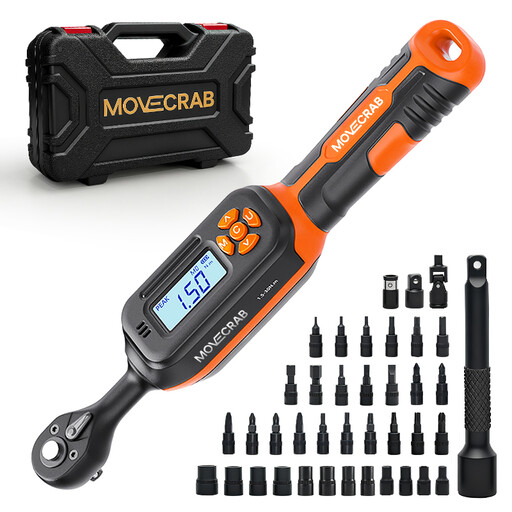
The Concept: This torque wrench set is an all-in-one solution, ideal for precision jobs that require low torque settings.
Advantages:
Who is it for? The tool of choice for cycling enthusiasts (bike torque wrench) and motorcycle mechanics working on small-displacement engines or sensitive engine components.
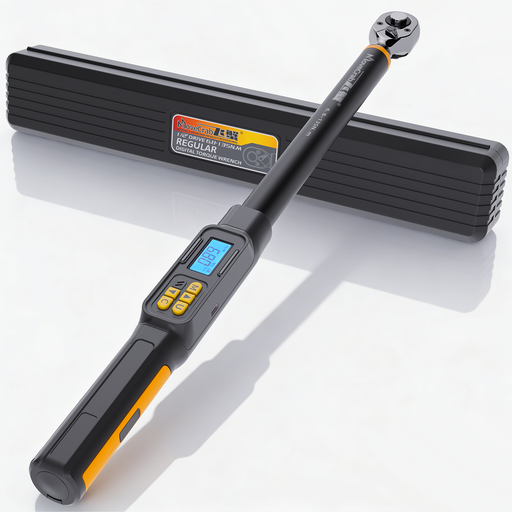
The Concept: This model is a step up with its triple alert system (vibration, sound, light). It's impossible to miss the signal, even in the most challenging workshop conditions.
Advantages:
Who is it for? The car or motorcycle mechanic looking for a reliable, high-performance tool for both routine and critical tasks, where precision and clear alerts are non-negotiable.
If your work focuses on bicycle maintenance, a field where a precision tightening tool for low torque is king, we have what you need. Controlled tightening is absolutely crucial for carbon frames and lightweight components.
? Discover our full range of torque wrenches for bicycles to find the perfect tool for your ride.
A mechanical wrench (known as a "click-type") produces an audible and tactile "click" once the torque is reached. The electronic wrench, on the other hand, uses sensors to measure torque continuously. It alerts the user via a screen and signals (sound, light, vibration) just before and at the exact moment the torque is reached. The electronic model offers better accuracy, memory functions, and conversion between multiple units of measurement.
To preserve its accuracy, a torque wrench is an instrument that must be handled with care. Avoid dropping it or using it as a breaker bar to loosen seized bolts (unless otherwise specified by the manufacturer). After each use, remember to set it to the lowest value in its range to release tension on the internal mechanism. Finally, always store it in its case, away from moisture and extreme temperatures.
As a general rule, the answer is no. A torque wrench is a measuring instrument designed for tightening, not loosening. Forcing it to break a seized nut loose can damage its calibration mechanism and compromise its accuracy. While some electronic models are bidirectional and can measure loosening torque, it is still preferable to use a standard ratchet or a breaker bar for this task.