
Livraison le jour même ou le lendemain

Qualité garantie

Débloquez vos offres de bienvenue: Livraison GRATUITE | Jusqu'à -80 % | 30 jours d'essai gratuits à JoyPlus
Téléchargez l'application
Repainting a room, refreshing a fence or renovating a piece of furniture may seem straightforward… until it is time to choose the right equipment. Between promises of an even finish, advertised power ratings and accessories presented as essential, it is easy to end up with a model that does not really match your needs.
An electric paint sprayer can speed up application, but its performance depends above all on the product’s viscosity, the flow-rate setting and how well the surface has been prepared. Here are the key points to check before placing an order, along with a selection of models suited to different uses in France.
A powerful motor does not, by itself, guarantee an even finish. An 800 W device can be suitable for painting walls, ceilings, fences or furniture, provided the nozzle and flow setting are appropriate for the product being used.
Conversely, a compact HVLP paint sprayer may be more practical for smaller surfaces. HVLP stands for “high volume, low pressure”: this technology provides more controlled application, but generally requires suitable dilution and particularly thorough cleaning.
Paint that is too thick can cause uneven splatter, clog the nozzle or make the flow inconsistent. Before you begin, always check the manufacturer’s recommendations and use the supplied viscosity-measuring cup whenever one is included.
Compatibility claims covering water-based paints, varnishes, stains or solvent-based paints do not replace consulting the product’s technical data sheet. Dilution should be carried out with the recommended thinner—not automatically with water.
Residue that dries inside the nozzle or passage quickly reduces spray quality. A device with a removable tank, unclogging needle and cleaning brush will be considerably easier to maintain in everyday use.
Clean the sprayer immediately after each session, before the paint starts to harden. Wear suitable gloves and work in a well-ventilated area, following the safety instructions shown on the product label.
For painting walls, ceilings or large outdoor surfaces, a corded 800 W model can provide a comfortable flow rate. The TILSWALL model featured below claims up to 1,100 ml/min, although the actual output will depend on the paint, nozzle and selected setting.
A cordless paint sprayer gives you greater freedom around furniture, in the garden or along a fence. However, check whether the battery and charger are included, review the runtime and confirm compatibility with any batteries you already own.
A paint sprayer with a 1,300 ml tank reduces the need for frequent interruptions when covering large surfaces. A more compact 1,000 ml tank, for example, makes the device lighter when painting a chair, door or more detailed elements.
For a corded device with a separate turbine, also check the length of the hose and power cable. A reach of 2.5 to 3 m makes moving around easier, but any extension lead must be suitable for the device’s power rating and used in a dry environment.
Adjustable nozzles and horizontal, vertical or circular spray modes let you adapt the jet to the shape of the surface. A fine nozzle is better suited to details and finishing work, while a wider nozzle can cover a properly prepared surface more quickly.
Protect floors, sockets, handles and nearby furniture with dust sheets. On a wall, fill any holes, remove dust thoroughly and apply a primer if recommended for the paint. For a fence or piece of furniture, sand and then degrease the surface before spraying.
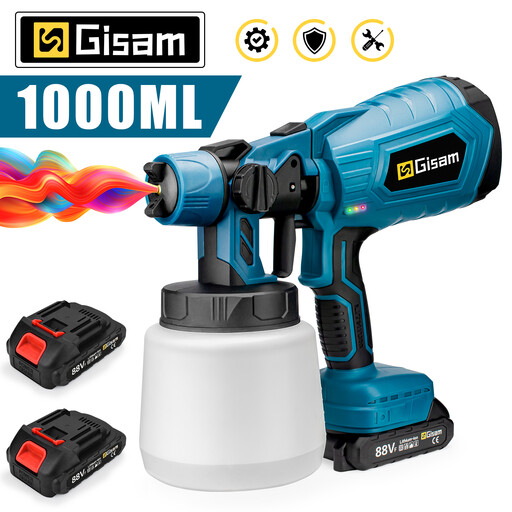
Why it suits this profile: its cordless design is well suited to small renovation jobs, furniture and occasional projects when you would rather not have a cable trailing across the floor.
The flow rate is adjusted with a dial, and three spray patterns are available. However, remember to check battery compatibility before buying.
1,000 ml tank, advertised pressure of 0.1 to 0.2 bar, three spray modes and cleaning accessories included.
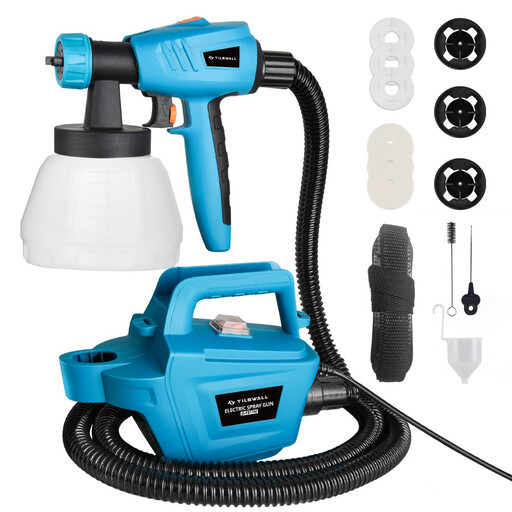
Why it suits this profile: its corded power supply and large tank make it suitable for walls, ceilings, furniture, fences and patios.
Three nozzles and three spray patterns let you tailor the application, while the removable tank makes cleaning easier.
800 W motor, advertised maximum flow rate of 1,100 ml/min, 2.5 m hose, 3 m cable and 1,300 ml tank.
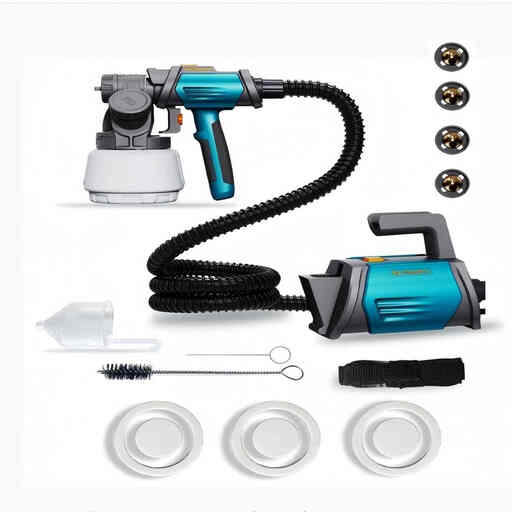
Why it suits this profile: its four brass nozzles are suitable for both large surfaces and precision work on furniture, sheds, walls or ceilings.
The advertised maximum viscosity is 120 DIN-S. You will still need to measure and adjust the paint before starting.
800 W, 1,300 ml tank, four nozzles from 1 to 3 mm, three spray patterns and 2.5 m hose.
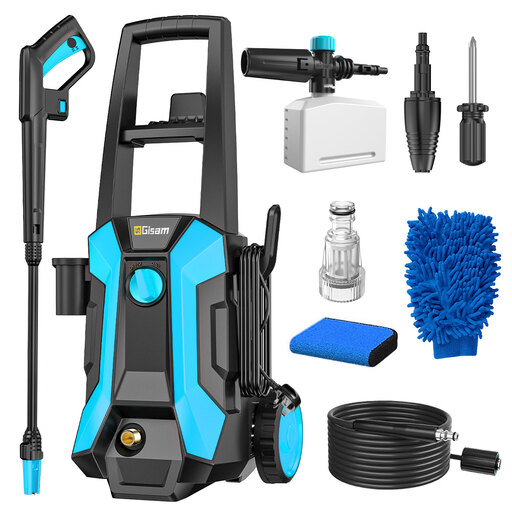
Why it suits this profile: this product is designed for cleaning, not painting: cars, fences, patios, gardens, driveways and outdoor furniture.
Do not mistake it for a paint sprayer: its accessories and jet are designed for water-based cleaning.
2,200 W motor, advertised pressure of 180 bar, flow rate of 480 l/h, 8 m hose, foam nozzle and rotary nozzle.
We have put together an up-to-date selection of products chosen to meet practical requirements for maintenance and spraying projects.
Not necessarily. It depends on the type of paint and the manufacturer’s recommendations. If the instructions call for dilution, filter out any particles first, then test the mixture on a piece of cardboard before applying it to the final surface. You can then adjust the flow rate, distance and spray pattern.
The recommended distance can vary from one device to another. As a general starting point, try around 30 cm, keeping the sprayer parallel to the surface and making steady passes. If you work too close, you risk creating runs; too far away, and you will increase overspray.
Consumption depends on the device’s power rating and how long it is used. An 800 W model running for one hour theoretically consumes 0.8 kWh, without taking into account variations caused by its actual operation. The final cost depends on the electricity rate specified in your contract. To avoid wasting paint and energy, prepare the surface and product before switching on the device, then clean it immediately after use.