
Livraison le jour même ou le lendemain

Qualité garantie

Débloquez vos offres de bienvenue: Livraison GRATUITE | Jusqu'à -80 % | 30 jours d'essai gratuits à JoyPlus
Téléchargez l'application
Preparing ground beef, meatballs, stuffing, or homemade sausages becomes much easier with an electric meat grinder. However, you still need to choose an appliance that suits your habits. Rated power, the number of attachments, and claims of versatility are not enough to assess a model’s quality.
For home users, three common pitfalls stand out: misunderstanding power ratings, choosing attachments that ultimately prove impractical, and underestimating how time-consuming cleaning can be. Here are the key criteria to review before buying, along with a selection of models for different needs.
On paper, a 1300 W or 2000 W meat grinder may seem certain to deliver better performance. However, the advertised wattage does not always reflect the motor’s typical power consumption. Some manufacturers highlight maximum or locked-rotor power, measured under a momentary condition rather than during continuous operation.
This figure should therefore be considered alongside how often you plan to use the appliance, the quantities you prepare, and the type of meat being processed. For a family that makes meatballs occasionally, a more modest model may be perfectly adequate. For regular use or larger batches, focus primarily on the durability of the auger, tray, and feed tube.
A multifunction electric meat grinder may come with several grinding plates, sausage-making tubes, a kibbeh attachment, or even cutting accessories. However, the “multifunction” label does not guarantee that every part you need is included.
Before placing your order, check the following carefully:
Two grinding plates are already enough to achieve different textures, from medium to coarser mince. In practice, this can prove far more useful than a long list of attachments that are rarely used.
The blades and grinding plates are genuinely sharp. The motor unit must never be immersed in water, and food should always be pushed through using the purpose-designed accessory—never your fingers. After each use, disassemble the parts that come into contact with food and dry them thoroughly.
Cast aluminium and stainless steel may create an impression of durability, but the manufacturer’s instructions remain decisive. A part that is not dishwasher-safe must not be placed in the dishwasher, even if doing so saves a few minutes.
For home use, do not focus solely on the advertised wattage: also examine the controls and available functions. The reverse function can help clear the auger when a piece of meat or sinew temporarily blocks the passage. However, it does not remove the need to switch off and unplug the appliance before attempting any manual intervention.
The KITCHENCOOK MG1300 is advertised as delivering up to 1300 W of locked-rotor power. This is the product’s stated maximum value, not a promise of continuous operation at that wattage.
Stainless steel blades and grinding plates are used in many models intended for home use. When properly maintained, they resist corrosion and do not impart any particular taste to food. Depending on the appliance, the tray and auger may be made from cast aluminium, steel, or plastic.
Stability also deserves your attention: non-slip feet or suction cups help prevent the appliance from moving across the worktop. Cable length and the presence of a compartment for storing the grinding plates are other small details that make a difference in everyday use.
If you mainly chop small quantities of onion, garlic, herbs, or vegetables, a compact vegetable chopper may sometimes be more practical than a bulky electric appliance. A pull-cord manual chopper requires neither a power outlet nor a battery and can be stored easily in a drawer.
For families, a chopper with a glass bowl can simplify the preparation of small portions of meat, fruit, or vegetables. The transparent bowl makes it easy to monitor the texture, but check its capacity, weight, and care requirements before making your decision.
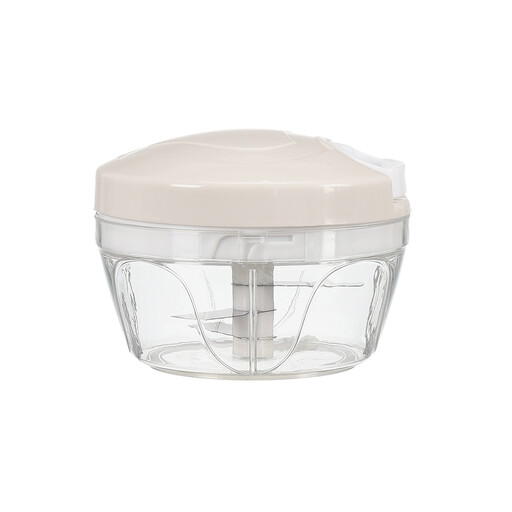
Why we chose it: Compact and convenient, this chopper is suited to everyday small-scale preparation and works without a power outlet or battery.
Its capabilities are clearly limited to manually chopping soft to moderately firm ingredients: it does not claim to handle large quantities.
Three stainless steel blades, an integrated bowl, a safety lock, and components advertised as dishwasher-safe.
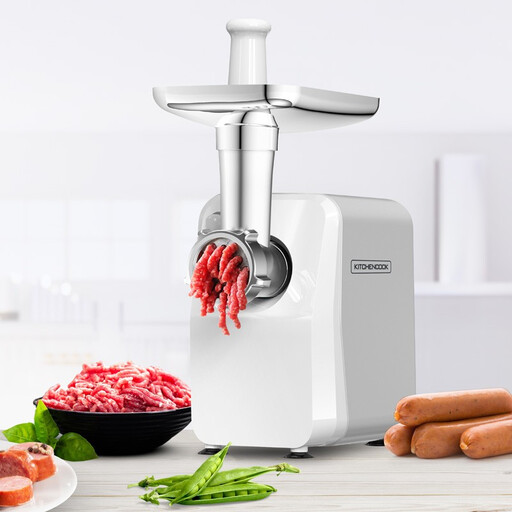
Why we chose it: It is designed for households that want to mince their own meat and occasionally prepare sausages or kibbeh.
The product information distinguishes locked-rotor power, the reverse function, and the included accessories, making comparisons with other models clearer.
Two 5 mm and 7 mm stainless steel grinding plates, sausage and kibbeh kits, a food pusher, suction-cup feet, and an advertised two-year warranty.
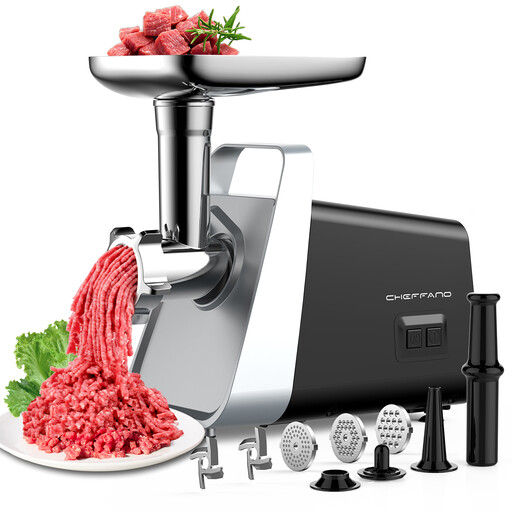
Why we chose it: Its configuration is aimed at users who regularly prepare burgers, stuffing, sausages, and kibbeh-style recipes.
The product information details the accessories and three grinding levels rather than relying solely on the “multifunction” label.
A motor advertised at 2000 W, two blades, three stainless steel plates, a sausage tube, a kibbeh attachment, and a large tray.
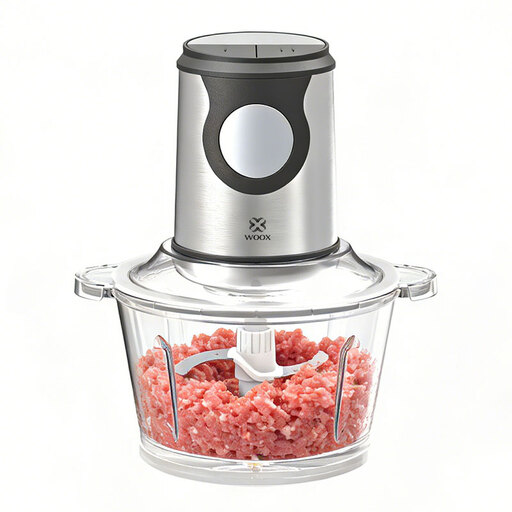
Why we chose it: This format is well suited to small quantities of meat, vegetables, or fruit, as well as certain baby-food preparations.
Its 1.5-litre capacity provides a clear reference point: it is not presented as an appliance for processing very large quantities.
A 1.5-litre glass bowl and stainless steel blades, with a design advertised for meat, fruit, and vegetables.
A pull-cord manual chopper is perfectly suited to herbs, garlic, onions, nuts, and certain vegetables. Quiet and compact, it works without electricity. However, it requires several pulls and cannot replace a genuine electric meat grinder.
For appetisers, a manual deli meat slicer may be more relevant than a multifunction appliance. The COOK CONCEPT model featured on Joybuy has a wooden body and a 16.8 cm stainless steel blade. It must be cleaned by hand and requires a stable surface, as well as a guide to keep your fingers away from the blade.
If you are specifically looking to shred meat rather than mince it, also explore our selection of meat shredding appliances.
We have gathered an up-to-date selection of appliances and utensils that meet these criteria, complete with details of their features and included accessories.
It depends on the quantities you prepare and how often you use the appliance. A device advertised as offering 1300 W of locked-rotor power will not necessarily operate continuously at 1300 W. You should also consider the materials, grinding plates, reverse function, and usage instructions.
Cut the meat into appropriately sized pieces, remove particularly tough sections, and do not overfill the feed tube. Use only the food pusher, switch off the appliance before clearing any blockage, then wash and dry the parts after every use. Also follow the operating times specified in the manual.
It depends on the motor’s actual power consumption and how long the appliance is used. A short preparation generally represents only a limited operating cycle, but the technical specifications do not always make it possible to estimate the cost precisely. For an approximate calculation, multiply the power consumed in kilowatts by the operating time, then by your electricity tariff.