
Livraison le jour même ou le lendemain

Qualité garantie

Débloquez vos offres de bienvenue: Livraison GRATUITE | Jusqu'à -80 % | 30 jours d'essai gratuits à JoyPlus
Téléchargez l'application
Buying an electric car charger is not simply a matter of choosing the power rating shown on the box. For example, a 22 kW charging station may operate at a significantly lower power if your car or electrical installation cannot support it. Conversely, a portable model connected to a domestic socket can be useful occasionally, but may not be suitable for intensive daily charging.
Before placing your order, it is best to avoid these three common mistakes:
A 7 kW electric car charger generally operates on a single-phase 230 V supply, with a current of around 32 A. It is suitable for many homes with a single-phase supply and allows you to charge your vehicle regularly overnight.
An 11 kW electric car charger usually requires a three-phase supply and an installation capable of providing the necessary current. However, it can only make full use of this power if the car’s onboard charger supports 11 kW AC charging.
A 22 kW electric car charger generally operates on a three-phase 400 V supply, with an installation able to support up to 32 A. The car must also have a 22 kW onboard charger. Otherwise, the vehicle will automatically limit the charging power.
The power that is actually useful therefore depends on three factors:
The Type 2 EV charger and Type 2 charging cable are widely used in France and Europe for AC charging. Nevertheless, check that your vehicle’s socket matches the Type 2, IEC 62196-2 standard.
A PHEV charger intended for a plug-in hybrid car may also use this connector. However, the power is often limited by the vehicle’s battery and onboard charger. Buying a 22 kW charging station will therefore not necessarily reduce the charging time of a PHEV compared with a 7 or 11 kW station.
A charging station must be connected to a correctly sized electrical installation. For a three-phase model, you should specifically check:
Models featuring Type B protection or a DC current detection device must still be installed in accordance with their instructions and the electrical regulations in force. For a fixed wallbox or three-phase charger, using a qualified electrician is strongly recommended.
An IP65 or IP66 rating indicates that the enclosure is protected against dust and water under the conditions specified by the manufacturer. This does not mean that the charger can be immersed or cleaned with a high-pressure jet.
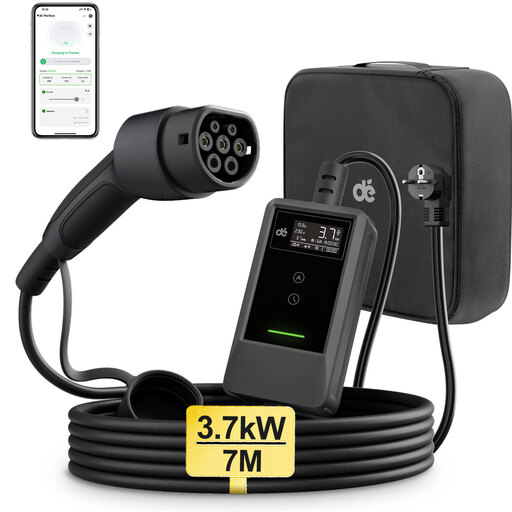
Why this choice suits this profile : With its Schuko plug and 7 m cable, this 3.7 kW charger is suitable for drivers looking for a plug-and-play solution, provided they have a suitable, properly protected socket.
Its moderate power reduces the risk of choosing a device that is oversized for a single-phase supply. The current can be adjusted from 6 to 16 A.
LCD display, 7 m cable, stated IP66 protection and AC and DC residual-current detection, according to the product details.
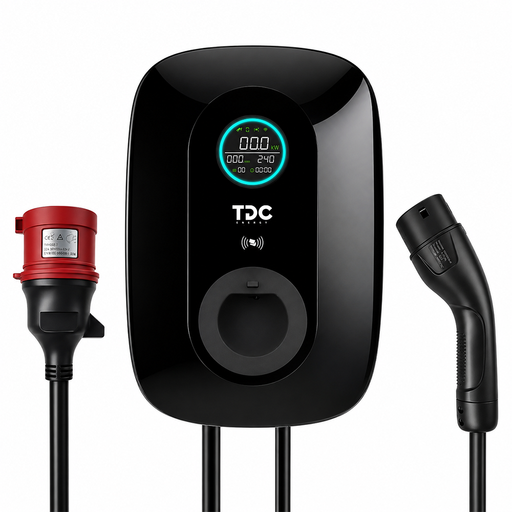
Why this choice suits this profile : This fixed wallbox is designed for homes with a compatible three-phase supply, where users want to monitor charging sessions through an app or use RFID cards.
The product details specify that it requires a 400 V three-phase supply and a 32 A, 5-pin CEE socket. This is useful information for checking your installation’s compatibility before buying.
Stated 22 kW power, 5 m Type 2 cable, 3-inch display, Wi-Fi, Bluetooth, RFID and several protection features specified by the manufacturer.
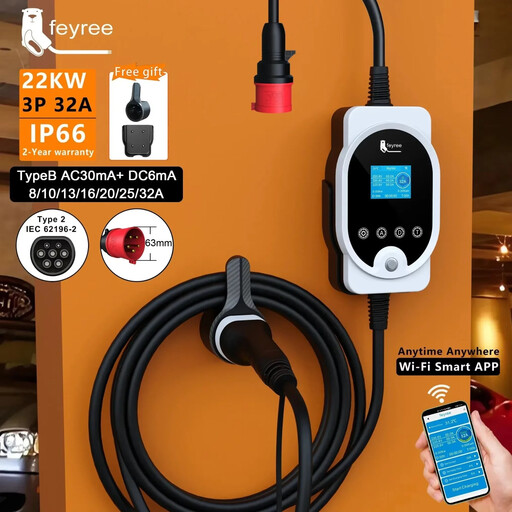
Why this choice suits this profile : This portable charger can be used both at home and on the road. It is intended for users with a compatible socket who want to adjust the charging current precisely.
The power is not fixed permanently : the current can be adjusted from 8 to 32 A. Depending on the chosen configuration, the model supports either single-phase or three-phase use.
App, scheduled charging, emergency stop button, Type 2 cable and stated IP66 rating.
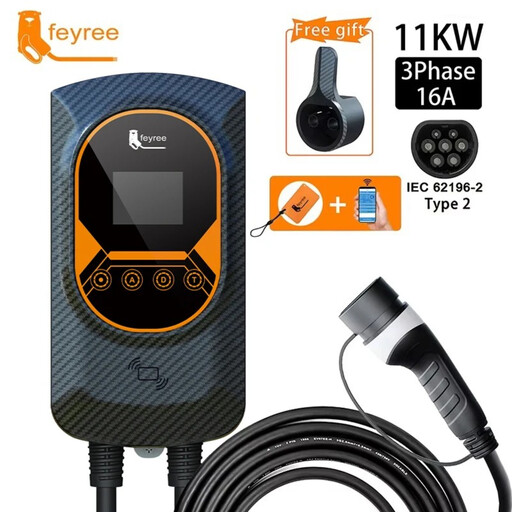
Why this choice suits this profile : This wall-mounted charger is suitable for drivers with a three-phase supply who want to schedule charging and monitor their consumption through an app.
The current setting allows you to adapt charging to the circuit’s capacity. However, you will need a dedicated three-phase installation and should check that the 2.4 GHz Wi-Fi network provides good coverage where the charger is located.
4.3-inch display, Tuya app, RFID, scheduled charging and protection against overcurrent, overvoltage and overheating, according to the description.
We have selected a complete, real-time updated range of products that meet these demanding criteria as well as European safety standards.
With a single-phase installation, you will generally need a 3.7 or 7 kW model. Power ratings of 11 or 22 kW usually require a three-phase supply and a compatible vehicle. Always check your car’s onboard charger specifications.
Consumption depends primarily on the energy required to fill the battery. The charger adds a small amount of energy loss, while the final cost depends on your supplier’s tariff and when you charge. An app can schedule charging sessions during the most favourable tariff periods, but this does not guarantee savings with every tariff plan.
The charger’s service life depends on the quality of the installation, outdoor conditions, maintenance and the condition of the cable. Inspect the enclosure, plug and connector regularly. Never use a device showing a cut, deformation, sign of overheating or failed waterproofing.