
Livraison le jour même ou le lendemain

Qualité garantie

Débloquez vos offres de bienvenue: Livraison GRATUITE | Jusqu'à -80 % | 30 jours d'essai gratuits à JoyPlus
Téléchargez l'application
Whether you're mowing the lawn, working on a job site, or simply need to plug in multiple devices in the living room, a good electrical reel or extension cord is an essential accessory. But with a vast array of options, how do you make sense of it all? The wrong choice can quickly prove impractical, or even dangerous. Our guide is here to provide clarity and help you identify the key criteria for a smart, safe purchase.
Before you start, let's review the common mistakes that lead to buyer's remorse:
To avoid these setbacks, a few technical specifications deserve your full attention. They are your guarantee of safety and the longevity of your equipment.
The Ingress Protection (IP) rating is an international standard that assesses a device's resistance to solid objects (dust) and liquids (water). For outdoor use, an outdoor extension cord must have a minimum rating of IP44.
The cable gauge, expressed in square millimetres (mm?), determines the current it can handle without overheating. It's simple: the larger the gauge, the higher the permissible power (in watts).
Warning: the maximum power rating shown for a cable reel always assumes the cable is fully uncoiled. When coiled, the cable cannot dissipate heat properly. Its capacity is then reduced by an average of two-thirds (for example, 3200?W uncoiled versus only 1100?W coiled).
The presence of the NF (French Standard) logo certifies that the product meets the safety requirements in force in France. It is an essential mark of trust.
A good job site cable reel, and even a quality domestic reel, must be equipped with a thermal cut-out. This safety mechanism automatically cuts the power in case of overheating or overcurrent, protecting your devices and preventing any risk of an accident.
To put theory into practice, here are a few products that meet specific needs, in line with our criteria for safety and practicality.
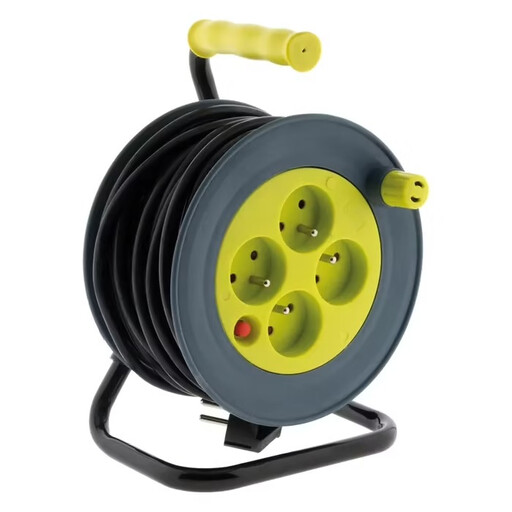
Why we recommend it : Perfect for light indoor DIY, occasional gardening in dry weather, or extending a power source for your devices (computer, lamps...). Its 15 m length offers great versatility without being too bulky.
Its integrated thermal cut-out eliminates any risk of overheating (mistake #2). Its design is clearly intended for domestic use, which prevents it from being mistaken for an outdoor model.
4 2P+E sockets for multiple connections. Safety ensured by the thermal cut-out. Compact and easy to store.
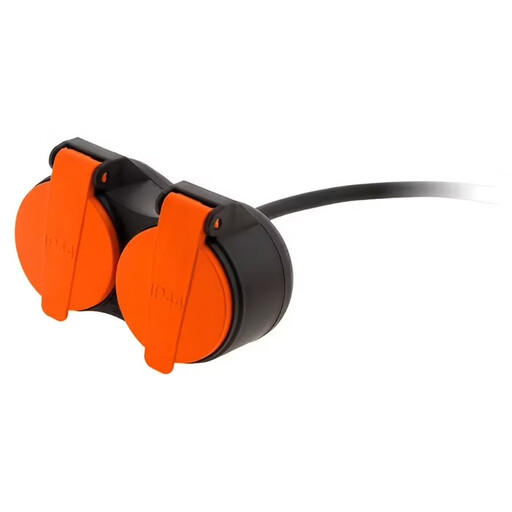
Why we recommend it : Essential for powering your garden tools (lawnmower, hedge trimmer) or temporary lighting. It is specifically designed to withstand moisture and the demands of outdoor use.
Its IP44 rating and the protective flaps on the sockets guarantee safe outdoor use (mistake #1). The H07RN-F rubber cable is designed for superior mechanical and weather resistance.
IP44 protection against water splashes. Ultra-durable H07RN-F cable. Bright orange colour for maximum visibility, reducing trip hazards.
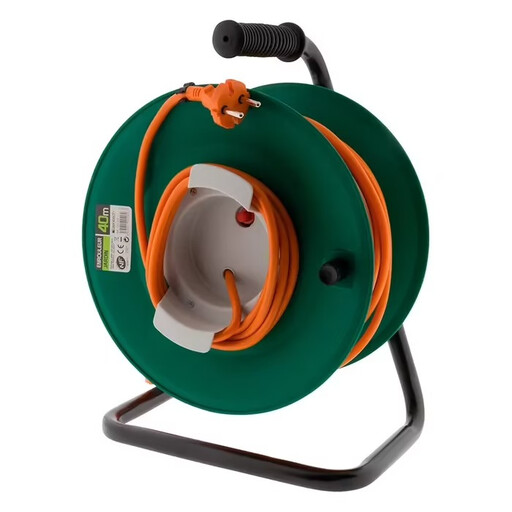
Why we recommend it : Built for job sites, workshops, and large properties. Its generous 40 m length and robust metal frame make it a reliable partner for intensive use and for powering heavy-duty tools.
Its high power rating (up to 3200 W uncoiled) is calibrated for the most demanding tools (mistake #3). The thermal cut-out and NF certification ensure safe operation, even in tough conditions (mistake #2).
Stable and durable metal frame. Long 40 m reach. Power and thermal safety suited for professional use.
Explore our full selection of products that meet our demanding selection criteria and French safety standards.
An electrical cable naturally heats up when current flows through it. When coiled on its drum, it can no longer dissipate this heat: this is the "coil effect." The temperature then rises dangerously, to the point where it can melt the insulation. This is why it is imperative to fully uncoil the cable before plugging in a powerful appliance. As a rule of thumb, the permissible power of a coiled cable is three times lower than its capacity when uncoiled (e.g., 1100?W coiled vs. 3200?W uncoiled).
Measure the maximum distance between your wall socket and the work area. Always add a margin of 2 to 3 metres to avoid working with a taut cable, which could damage the connectors. However, choosing an excessive length isn't the solution either: it increases clutter, the risk of tangles, and voltage drop (power loss).
No. An IP44 rating guarantees protection against water splashes (like spray), but not against immersion or heavy, driving rain. If you must work in the rain, it is safer to protect the connections with specific waterproof boxes and ensure the sockets are not sitting in puddles. Safety first