
Livraison le jour même ou le lendemain

Qualité garantie

Débloquez vos offres de bienvenue: Livraison GRATUITE | Jusqu'à -80 % | 30 jours d'essai gratuits à JoyPlus
Téléchargez l'application
An electric wiggle car for kids combines several activities in one toy: driving, rocking and, sometimes, music. For a birthday or Christmas, this type of gift appeals with its lights and connected features. But a well-filled spec sheet doesn't necessarily mean the model will be suitable for your home, your child's age or your garden.
Here are the points to examine before choosing an electric car for a 3-year-old, a scooter or a 3-in-1 ride-on toy.
Battery life varies depending on the child's weight, the type of surface, the incline, the temperature and the number of starts. A battery advertised for 60 to 70 minutes can therefore offer a noticeably different duration in real-world conditions.
The charging time also deserves your attention. On some models equipped with a 12 V lead-acid battery, a full charge can take 8 to 12 hours. That's a point not to overlook if the toy needs to be ready regularly at weekends.
For a young child, a high speed isn't necessarily an advantage. Several adjustable speed levels, including a slow mode, will be far more useful for accompanying their first attempts. Also check that the start is gradual and that stopping doesn't cause any jerky movement.
Product listings sometimes show different values depending on the units or versions. The same description might mention 5 km/h in one section, then around 8 km/h in another. If you spot an inconsistency, consult the manual and ask the seller for confirmation before placing your order.
LED wheels and Bluetooth music make the toy more fun, but they don't replace a helmet or adult supervision. The lights can also drain the battery faster. Safety depends above all on the stability of the base, the quality of the wheels, the braking and the place of use.
For a rechargeable kids' car, check:
Charging must be done by an adult, using the supplied charger, in a dry and well-ventilated area. The vehicle must never be used while charging.
An anti-tip vehicle for kids should be used on a flat, clear surface away from traffic. A wide base, stabilising rear wheels and a system that limits tipping can reduce certain risks, but they don't replace the usual precautions.
Avoid stairs, slopes, the edges of a pool, very uneven ground and areas used by cars or bikes. Even with an anti-tip feature, sharp turns should still be avoided.
Before buying, look for the CE mark, a manual you can understand in English, warnings about small parts and the contact details of the responsible party established in the European Union. The product listing should also state the recommended age, the maximum supported weight and the conditions of use.
The mention of EN71 on a commercial listing refers to safety requirements applicable to toys. It's still best to check the documents supplied with the product. This mention is neither a medical guarantee nor a promise of zero risk.
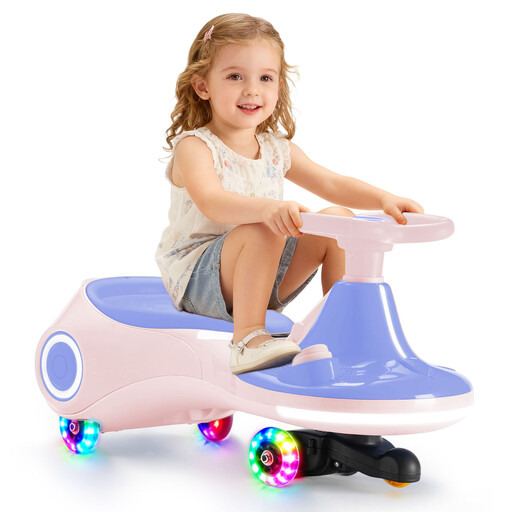
Why this choice suits this profile: This model combines electric movement and a rocking function, without you having to buy two different toys. According to the supplied listing, it's suitable for children aged 3 and over.
It offers three speed levels and a base described as anti-tip. However, the listing shows different speeds in different sections: check the manual before buying.
Rechargeable 12 V battery, advertised battery life of over 60 minutes, rocking mode, Bluetooth and light-up wheels.
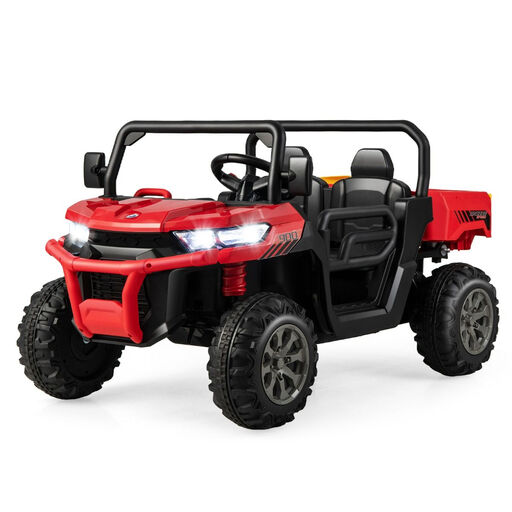
Why this choice suits this profile: This two-seater vehicle is aimed at families who want more space and a parental remote control to accompany the first uses.
The 2.4 GHz remote control, gradual start and adjustable seatbelt allow the adult to stay in control during the learning phase.
Two motors, 12 V battery, spring suspension, three speeds and a maximum advertised load of 50 kg.
Why this choice suits this profile: Its versatile format suits households that want to alternate between ride-on play and rocking, especially when indoor space is limited.
The rocking function can be used on a smooth surface, while the speed settings allow you to limit the pace during the first sessions.
Stabilising rear wheel system described in the listing, wider seat, LED lighting and music player with Bluetooth connection.
We've put together a complete list, updated in real time, of products that meet these strict selection criteria and European safety regulations.
Before the first outing, fully charge the battery, check that the wheels and handlebar are tightened, then select the lowest speed. The child must remain seated and wear a suitable helmet. Knee pads and elbow pads can complete the gear.
After each use, wipe the vehicle with a damp cloth. Never use a water jet: moisture could damage the electrical components. Regularly inspect the wheels, screws and cables. At the slightest unusual noise or irregular behaviour, stop the toy immediately.
Choose a model explicitly designed for this age, with adjustable speed, a gradual start, a stable base and a suitable seat. A parental remote control can also prove useful on larger or faster vehicles.
The electricity consumption is generally modest. However, its cost depends on the battery capacity, the frequency of charging and your electricity supplier's rate. Over time, replacing the battery is often the main expense to plan for. Follow the charge cycles and storage recommendations given in the manual.
Yes, if the manufacturer allows it and the ground is flat, dry and away from traffic. A kids' electric scooter or a rocking car must not be used on public roads, on a steep slope or near water. Direct adult supervision remains essential.