
Livraison le jour même ou le lendemain

Qualité garantie

Débloquez vos offres de bienvenue: Livraison GRATUITE | Jusqu'à -80 % | 30 jours d'essai gratuits à JoyPlus
Téléchargez l'application
The inflatable stand-up paddleboard (SUP) has completely revolutionized watersports. But before you can enjoy the tranquility of the water, there's the dreaded chore: inflation. If you're tired of exhausting yourself with a manual pump before you even set foot on your board, investing in an electric SUP pump is the logical next step.
The problem is, the market is flooded with models making tempting promises that too often lead to costly disappointments. As a product specialist at Joybuy, my mission is to help you decode the spec sheets to make a truly informed decision. To guide you, here are the pitfalls to avoid and the criteria to watch closely.
To make the right choice, focus on a few objective technical specifications. These are what reveal the true performance and reliability of your future electric paddleboard inflator.
Power Source: This is the starting point; it all depends on your habits.
Pressure and Airflow (Dual-Stage): A good paddleboard pump is always dual-stage. First, a "high-volume" mode (high flow rate, e.g., 350 L/min) quickly fills the board to about 1 PSI. Then, a "high-pressure" compressor (lower flow rate, e.g., 70 L/min) takes over to reach the required 15 to 18 PSI. Choosing a high-pressure paddleboard pump that goes up to 20 PSI is a safeguard: the motor won't run at its maximum capacity, so it wears out more slowly.
Life-Changing Features:
Rather than an endless list, here are models that cater to specific user profiles, selected based on performance and reliability criteria.
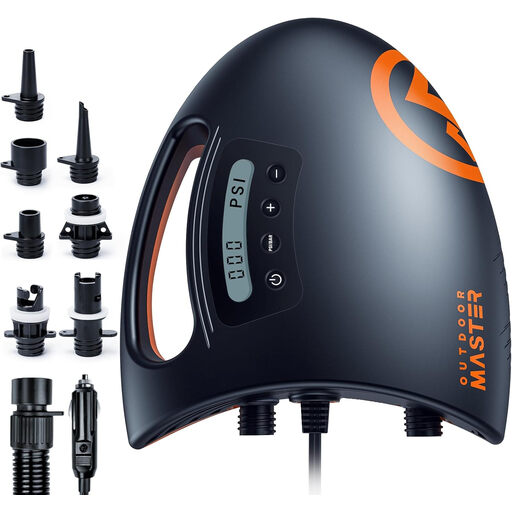
Why it's the right choice: Ideal for beginners or those who always launch from spots accessible by car. It plugs into the 12V outlet and delivers reliable performance without the hassle of managing a battery.
No more dead batteries! By plugging into the car, the power supply is continuous. Its active cooling system allows it to inflate up to 3 boards in a row, thus avoiding the overheating trap.
Automatic dual-stage inflation with a programmed shut-off. Patented cooling system for continuous, risk-free use.
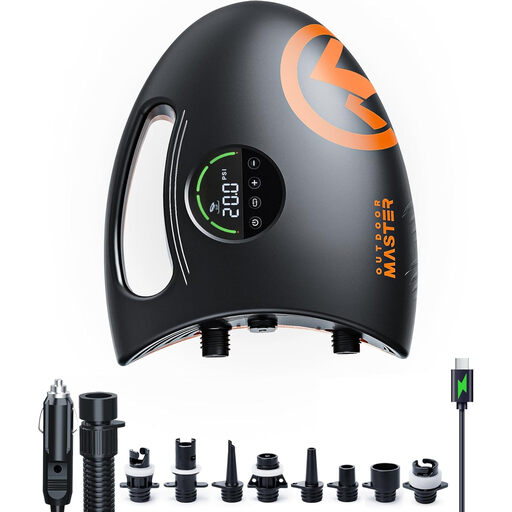
Why it's the right choice: Built for adventurers who need maximum autonomy. Its large-capacity integrated battery is a game-changer for group outings or remote spots.
It frees you from the constraint of a car. Its 88.8 Wh battery can, according to the manufacturer, inflate up to 6 boards, avoiding the low-autonomy trap. Fast charging via USB-C is a major plus.
Excellent autonomy thanks to its rechargeable battery. Versatile with multiple power and charging options (including in the car).
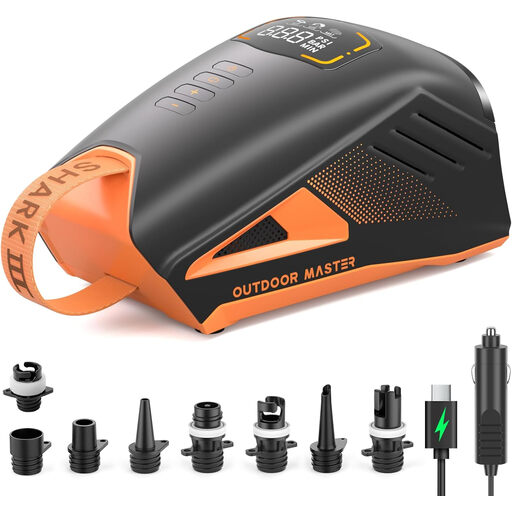
Why it's the right choice: For those who want to spend maximum time on the water and minimum time prepping their gear. Here, inflation speed is the number one criterion.
It tackles the "slow inflation" pitfall head-on. The manufacturer advertises a record time of 3 minutes and 50 seconds to inflate a 10.6-foot board to 15 PSI. A top-tier performance.
Ultra-fast inflation speed. Powerful 74 Wh battery and advanced cooling system for maximum efficiency.
These inflators are excellent allies for your paddleboard. To go further and complete your setup, discover our full selection of boards and accessories, all rigorously tested by our experts.
1. How long does it take to inflate a paddleboard with an electric pump? It all depends on your board's volume, the target pressure, and, of course, the pump's power. On average, expect it to take between 8 and 12 minutes for a standard board at 15 PSI with a good model. The most powerful ones can do it in under 5 minutes.
2. Is a 20 PSI inflator really necessary? Most boards require between 15 and 18 PSI for proper rigidity. Choosing a model that can go up to 20 PSI is an excellent idea. It prevents the motor from constantly running at full capacity, which preserves its lifespan and ensures it will reach the target pressure without straining.
3. Can a battery-powered pump inflate multiple paddleboards? Absolutely, provided you choose the right model. The key criterion is the capacity in watt-hours (Wh): aim for at least 70 Wh to be able to inflate 3 to 4 boards on a single charge. Reputable manufacturers usually state the number of possible inflations, which is a good benchmark.