
Same-day & Next-day Delivery

Quality Guaranteed

Unlock Your Welcome Offers: FREE Delivery | Up to 80% OFF | Free 30-day JoyPlus trial
Download the APP
With the widespread adoption of remote work, our homes have transformed into full-fledged offices. In this new reality, ergonomics is no longer a luxury but a necessity for staying healthy and productive. The electric standing desk has emerged as the cornerstone of this modern setup.
But with an overwhelming number of options on the market, how do you avoid falling for marketing traps? Our editorial team has scrutinised the market to help you see clearly. Let's break down the common mistakes to avoid and the essential criteria for a successful and long-lasting purchase.
Marketing often touts features that do a poor job of hiding mediocre quality. Here are three points to watch closely to ensure you don't regret your investment.
To be certain of the quality and longevity of your future work-from-home desk, carefully examine these three key points.
The stability of a standing desk depends primarily on its frame. Opt for a sturdy steel frame with wide feet for a solid foundation. The most reliable models integrate a dual-motor system (one motor per leg) rather than a single motor. This configuration offers several advantages:
The size of the desktop should match your actual needs.
The most common material is Medium-Density Fibreboard (MDF). Check that its thickness is sufficient (at least 2.5 cm) to prevent it from sagging under the weight of your equipment.
The ergonomics of an electric desk also depend on the simplicity of its control panel. A good control panel should offer a height memory preset function. The ability to save 3 or 4 heights (e.g., sitting, relaxing, standing) allows you to change posture with a single press, without having to guess to find the ideal setting.
The anti-collision feature is another essential safety guarantee. It detects obstacles (like a chair or a cabinet) during adjustment and automatically stops the movement to prevent accidents and damage.
Instead of an endless catalogue, here is our curated selection for three user profiles to help you find the model that truly suits you.
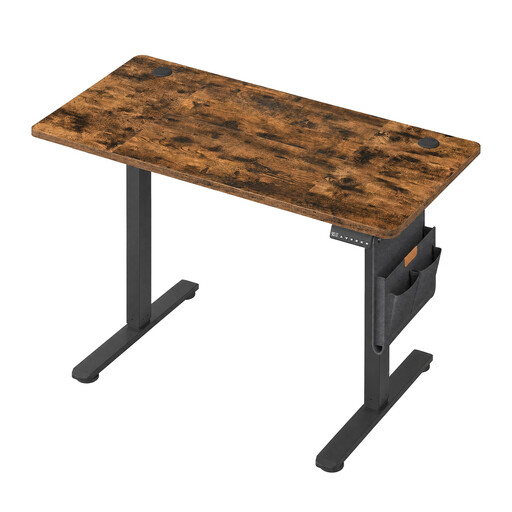
Why we chose it: Perfect for a first setup or for creating an office nook in a small area. Its compact dimensions easily accommodate a laptop and a monitor without overwhelming the room.
Its steel frame is designed to ensure excellent stability despite its compact size. Its motor, advertised as quiet, avoids the nuisance of a loud mechanism that ultimately discourages use.
It includes the essentials: 4 memory presets and cable grommets, for an unbeatable features-to-footprint ratio.
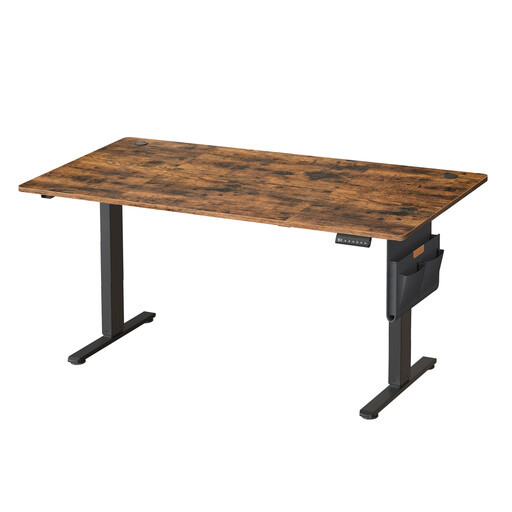
Why we chose it: With its large desktop, this desk is aimed at demanding users who juggle dual monitors, files, and multiple peripherals. It's the perfect foundation for a fully-featured workstation.
Its steel frame is sized to support the large desktop without wobbling, even at its highest position. Its 70 kg weight capacity is realistic and suitable for heavy equipment.
The combination of a large work surface and 4 memory presets allows for optimal organisation and instant transitions between tasks.

Why we chose it: A standing desk is only half the battle. For long hours spent sitting, an ergonomic office chair is non-negotiable. This model perfectly complements the setup for complete postural wellness.
More than just a chair, it focuses on ergonomic fundamentals: a backrest that contours to the spine, adjustable lumbar support, and a headrest to maintain a healthy posture and reduce fatigue.
The game-changing detail: its flip-up armrests allow the chair to slide under the desk for optimal space-saving. Its breathable mesh seat ensures lasting comfort, even during long work sessions.
Our complete selection features products that all meet our quality criteria and European safety standards.
Stability is directly related to the quality of its frame. A model with a wide base, thick steel legs, and ideally, a dual-motor system will offer flawless stability, even at its maximum height. A good indicator is the weight of the desk itself. A heavier weight is often a sign of denser materials and better engineering.
In practice, 3 or 4 memory presets are more than enough. This is sufficient to program a "focused sitting" height, a "relaxed sitting" height, and one or two heights for standing work. Any more than that, and the presets become redundant and can even complicate daily use.
The weight capacity (excluding the desktop's own weight) for quality models is typically between 70 and 120 kg. Take stock of your equipment (monitors, PC tower, speakers, etc.) to estimate the total weight it needs to support. To be on the safe side, choose a model with a weight capacity at least 20% higher than your needs. This will prevent the motor from constantly operating at its limit and will extend its lifespan.