
Livraison le jour même ou le lendemain

Qualité garantie

Débloquez vos offres de bienvenue: Livraison GRATUITE | Jusqu'à -80 % | 30 jours d'essai gratuits à JoyPlus
Téléchargez l'application
Spending long hours in front of a screen, whether for remote work or studying, takes a toll on your body and focus. To break up a sedentary lifestyle and re-energise your day, nothing beats an electric sit-stand desk. This smart piece of furniture allows you to switch between postures at will—a real boost for your well-being and productivity.
But with an overwhelming number of options on the market, how do you choose? This guide breaks down the essential criteria and presents our selection of the best models to help you make the right choice for your workspace.
Before you take the plunge, let's review the key technical points that will make all the difference in your daily routine.
First, and most importantly: get out your tape measure and assess your available space. The desktop needs to be large enough to accommodate your entire setup (monitors, computer, keyboard) without feeling cramped. A good ergonomic desk is, above all, a workspace with room to breathe.
Also, be sure to check the maximum supported weight capacity. Do the maths: add up the weight of your monitors, PC tower, and all your accessories. Most models can handle between 50 and 80 kg, which is more than enough for a standard configuration. A steel frame is an excellent guarantee of sturdiness and stability, especially when the desk is at its maximum height.
The secret to a good motorised desk? A smooth mechanism. A quiet motor (under 50 dB) is essential to avoid disturbing your concentration or those around you.
Also keep an eye out for the small features that make a big difference in daily use:
A tidy desk promotes a clear mind. For a home office desk worthy of the name, good cable management is not optional. Cable grommets, trays, storage baskets, or dedicated hooks: these accessories are essential for hiding wires and maintaining a clean, uncluttered desktop.
We've selected a few models that stand out from the crowd, designed for different needs and budgets.
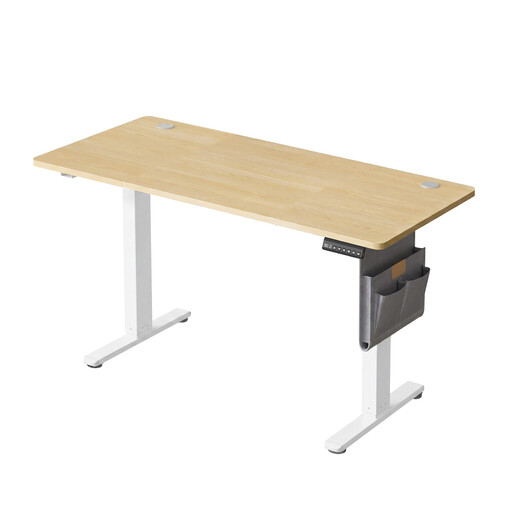
Why it stands out
This model strikes the perfect balance between a generous work surface and thoughtful features. Its 160 x 70 cm dimensions comfortably accommodate a dual-monitor setup and peripherals. The golden oak-effect desktop adds a warm touch that blends easily with most interior designs.
What we like
Who is it for? For remote workers and creatives who need a large workspace to spread out their equipment without feeling cramped.
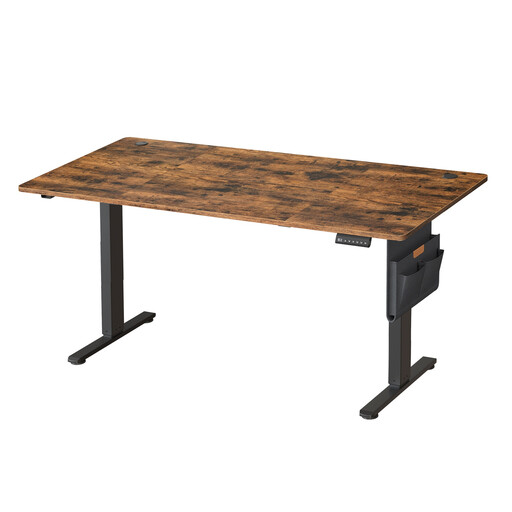
Why it stands out
With its massive 180 x 80 cm desktop, this desk is for those who think big and refuse to compromise on space. Its rustic brown finish, paired with the black frame, creates a very stylish industrial look. In terms of features, it checks all the boxes of a high-end model.
What we like
Who is it for? For power users (developers, architects, gamers...) who juggle multiple monitors and numerous peripherals, and for whom workspace is non-negotiable.
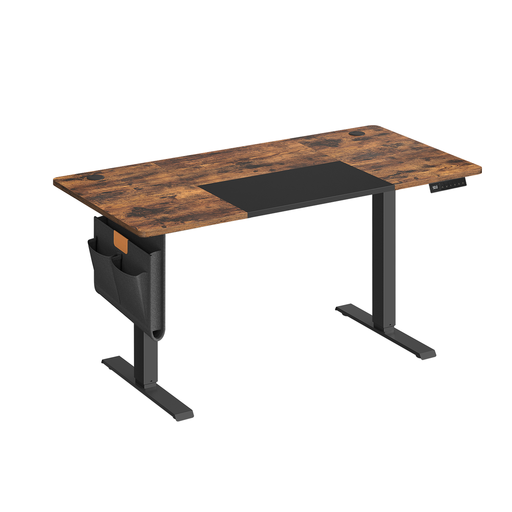
Why it stands out
With its 140 x 60 cm dimensions, this model is the perfect solution for more compact spaces, like a student's room or a dedicated office nook in a living room. However, it makes no compromises on essential features: you still get height memory presets and modern connectivity in a smaller form factor.
What we like
Who is it for? For students, freelancers, and anyone with limited space who doesn't want to sacrifice the comfort and benefits of a motorised desk.
Technical specs are important, but aesthetics are essential for feeling good in your workspace. If the design of these models didn't catch your eye, don't worry—there are plenty of other styles available.
? Take a look at our complete collection of computer desks to find the model that will perfectly complement your home.
The golden rule for good ergonomics: your elbows should form a right angle (90°) with the desktop, whether you are sitting or standing. When seated, your feet should be flat on the floor. When standing, your forearms should rest naturally and parallel to the desk. Most desks offer an adjustment range from 72 to 120 cm, which suits the vast majority of body types.
Modern models are designed to be as quiet as possible. The motor noise rarely exceeds 50 decibels (dB) during adjustment, which is equivalent to a whisper or the quiet ambiance of a library. This allows you to change positions without disturbing anyone.