
Livraison le jour même ou le lendemain

Qualité garantie

Débloquez vos offres de bienvenue: Livraison GRATUITE | Jusqu'à -80 % | 30 jours d'essai gratuits à JoyPlus
Téléchargez l'application
A grimy patio, a moss-covered driveway or a car stained after winter can make you want to buy an electric pressure washer as quickly as possible. Yet disappointment often comes less from the motor than from a poorly understood spec sheet.
Before comparing an electric Kärcher or an equivalent machine, take the time to examine three things: the pressure you can actually use, the water flow rate, and the accessories plus ease of storage. These are what will make the difference in everyday use.
A figure of 150 bar, 180 bar or 225 bar catches the eye, but it isn’t enough to judge a machine. The stated pressure is often a maximum value measured under specific conditions. The result also depends on the flow rate, the nozzle you use, the distance from the surface and the consistency of the motor.
On a car, a jet that’s too concentrated or a poorly chosen nozzle can damage delicate paintwork, a seal or a trim piece. On a patio or driveway, high pressure must also be used with care to avoid gouging the joints.
The flow rate, expressed in litres per hour (L/h), directly affects how quickly you can clean. At a comparable pressure, an electric pressure washer delivering between 450 and 540 L/h will cover an area faster than a less generous model. However, check that your water supply provides enough flow and that the inlet hose is compatible with the machine’s connection.
A hose that’s too short, difficult to store or constantly kinking can quickly make using the machine a chore. A pressure washer with a hose reel generally makes storage simpler and reduces tangles. For washing a car, a foam lance or detergent tank lets you apply product before rinsing. A brush for the wheels, a rotary nozzle and a patio cleaner can also save you from buying accessories separately.
Power, expressed in watts, indicates the motor’s rated consumption and gives you an idea of its operating capability. A 2,000 W pressure washer is suitable for many household tasks: garden furniture, car, balcony, small patio or fencing.
A 2,200 W pressure washer will handle larger surfaces or more stubborn dirt. Even more powerful machines, such as a model rated at 3,200 W, should be chosen based on how often you’ll use it, the storage space you have and your electrical setup.
Here’s how to interpret the most common values:
These figures remain manufacturer-stated specifications. On their own, they don’t guarantee identical results on every surface. Always consult the manual, especially for paintwork, wood, soft stone and joints.
An aluminium pump is generally presented as better suited to longer sessions, with less fatigue than some composite pumps. The automatic on/off trigger system stops the motor running unnecessarily and limits water consumption when you release the control.
Finally, an 8-metre hose, a handle and wheels make it easier to move around a car, patio or garden shed. A dirt filter is also welcome when the water may contain particles.
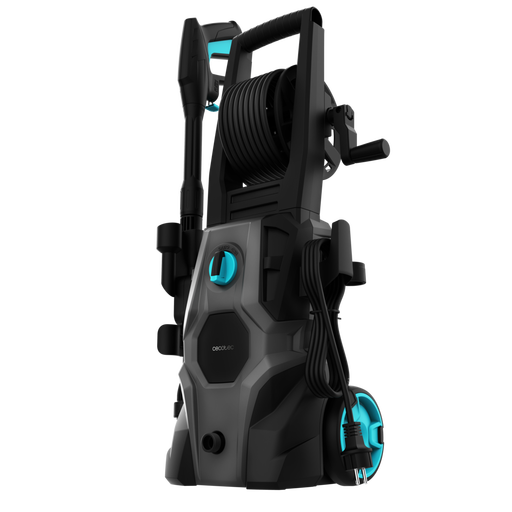
Why this choice suits this profile: With its 2,000 W, 150 bar and 450 L/h flow rate, this setup covers the everyday tasks of a house or flat with an outdoor space, without claiming to tackle the most intensive jobs.
The aluminium pump, dirt filter and automatic shut-off address durability concerns and prevent wasting water unnecessarily.
8 m high-pressure hose, adjustable foam bottle, patio cleaner, wheel brush and corner brush included.
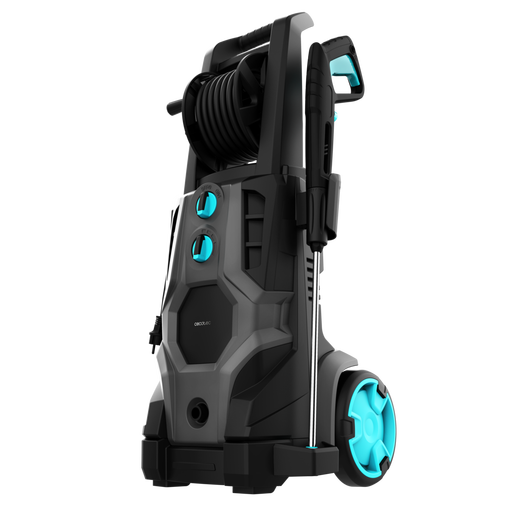
Why this choice suits this profile: With its stated specifications of 3,200 W, 225 bar and 540 L/h, this model is aimed at homeowners who regularly maintain a patio, driveway, fence or several vehicles.
The high flow rate complements the stated pressure; however, it’s still essential to choose the right nozzle to avoid applying excessive force to delicate surfaces.
Aluminium pump, adjustable foam bottle, wheels and carry handle, with a stated reach of 9 m.
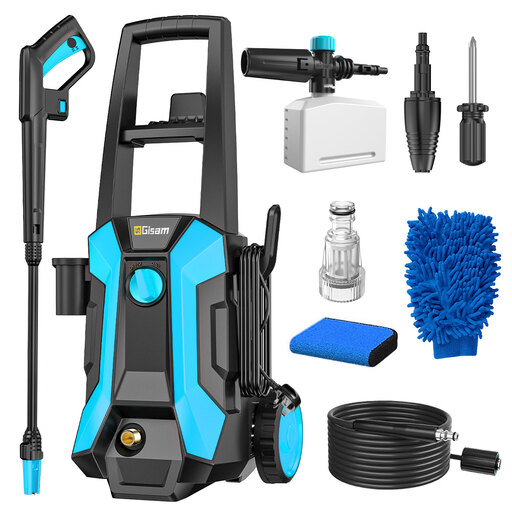
Why this choice suits this profile: This model suits those who alternate between car washing, garden maintenance, cleaning fences, patios and driveways, with equipment used regularly.
The integrated hose reel simplifies storing the hose, while the 8 m hose makes it easier to move around large areas.
2,200 W, 180 bar, 480 L/h, foam nozzle, rotary nozzle and high-pressure gun included.
We’ve compiled a complete selection, updated in real time, of products that meet these demanding criteria and European safety standards.
A flow rate between 450 and 480 L/h can be suitable for domestic washing, provided the water supply is adequate. For the car, the method matters as much as the power: use a suitable foam, rinse from top to bottom and keep a reasonable distance from the bodywork.
A 150 bar machine can meet many residential needs. Models rated at 180 or 225 bar offer a greater power reserve, but their use should remain gradual. The type of surface, the condition of the joints and the choice of nozzle are all decisive factors.
The cost depends on the motor power, the duration of use and your electricity tariff. A 2,000 W machine theoretically consumes 2 kWh if it runs for one hour at its rated power. In practice, pauses and the automatic shut-off often reduce the actual running time. Water consumption should also be factored into your budget.