
Livraison le jour même ou le lendemain

Qualité garantie

Débloquez vos offres de bienvenue: Livraison GRATUITE | Jusqu'à -80 % | 30 jours d'essai gratuits à JoyPlus
Téléchargez l'application
Rejuvenating a patio, making your car shine, or stripping a moss-covered wall… The electric pressure washer is a powerful ally for outdoor maintenance. Yet, faced with an overwhelming number of options and complex technical sheets, it's easy to get lost and make the wrong choice.
As a product expert for Joybuy, I'm here to help you see things more clearly. Together, we'll break down the essential criteria and sidestep the marketing traps so you can choose the device that truly fits your needs, without overspending.
The market is flooded with models making tempting promises. Unfortunately, some highlighted features hide flaws that only become apparent with use. Here are the three most common mistakes to avoid.
To make an informed choice, ignore the marketing hype and focus on these three objective data points. They determine the real performance and lifespan of your future washer.
This is the true performance indicator—the only one that counts.
For versatile home use (car, garden furniture, small patio), a pressure of 120 to 140 bar with a flow rate of 380 to 450 L/h is an excellent compromise. For tougher jobs like stripping large stone patios or facades, a 180 bar pressure washer with a flow rate around 500 L/h will be necessary.
Expressed in watts (W), the motor's power is directly linked to the pressure/flow rate combination the device can deliver. A more powerful motor (typically 2000W and above) is often a guarantee of better endurance and the ability to maintain a high level of performance over time. It's also a sign of robustness for key components, like the pump.
These are the practical details that make all the difference in daily use:
Rather than an endless list, here are our targeted recommendations based on your user profile.
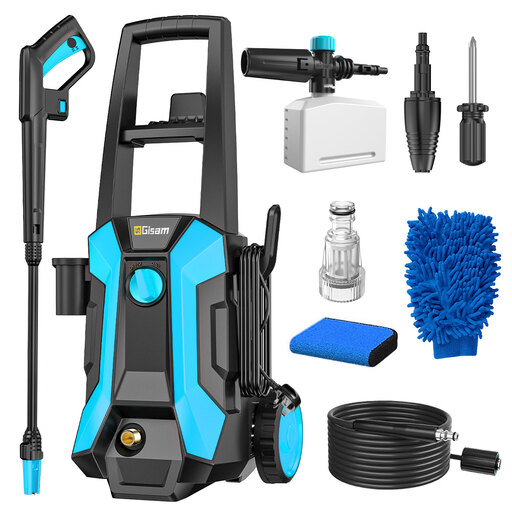
Who is it for? For those who juggle multiple needs: cleaning the car on the weekend, stripping the patio in spring, and maintaining pathways. This user needs power, but also versatility.
With its 180 bar / 480 L/h combination, it offers an excellent balance of power and flow rate. Its 8-metre hose and built-in reel put an end to handling and storage hassles.
Its comprehensive accessory kit (foam cannon, turbo nozzle, spray gun, etc.) makes it immediately ready for any task, from gentle car washing to intensive stripping.
Who is it for? Perfect for renters or owners of small outdoor spaces (balconies, small yards) or for occasional needs like cleaning bicycles or garden furniture.
By aiming for a model around 110-130 bar with a hose of at least 5m, you avoid unusable 'gadget' devices and ensure you have an effective machine for small tasks.
Their compact size makes them very easy to store in a garage, cellar, or even a cupboard. The price point is also much more accessible.
We have compiled a complete and updated list of products that meet these strict selection criteria and safety standards.
Here are a few benchmarks for choosing the right power for the surface, and most importantly, to avoid causing any damage.
Contrary to popular belief, a pressure washer is much more water-efficient than a standard garden hose: up to 75% water savings for the same result! A 450 L/h model uses 450 litres in one hour, whereas a garden hose can output over 3,000 litres in the same amount of time. As for electricity, consumption depends on the motor's power. A 2200W (or 2.2 kW) device will consume 2.2 kWh if it runs at full power for one hour.
A few simple steps are all it takes to extend its lifespan.