
Livraison le jour même ou le lendemain

Qualité garantie

Débloquez vos offres de bienvenue: Livraison GRATUITE | Jusqu'à -80 % | 30 jours d'essai gratuits à JoyPlus
Téléchargez l'application
A moss-covered patio, a car that's unrecognisable after a weekend in the country, a fence that’s looking dull and grey… A major outdoor clean-up can quickly turn into a real headache. An electric pressure washer is the obvious solution, but how do you navigate the jungle of marketing promises and misleading spec sheets?
As a product expert at Joybuy, my mission is to help you see things more clearly. Let's forget the jargon and focus on what's essential for making a smart purchase. Here are the pitfalls to avoid and the real criteria for making your choice.
Before you get tempted by an impressive spec sheet, watch out for these three common mistakes that cost unwary buyers dearly.
high-pressure car washing.pressure washer with a hose reel isn't a luxury; it's a necessity for quick and easy storage, and for preserving the life of the hose.To choose a powerful and durable electric pressure washer, focus on these three fundamental parameters.
Imagine you're sweeping: pressure is the force with which you scrub the floor, and flow rate is the width of your broom. One is useless without the other.
patio and car washer and for covering large areas without spending all day on it.The key is balance. For versatile use, a model with at least 140?bars and 450?L/h is an excellent starting point.
The motor's power, expressed in watts (W), is a good indicator of the machine's robustness. A more powerful motor (generally 2000?W and above) will maintain high pressure and flow rate consistently, especially during prolonged use. It's a guarantee of performance and reliability.
User comfort is just as important as raw performance.
pressure washer with a hose reel makes storage much easier and protects the hose from premature wear.ergonomic high-pressure gun reduces fatigue. Check for essential nozzles: a flat jet nozzle (adjustable) for most surfaces and a rotary nozzle (turbo nozzle) to concentrate power on deeply ingrained dirt.Here are a few models that meet specific needs, taking into account the criteria we've just discussed.
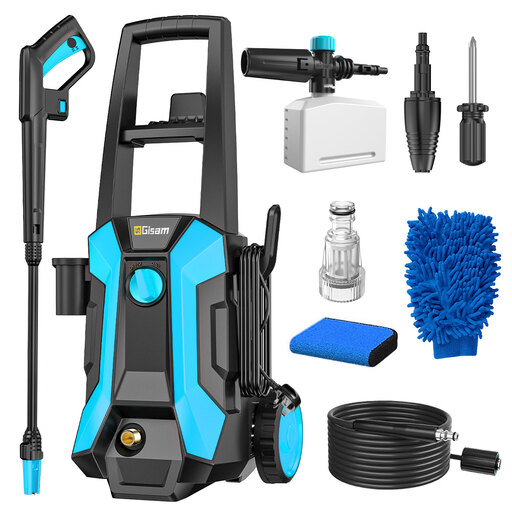
WHY IT'S A GREAT MATCH: Perfect for the homeowner looking for a do-it-all machine: cleaning the patio, washing the car, stripping the fence, and maintaining pathways. It's the ideal balance of power and ease of use.
It outsmarts the storage trap with its integrated hose reel and avoids the useless accessory pitfall by providing a relevant and practical kit (foam nozzle, rotary nozzle).
Its key strength: a perfect balance between 180 bars of pressure and a comfortable 480 L/h flow rate, all powered by a 2200 W motor. Its 8-metre hose ensures excellent freedom of movement.
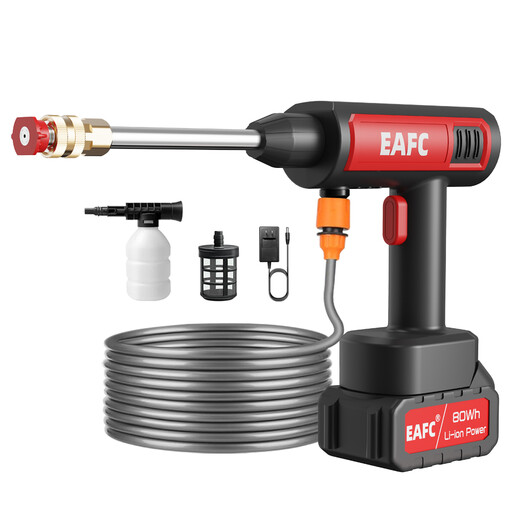
WHY IT'S A GREAT MATCH: Essential for those without a nearby power outlet, or for anyone who wants a go-anywhere solution to clean a mountain bike after a ride, the car downstairs, or balcony furniture. Its ability to draw water from a simple bucket is a real bonus.
This model doesn't try to compete on maximum pressure, and that's its strength. It meets a specific need: absolute mobility. Its performance is calibrated for quick, targeted cleaning where a large corded model would be unusable.
Its cordless, battery-powered design is its key advantage. The battery life is sufficient for a complete wash, and its self-priming system makes it completely independent of a water supply: a bucket is all you need!
Explore our full selection of products that meet our strict selection criteria and current standards.
1. What bar pressure is needed to clean a very dirty patio? For a wood or composite deck, a pressure of 120 to 140?bars is generally sufficient to avoid damaging the material. For a very grimy concrete or tiled patio, you can opt for a model up to 160-180?bars, ideally paired with a rotary nozzle for maximum efficiency.
2. Can any detergent be used with a pressure washer? No, it is imperative to use detergents specifically designed for pressure washers. These products are formulated to not damage the internal components of the pump and are often more environmentally friendly. Always check the recommendations of your machine's manufacturer.
3. What is the lifespan of an electric pressure washer? The lifespan depends on the build quality and maintenance. An entry-level model will last a few years with occasional use. A higher-end model with a more robust induction motor can last much longer. The pro tip to extend its life: always purge the water from it before winter storage to prevent frost from damaging the pump.