
Livraison le jour même ou le lendemain

Qualité garantie

Débloquez vos offres de bienvenue: Livraison GRATUITE | Jusqu'à -80 % | 30 jours d'essai gratuits à JoyPlus
Téléchargez l'application
Thinking of switching from a manual to an electric pencil sharpener? The appeal is obvious: a perfect point in seconds, whether you're an artist, a teacher, or just in the office. But be warned—the market is flooded with models that hide deal-breaking flaws beneath a sturdy-looking exterior. To ensure you don't regret your purchase, here are the common pitfalls to avoid.
User reviews consistently highlight three major disappointments:
Choosing the right electric pencil sharpener, therefore, isn't just about design or price. It's primarily about the technical specifications—the features that distinguish a sound investment from a gadget destined for the bin.
To avoid making the wrong choice, here are the technical points you absolutely must check. This is what separates a reliable tool from a disappointing gadget.
Versatility is key. A good device must accept a wide range of diameters, ideally from 6 to 12?mm, to be truly all-purpose. It should be just as comfortable with a standard graphite pencil as it is with fragile coloured pencils or the large-diameter models used by artists and young children.
The secret? The blade. Absolutely aim for a model with a metal helical blade. Unlike a simple flat blade that merely "scrapes" the wood, a helical blade acts like a milling cutter, sharpening the pencil with precision and consistency. It's the best way to protect fragile leads and get a flawless point effortlessly.
The power source drives performance. For regular or heavy-duty use, nothing beats an AC-powered sharpener. Plugging it directly into the mains ensures consistent torque, capable of sharpening quickly and effectively without ever faltering, even on the hardest woods. Dual-power models (AC and USB) are an excellent compromise between power and portability. As for battery-powered versions, save them for portable and very occasional use. A professional or school-grade sharpener needs a reliable energy source.
A good automatic sharpener with a reservoir must tick several boxes to be truly practical and safe for daily use. Check for these three essential features:
Based on these criteria, we've selected models that tick all the boxes, whether you're an artist, a teacher, or a professional in an open-plan office.

Key feature for this use: An artist demands control. This model offers exactly that with three sharpness settings (sharp, medium, blunt), perfect for adapting the point to your technique, from fine lines to broad strokes. Its compatibility with pencils up to 12 mm makes it the ideal partner for creatives who juggle different types of pencils.
It shatters the "universal" myth: its robust helical blade and AC-powered motor can handle the soft leads of coloured pencils without ever breaking them.
Its three sharpness settings, which offer formidable versatility for drawing and sketching.
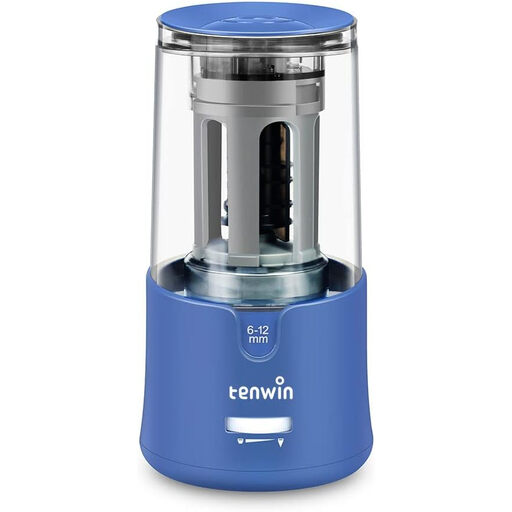
Key feature for this use: In the classroom, the watchwords are safety, durability, and efficiency. This model is built for intensive, repetitive use. Its large reservoir means you don't have to empty it every five minutes—a real relief for a school sharpener.
It ticks all the safety boxes. Its triple-stop system (sharpened point, open reservoir, overheating) makes it an ultra-safe choice for an environment full of children.
Its foolproof safety features and its XXL reservoir for minimal maintenance.
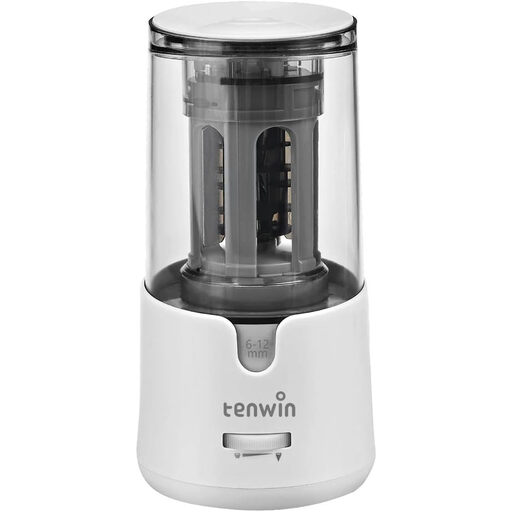
Key feature for this use: In the office, you want efficiency and cleanliness. This professional sharpener delivers a perfect point in 3 to 5 seconds flat. With its stable base and non-slip feet, your desk stays pristine.
It doesn't fall into the trap of anemic battery-powered models. Plugged into AC power, it delivers consistent power, which is essential for daily office use without ever slowing down.
Its speed and its design, which is geared towards keeping a desk tidy.
We have put together a complete selection of products that meet our performance criteria and current safety standards.
Yes, absolutely. A low-end model can shatter the soft, waxy leads of coloured pencils. To prevent this, you must have a device with a helical blade and, ideally, an adjustable sharpness setting. This ensures a gentle sharpening process that respects the lead. Avoid flat-blade models for this purpose.
Its longevity primarily depends on the quality of its motor and blade. A good model for heavy-duty use, with a metal helical blade and an AC power source, can easily last for several years. To make it last, there's one secret: empty the reservoir regularly and never insert anything other than wood-cased pencils (no wax crayons or oil pastels!).
First thing's first, and this is non-negotiable: unplug the device. Next, empty the reservoir. Using a small brush (often included) or a paintbrush, gently remove any wood and lead debris stuck around the blade. Never use a metal or sharp object! If a piece of lead is stuck, the best trick is often to insert a sturdy graphite pencil and gently turn it by hand (with the device still unplugged) to dislodge the obstruction.