
Livraison le jour même ou le lendemain

Qualité garantie

Débloquez vos offres de bienvenue: Livraison GRATUITE | Jusqu'à -80 % | 30 jours d'essai gratuits à JoyPlus
Téléchargez l'application
Say goodbye to spending hours with a roller in hand, battling streaks and drips. The electric paint sprayer promises lightning-fast application, a flawless finish, and spectacular time savings. But be warned: the market is flooded with models making tempting promises, and it's easy to end up with a device that turns your project into a chore rather than a pleasure.
Before making your choice, watch out for these common pitfalls that can turn your renovation project into a real headache:
To find the sprayer that will genuinely save you time, you need to read between the lines of product descriptions and focus on a few key technical specifications.
Most consumer-grade models use HVLP (High Volume, Low Pressure) technology, also known as a low-pressure paint station. This system sprays a large volume of paint with low air pressure. The main advantage is better control and a significant reduction in paint mist (overspray). The result: less waste and easier cleanup of protected areas. This technology is particularly well-suited for interior jobs, like painting walls and ceilings, as well as for finishing furniture.
Instead of focusing solely on watts, examine these three indicators:
A good paint sprayer must be versatile. Make sure it has these three features:
Rather than a simple product list, we've matched each model to a specific user profile. The goal: to help you find the tool that truly fits your projects.
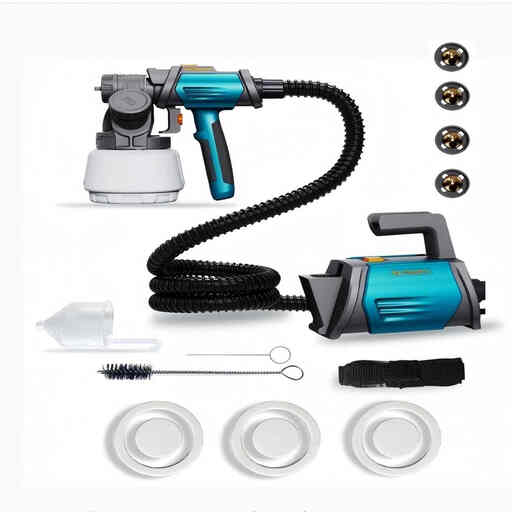
The right choice for this profile: Ideal for those who tackle varied projects (fences, walls, furniture) without wanting to invest in highly specialised equipment. Its versatility and accessible price make it an excellent first-time purchase.
It comes with 4 brass nozzles (1 mm to 3 mm) and 3 spray patterns, avoiding the single-nozzle trap. Its design allows for easy disassembly for a thorough cleaning.
Its ability to handle a viscosity of up to 120 DIN-s makes it compatible with a wide range of paints, including minimally diluted wall paints. The 1300 ml container allows you to cover large areas without constant refilling.
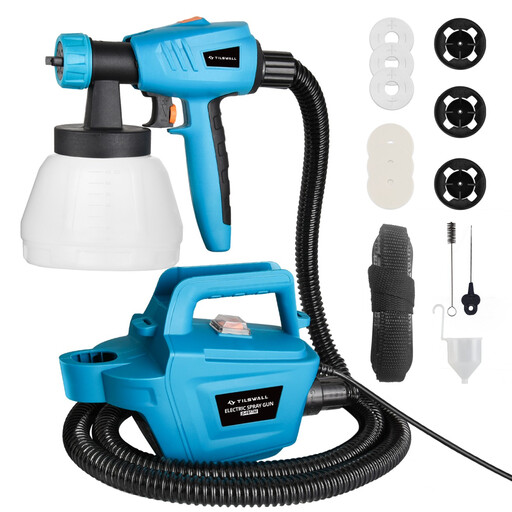
The right choice for this profile: Designed for those tackling large-scale projects (walls, ceilings, long fences). Long-term comfort is the main criterion to prevent fatigue and maintain a consistent finish.
It bypasses the problem of hand-held weight thanks to its separate design: the motor is worn over the shoulder with a strap, making the spray gun significantly lighter. This is an often-overlooked ergonomic detail that is crucial for long sessions.
The 2.5 m flexible hose provides excellent freedom of movement to reach ceilings and corners without having to move the base unit every five minutes. The high flow rate (up to 1100 ml/min) allows for rapid surface coverage.
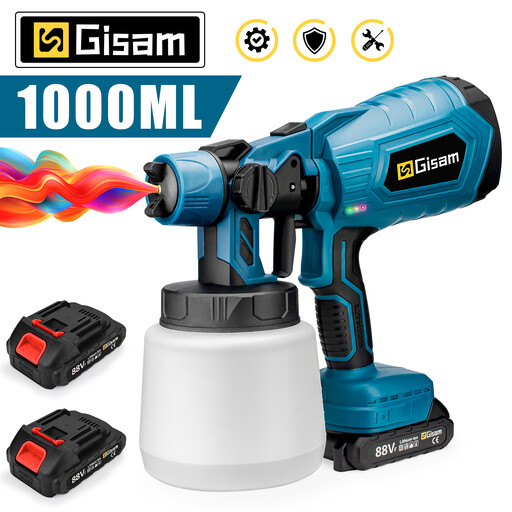
The right choice for this profile: Perfect for DIYers who already own Makita 18V tools (LXT series). This **cordless paint sprayer** offers complete freedom for outdoor jobs (garden sheds, gates) where outlets are scarce, without the hassle of a new charger and battery collection.
It meets a very specific need instead of making vague promises. Its clearly stated compatibility with Makita 18V B-series batteries (BL1850B, BL1840B, etc.) prevents unpleasant surprises and capitalises on an existing investment.
Absolute mobility. Being cordless, it allows you to reach any area without restriction. The paint flow is adjustable to adapt to different tasks, from large surfaces to fine details.
We have compiled a complete and up-to-date list of products that meet these strict selection criteria and current safety standards.
Most HVLP sprayers are compatible with water-based (acrylic) and solvent-based (oil) paints, as well as varnishes, stains, and lacquers. The one point you should never overlook: check the maximum viscosity (DIN-s) supported by your device. A viscometer (or viscosity cup) is almost always included to measure your paint's thickness. If it's too thick, you'll need to dilute it (with water for acrylics, mineral spirits for oil-based paints) following the sprayer manufacturer's recommendations (usually 5 to 10%).
Clogging is the number one enemy. To avoid it, there are two golden rules: