
Livraison le jour même ou le lendemain

Qualité garantie

Débloquez vos offres de bienvenue: Livraison GRATUITE | Jusqu'à -80 % | 30 jours d'essai gratuits à JoyPlus
Téléchargez l'application
Tired of spending hours with a roller in hand? Do you dream of a perfectly smooth, even finish for your walls, ceilings, or furniture, without a single brush mark? The electric paint sprayer promises a professional, fast, and effortless result. However, the reality is often quite different: many users end up with a disappointing device that's complicated to handle and, worst of all, a complete nightmare to clean.
As a product expert for the Joybuy editorial team, my mission is to help you navigate the marketing traps and make the right choice. Together, let's review the common mistakes that can turn your project into a disaster.
The 3 Pitfalls to Avoid When Buying a Paint Sprayer:
To avoid these disappointments, a few technical specifications need to be scrutinised. These are what separate a gadget from a truly versatile tool.
Most consumer models use HVLP (High Volume, Low Pressure) technology. In simple terms, the device projects a large volume of paint with low air pressure.
This trio is inseparable. It's what determines the true potential of your sprayer.
A sprayer that comes with only one nozzle is like a Swiss Army knife with a single blade: its usefulness is limited. A good set of nozzles is essential to adapt to all your projects:
Also, check that the sprayer allows you to adjust the spray pattern (round, flat horizontal, and vertical) to paint comfortably in any position.
Rather than an impersonal list, here are options that meet specific needs, taking into account the criteria we've just discussed.
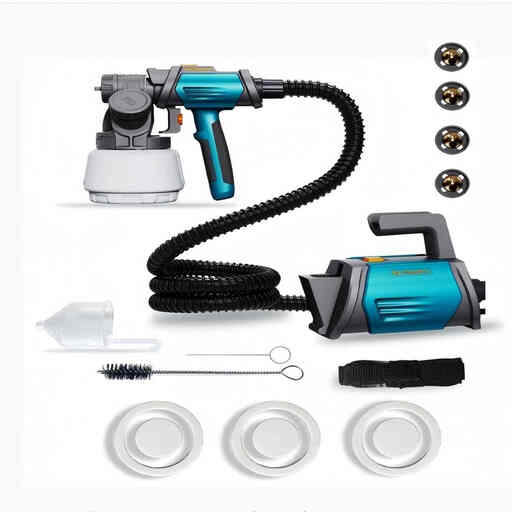
Best for: Tackling large-scale jobs (walls, ceilings, fences). Its power and large reservoir let you work quickly and cover large areas without having to refill every five minutes.
Thanks to its compatibility with thick paints (up to 120 DIN-s) and its 4 brass nozzles (including a 3mm one), it says goodbye to pitfall #3: incompatibility.
Its 800W motor and extra-large 1300ml reservoir ensure a steady pace for rapid coverage. The clever side-fill design helps prevent messes.
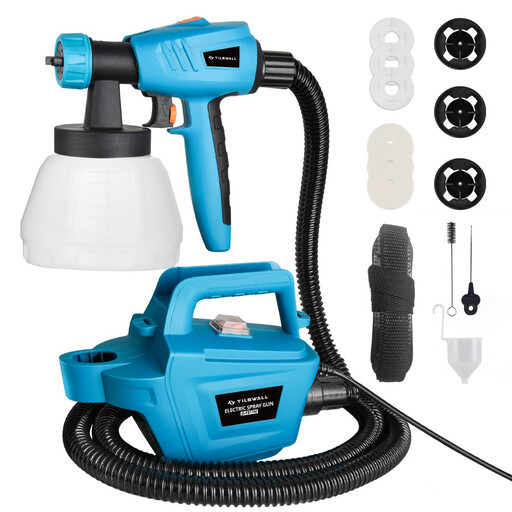
Best for: The go-to for those who juggle refinishing furniture, painting a wall, and treating woodwork. Its strong suit is user comfort, even over long periods.
The motor is separate and sits on the floor, which significantly lightens the spray gun and reduces arm fatigue. Its fully detachable container directly addresses pitfall #2: the endless cleanup.
Ergonomics designed for manoeuvrability and precise control. The long 2.5m hose provides an excellent range of motion for both indoor and outdoor work.
Discover our full selection of products that meet our quality criteria and current standards.
Most paint sprayers come with a small funnel called a viscosity cup. To use it, fill it with the paint you plan to use and time how long it takes to drain completely. Compare this flow time (in seconds) with the time recommended by your sprayer's manufacturer (e.g., "between 40 and 60 seconds"). If your paint is too slow, add a suitable thinner (water for latex, mineral spirits for oil-based) in small increments (no more than 5% at a time) until you reach the ideal consistency.
For the application itself, the answer is a resounding yes. A sprayer can cover a wall in minutes, whereas it would take you over twenty with a roller. However, don't underestimate the prep time: protecting floors, furniture, and baseboards with drop cloths and masking tape is a crucial step. Even with an HVLP system, paint mist, though reduced, will settle everywhere. Add to that the time it takes to clean the device. In the end, the time savings are spectacular on large, clear surfaces, but less obvious for a small, furnished room.
Yes, provided you choose a versatile model. A good indoor and outdoor paint sprayer must be able to handle different viscosities and come with several nozzle sizes. You'll use a wide nozzle and a high flow rate for the wall, then switch to a finer nozzle to apply a stain to your garden shed. Meticulous cleaning between the two types of paint is, of course, non-negotiable.