
Livraison le jour même ou le lendemain

Qualité garantie

Débloquez vos offres de bienvenue: Livraison GRATUITE | Jusqu'à -80 % | 30 jours d'essai gratuits à JoyPlus
Téléchargez l'application
Achieving rich, velvety milk foam at home is the key to transforming a simple coffee into a barista-quality beverage. Yet, the electric milk frother market is a minefield of unfulfilled promises. As a product expert for Joybuy, my mission is to help you see clearly and find the appliance that truly delivers, cutting through the marketing noise.
Who hasn't been disappointed by a device that, after just a few weeks, produces nothing more than a thin foam that collapses before the first sip? Let's break down the pitfalls to avoid and the essential criteria for a purchase you won't regret.
The "big bubble" foam that vanishes instantly: This is the most common trap: entry-level devices that simply beat the milk aggressively. The result? A mountain of unstable air bubbles, a world away from the silky, dense microfoam essential for a cappuccino or latte art worthy of the name. This pseudo-foam disintegrates in seconds, leaving you with disappointment.
The non-stick coating that's non-stick in name only: An automatic milk warmer must be easy to clean. Unfortunately, too many models feature a poor-quality coating that scratches or flakes at the first opportunity. Cleaning becomes a chore, and serious questions about durability arise. Burnt milk sticking to the bottom becomes your daily reality.
False compatibility with plant-based milks: Marketing may promise universal compatibility, but the reality is often quite different. A good milk frother for plant-based milk requires specific technology capable of handling the varying protein and fat contents of oat, soy, or almond milks. An unsuitable device will merely produce a lukewarm liquid with no hint of foam.
To avoid these pitfalls, focus on a few key technical features. These are the true guarantors of your future milk frother's performance and longevity.
There are two main technologies: mechanical drive (a small spinning whisk) and magnetic induction.
The lifespan of your frother depends directly on its materials. Opt for a stainless steel jug over a plastic model or one with a simple non-stick coating. Stainless steel is not only more durable and hygienic, but it also has the advantage of not retaining odours.
Also, check if the removable parts (jug, whisks, lid) are dishwasher-safe. This detail, often overlooked at the time of purchase, makes all the difference in daily use. It's your guarantee of a flawlessly clean appliance, effortlessly.
Because every coffee lover is unique, here are targeted recommendations based on our performance and reliability criteria.
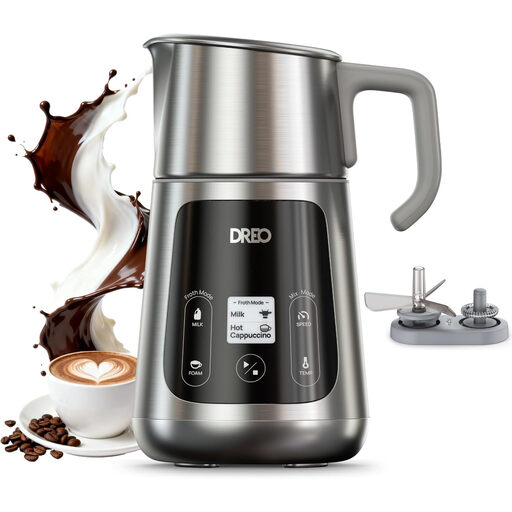
Why it stands out: For those who aim for perfection and want to try their hand at latte art, foam quality is non-negotiable. This model is specifically designed to produce the dense, silky microfoam essential for creating designs on your drinks.
It avoids the "big bubble foam" trap thanks to its specific whisk (Impeller) and dedicated mode. The result: a fine, long-lasting texture, perfect for a milk frother for latte art.
Its four preset modes, including a dedicated microfoam option. The jug, lid, and whisks are top-rack dishwasher-safe.
Why it stands out: Perfect for those who love to vary their drinks (iced coffees, hot chocolates...) and juggle different types of milk. This model offers all the flexibility you need to experiment without limits.
It overcomes the challenge of incompatibility with plant-based milk and a lack of versatility. Its technology and adjustable modes are designed to perform equally well with dairy and plant-based milks, both hot and cold.
Its large capacity (450 ml), its hot and cold milk frother modes, and its proven compatibility with plant-based milks. Its touch control panel simplifies the customisation of every drink.
The profile: You want an excellent coffee, without the fuss. Your priority? A device that gets the job done perfectly with a single button, for a successful cappuccino every morning before you head out.
Look for a model with a stainless steel jug and simple operation, ideally one-touch for hot foam. This will help you avoid the trap of over-engineered devices that are complex to use and clean daily.
Maximum ease of use and minimal maintenance. The goal is performance and reliability, not an avalanche of features you'll never use.
To perfect your coffee corner, we have selected products that meet our strict selection criteria for design and functionality.
Does an electric milk frother work with all plant-based milks? Not always. The ability to froth a plant-based milk depends on its protein content. Oat and soy milks labelled "barista edition" generally yield the best results. To give yourself the best chance of success, opt for a milk frother for plant-based milk whose compatibility is clearly stated, like the DREO milk frother, which has suitable settings.
What's the best way to clean a milk frother? Ideally, rinse it with clean water immediately after use, before the milk dries. For a deep clean, choose models where the jug and accessories are dishwasher-safe. If not, a soft sponge and a little soapy water will do. Never use abrasive sponges, as they will undoubtedly damage the coating.
What's the difference between an induction frother and a mechanical one? A mechanical model has a small motor that directly drives the whisk. It's a simple technology, but it can create hot spots and lead to uneven heating. An induction frother, on the other hand, uses a magnetic field to levitate and spin the whisk. The jug is therefore separate, with no direct electrical connection, which greatly simplifies cleaning and ensures much more even heat distribution.