
Livraison le jour même ou le lendemain

Qualité garantie

Débloquez vos offres de bienvenue: Livraison GRATUITE | Jusqu'à -80 % | 30 jours d'essai gratuits à JoyPlus
Téléchargez l'application
Working from home for several hours, studying or gaming at a fixed desk can quickly become uncomfortable. An electric height-adjustable sit-stand desk lets you switch between sitting and standing positions in seconds, without having to move your screen, keyboard or other accessories.
Product listings, however, don’t always give a realistic picture of day-to-day use. Some details can turn a great idea into an impractical purchase.
A stated maximum load, for example 70 kg, usually refers to a distributed static load. On its own, it doesn’t guarantee the absence of wobble when you have a heavy monitor, a desktop computer and several accessories all grouped on one side.
The frame design, foot adjustment and how you distribute your equipment all play a key role. A 160 × 70 cm desktop offers more surface area, but you need to make sure the floor is level and the feet are properly adjusted.
A 120 × 60 cm desk may be enough for a laptop, one monitor and a keyboard. However, with two screens, documents or a gaming setup, a depth of 60 cm can limit the viewing distance you need.
Before choosing a desk for remote work, a home office desk or an adjustable gaming desk, measure the space you have available. Also think about the area behind the desk, which needs to stay clear while the desktop rises and lowers.
Memory presets are only really useful if they let you easily save and recall the positions you use. Check the number of presets, whether there’s a digital display and how simple the controls are.
A desk with height memory saves you from having to faff around every time you change position. However, this feature doesn’t replace proper adjustment for your chair, your screens and your working posture.
The models shown typically offer a range between 72 and 120 cm, with some variation depending on the reference. This range suits many uses, but check the minimum height with your chair and the maximum height with your arms and screens.
In a smaller space, a 120 × 60 cm desktop keeps the footprint compact. A 140 × 60 cm model offers more comfort without taking up as much room as a large desk. 160 × 70 cm formats are better suited to a dual-monitor setup, a laptop alongside documents or a well-equipped gaming rig.
The technical specifications state a maximum static capacity of 70 kg for the models shown. This figure needs to include the desktop, monitors, monitor arm, desktop computer, speakers and any other items placed on the desk.
It’s better to keep a safety margin than to constantly use the stated limit. Distribute the weight towards the centre and avoid placing heavy equipment on just one edge when the desktop is in the raised position.
An electric height-adjustable desk should raise and lower smoothly. Depending on the model, the products shown advertise quiet operation, obstacle detection or a built-in sensor. These features don’t remove the need to keep the area around the desk clear.
The manuals also mention overheating protection after roughly two minutes of continuous adjustment, followed by an 18-minute waiting period. So avoid running cycles back-to-back without a break. The electrical components must be kept away from liquids, and the desk should only be used indoors.
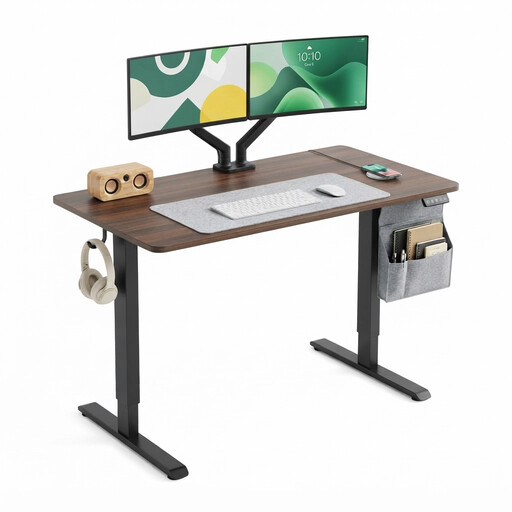
Why this choice suits this profile: Its compact size fits easily into a bedroom, a desk corner or a study space. The digital control panel and two programmable height positions make daily height changes simple.
The dimensions are clearly stated and the 70 kg maximum load makes it easy to check compatibility with your equipment.
Adjustment from 72 to 118 cm, 120 × 60 cm desktop, digital display, two memory presets and two hooks.
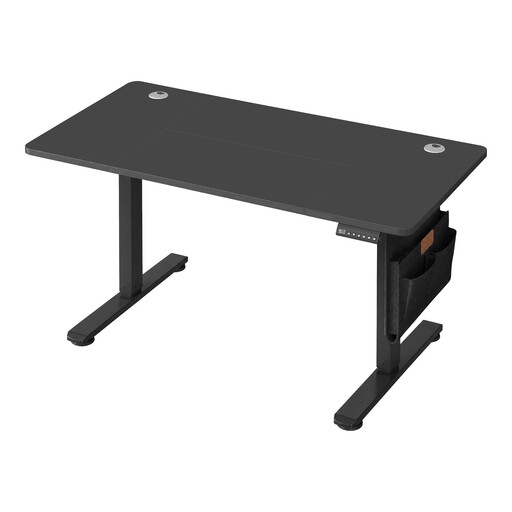
Why this choice suits this profile: Its large desktop is ideal for remote workers who use multiple devices or want to clearly separate their professional workspace from their note-taking area.
The 70 cm depth stops you feeling cramped with multiple screens. The adjustable feet make it easy to level on an uneven floor.
160 × 70 cm desktop, four height memory presets, USB-C port, two cable grommets and a stated static load of 70 kg.
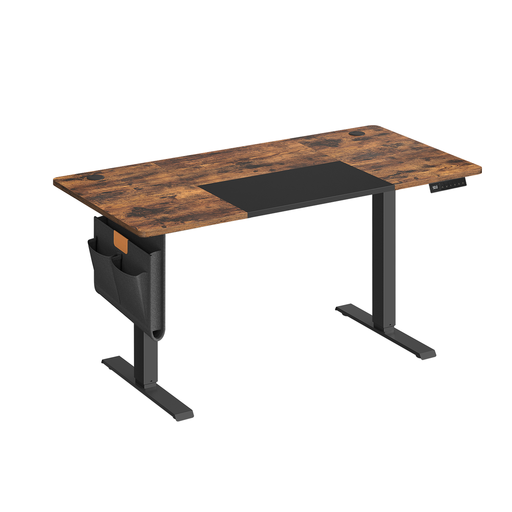
Why this choice suits this profile: It suits users who change their setup often, switch between work and gaming, or want to keep their accessories well organised.
The four presets mean you don’t have to redo the settings every time you change your configuration. The cable grommets, organiser and hooks also reduce visual clutter.
Adjustment from 72 to 120 cm, four memory presets, USB-C port, cable management, storage bag and three hooks.
We’ve put together a complete, real-time updated selection of products that meet these demanding criteria, as well as European safety standards.
To get the most out of an ergonomic sit-stand desk, take a few precautions:
The models shown require assembly. The parts are usually numbered or labelled, and the manuals detail the installation order. For the electrical connections, follow the instructions provided carefully.
The power consumption depends on the motor wattage, how often you adjust it and your electricity supplier’s rate. Without knowing the exact power and usage duration, it’s impossible to give a reliable cost. Since height changes are usually occasional, check the technical specifications and activate the energy-saving mode if one is available.
It all depends on your height, your chair and your equipment. When sitting, your shoulders should stay relaxed and your forearms should rest naturally on the desktop. When standing, adjust the screen so you don’t have to keep looking up. You can then save these two positions in the desk’s memory.
The lifespan depends on the load it carries, how often you move it, the quality of the assembly and how well you maintain it. Stick to the stated static load of 70 kg, avoid prolonged cycles without a break and wait for the overheating protection to reset when it kicks in. A stable floor and regularly tightened fixings also help ensure reliable long-term use.