
Livraison le jour même ou le lendemain

Qualité garantie

Débloquez vos offres de bienvenue: Livraison GRATUITE | Jusqu'à -80 % | 30 jours d'essai gratuits à JoyPlus
Téléchargez l'application
An electric heater can quickly warm up a bedroom, office or living room without the need for major installation work. But between the promises of high power and so-called 'smart' features, product descriptions sometimes gloss over the real limitations of the appliance.
Before you place your order, keep three common pitfalls in mind:
Measured in watts, the power rating gives an indication of the heater's heating capacity. A 1500 W heater is generally suitable for a small to medium-sized room with decent insulation. A 2000 W heater may be better suited to a larger space or one that is difficult to warm up. However, this is only a rough guide – the layout of your home matters just as much.
To help you decide:
An adjustable thermostat reduces running time once the desired temperature is reached. 'Eco' modes can also limit power in certain situations, but they don't guarantee a specific bill – the cost depends mainly on how long you use the heater and your electricity tariff.
The right choice depends on how quickly you need heat and how you use the room.
For everyday use, choose a heater with an adjustable thermostat, a timer and, if useful to you, a remote control. Oscillation helps distribute warm air in several directions. In a bedroom or while working from home, a silent mode can make all the difference.
Here are the features to look for in the specification:
The CE mark indicates that the manufacturer declares the product meets applicable European requirements. It does not, however, replace the need to read the instruction manual. Never cover the appliance, do not place it near curtains or bedding, and avoid extension leads and multi-socket adaptors with high-power models unless the manufacturer explicitly says otherwise.
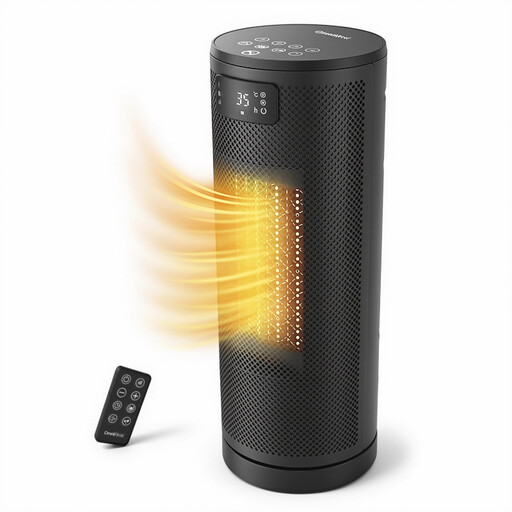
Why this choice suits this profile: This ceramic fan heater combines several handy controls in a compact format, ideal for a bedroom, office or small living room.
The description lists four modes, including an ECO mode, plus an adjustable thermostat from 5 to 35 °C. This lets you tailor operation to your needs rather than leaving the appliance running constantly at 1800 W.
Remote control, oscillation, 24-hour timer, overheat protection and tip-over shut-off are all included.
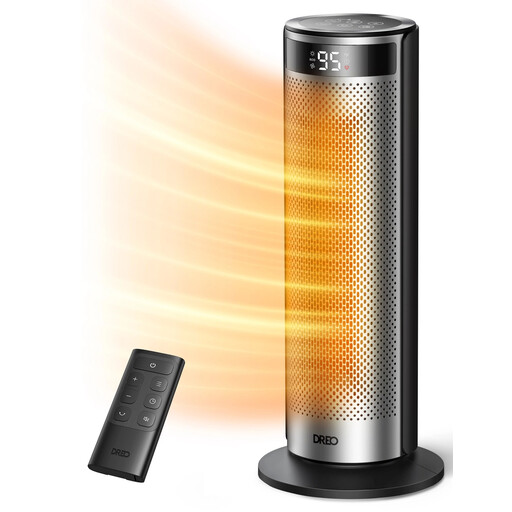
Why this choice suits this profile: Its precise settings and stated noise level of between 25 and 42 dB should suit homeworkers and anyone particularly sensitive to noise.
The 2000 W power comes with an adjustable thermostat from 5 to 35 °C and an adaptive control system as claimed by the brand. It's up to you to use them according to the room and heating duration.
The specification mentions 70° oscillation, a 12-hour timer, child lock, tip-over shut-off and overheat protection.
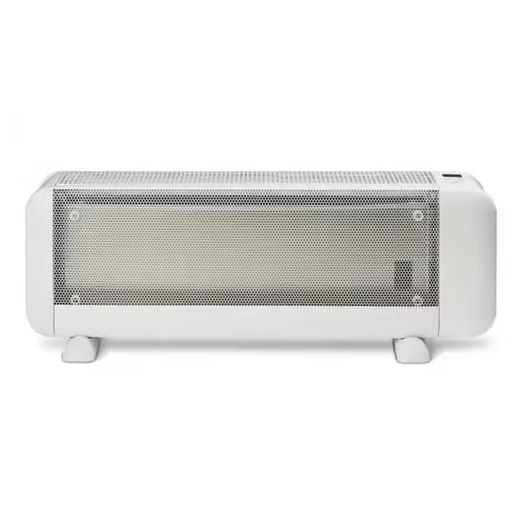
Why this choice suits this profile: This radiant panel heater is aimed at those who prefer fan-free heat distribution in an office, bedroom or living room.
Its two power levels, 750 W and 1500 W, prevent it from always running at full power. The electronic thermostat allows more precise, gradual adjustment.
Timer from 1 to 12 hours, frost protection mode, carry handles, tip-over protection and overheat protection.
We've selected a comprehensive, real-time updated list of products that meet these demanding criteria as well as European safety regulations.
No single technology guarantees minimal consumption on its own. At the same power rating, electricity consumption depends mainly on how long the heater runs. A thermostat, timer and ECO mode can help avoid unnecessary heating, especially in a well-insulated room.
For a small bedroom, a 1000 to 1500 W appliance may be suitable, depending on insulation and the temperature you want. Take the room dimensions, check the product specification and choose a model with an adjustable thermostat rather than relying solely on the stated room size.
It's best to limit overnight use and follow the instructions in the manual carefully. If the appliance has a timer, keep it away from all fabrics, check it has overheat protection and tip-over shut-off, and never cover it.