
Same-day & Next-day Delivery

Quality Guaranteed

Unlock Your Welcome Offers: FREE Delivery | Up to 80% OFF | Free 30-day JoyPlus trial
Download the APP
An electric grill lets you cook meat, fish, vegetables, paninis, crêpes or raclette without having to fire up a traditional barbecue. Yet buying one can quickly turn into a disappointment if you rely solely on the wattage displayed or a promising list of features.
Before you place an order, it's worth looking at the actual cooking surface, the precision of the temperature control and how easy it is to clean. Here are the most common pitfalls, along with a selection of models suited to different needs.
High wattage speeds up the heating time, but it tells you nothing about how many portions the appliance can hold. A small 800 W contact grill will suit a single person or a couple, whereas a large electric plancha measuring 43 × 35 cm will be far more comfortable for a family meal.
So power should be compared to the cooking surface, not looked at in isolation. For several diners, a plate measuring 49 × 27 cm or larger will help you avoid cooking in multiple batches.
A multifunction grill with several plates can replace a toastie maker, a panini press, a plancha and sometimes even a waffle iron. But when the plates aren't removable, food residue and grease splatters quickly become difficult to shift.
Check for removable plates, a grease collection tray and, where the manufacturer states it, dishwasher compatibility. The heating element and electrical connections must never be immersed, of course.
Not all appliances are designed to be used outdoors. Some are intended for the kitchen only, while others can be used both indoors and outdoors. In the latter case, they still need to be kept out of rain and damp, on a stable, heat-resistant surface.
For a tabletop grill used every day, a surface of around 28 × 22 cm is enough for individual portions or a meal for two. A plate measuring 43 × 35 cm or 50 × 25 cm offers more comfort for a family.
Very long models, such as those measuring 100 × 23 cm, are designed for sociable meals around a large table. However, they do require storage and installation space to match their dimensions.
An adjustable thermostat lets you tailor the temperature to each food: moderate heat for vegetables or eggs, a higher temperature for searing meat. A pilot light or preheat indicator also makes daily use easier.
Some appliances have two independent thermostats so you can set each plate separately. Handy for cooking different foods at the same time, this feature usually comes with a bulkier, heavier appliance.
A non-stick plate makes it easier to release food and often allows you to cook without oil, or with a reduced amount, depending on the recipe. Use wooden, silicone or heat-resistant plastic utensils to avoid scratching the coating.
A removable grease collection tray prevents drips on your worktop. To clean the appliance, wait until it has completely cooled down, unplug it and remove only the parts designed for that purpose. The instruction manual will tell you whether they can go in the dishwasher.
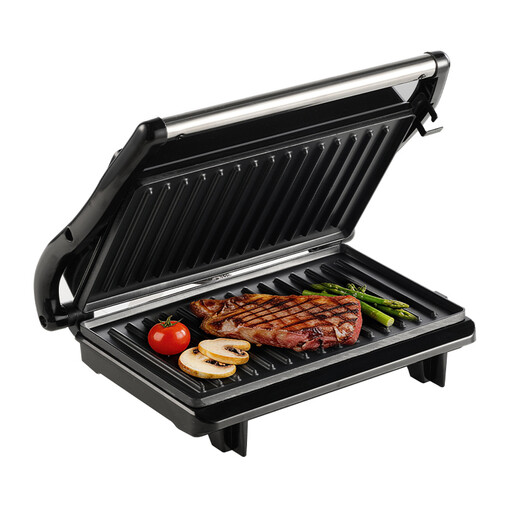
Why this choice suits this profile: Its compact size and 22.5 × 14 cm plates are ideal for small kitchens, students and quick meals. It works as a grill, a toastie maker and a panini press all in one.
Its 800 W are consistent with its small size: it doesn't claim to replace a large family plancha.
Dual heating, non-stick coating and simple operation for sandwiches and small portions.
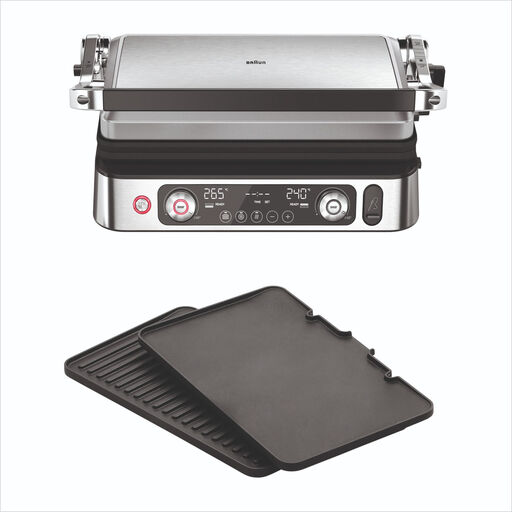
Why this choice suits this profile: With its 2,200 W, three cooking positions, two independent thermostats and temperature probe, this model is aimed at those who want precise control over their cooking.
The different uses are clearly defined: contact grilling, flat open cooking or oven position. So the versatility isn't just a marketing promise.
Plates and drip tray are dishwasher-safe, 2,200 W power and a temperature that can reach 265 °C with the searing function.
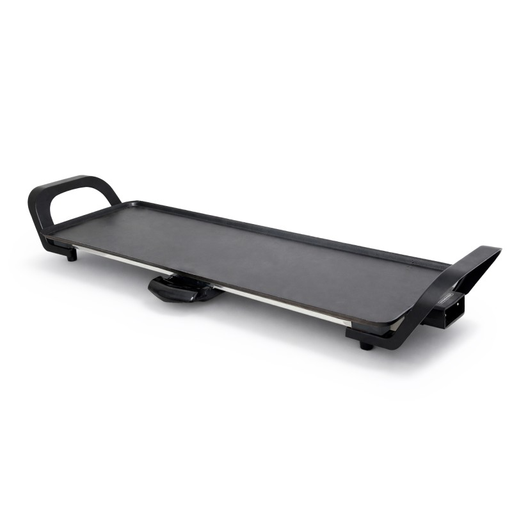
Why this choice suits this profile: Its 100 × 23 cm surface is designed for large gatherings and meals where several foods are cooked at the same time.
The stated capacity, up to 10 people, is backed by a size that's easy to verify. The thermostat also offers five levels.
Non-stick plate, removable grease tray and insulated handles make serving at the table more convenient.
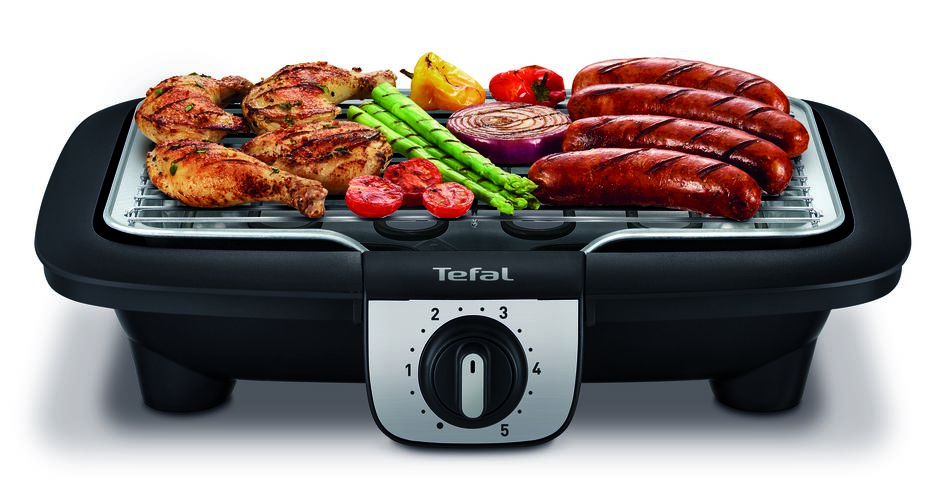
Why this choice suits this profile: This 2,100 W electric barbecue switches between a grill and a plancha plate. It can be used indoors and outdoors, under the conditions specified by the manufacturer.
The two surfaces are distinct and their dimensions are specified: 735 cm² with the grill and 680 cm² with the plancha.
Five-position thermostat, removable parts that are dishwasher-safe and a water tray designed to reduce smoke and odours.
We've put together a comprehensive, real-time selection of products that meet these demanding criteria, while complying with European safety regulations.
Yes, provided the model is designed for that purpose. Place it on a flat, dry, heat-resistant surface, leaving enough space around the appliance. Good ventilation is essential, especially when cooking fatty foods. An appliance marked "indoor use only" must not be used on a patio exposed to damp.
For a small sandwich maker or single-person use, 800 W may be enough. To cook several portions more quickly, a power rating between 1,800 and 2,800 W generally corresponds to larger formats. The cooking surface, heat distribution and thermostat quality matter at least as much as the number of watts.
The cost depends on the appliance's wattage, the preheat time and the cooking time. A 2,000 W model used for 30 minutes theoretically consumes 1 kWh, before applying the rate under your electricity contract. To reduce consumption, prepare your food in advance, avoid unnecessarily long preheating, then switch off and unplug the appliance as soon as you've finished.