
Livraison le jour même ou le lendemain

Qualité garantie

Débloquez vos offres de bienvenue: Livraison GRATUITE | Jusqu'à -80 % | 30 jours d'essai gratuits à JoyPlus
Téléchargez l'application
An electric fan heater can quickly warm up a bedroom, office or living room without the need for fixed installation. But not all models are created equal, and they don't all meet the same needs. High power doesn't guarantee quiet operation, while a model marketed as economical can quickly become expensive if it lacks a thermostat or multiple power settings.
Before you buy, it's worth looking at the truly useful technical features, the safety devices and whether the heater's power matches the size of your room.
A 2000 W electric heater generally heats up faster than a 1500 W model, but it also uses more electricity when running at full power. The final consumption depends mainly on how long you use it, your home's insulation, the temperature you set and the quality of the temperature control.
For a supplementary heater used for a few hours, multiple power levels, a thermostat and a timer help avoid unnecessary heating periods. A power of 1500 W can suit a room of 10 to 20 m², while a 2000 W model will be more comfortable in 15 to 25 m², depending on insulation and ceiling height.
Claims like "silent" or "quiet" are no substitute for a decibel measurement. For a bedroom or office, check the noise level stated by the manufacturer. DC motors and PTC ceramic heating elements can help reduce noise, but the airflow itself will usually still be audible.
A quiet fan heater should also provide steady airflow without excessive vibration. Where you place the heater, any dust build-up and the surface it sits on all affect the acoustic comfort too.
Never place a heater against a curtain, under furniture or near fabrics. Its air intakes and outlets must remain completely clear. Overheat protection and a tip-over switch are essential features to check before buying.
An IPX1 rating, like the one stated for the SUPRA model featured below, means limited protection against vertically falling water droplets. It does not mean the appliance can be sprayed or immersed. In a bathroom, always follow the safety distances and zones given in the manual and required by your home's electrical installation.
The coverage area stated on a product page is indicative only: it is not a guarantee that works in every situation. A poorly insulated room, large windows or low outdoor temperatures can significantly increase the heating time.
The thermostat matters just as much as the power. It stops the heating element from running at maximum all the time.
A PTC ceramic fan heater uses a heating element with a positive temperature coefficient. Its electrical resistance changes with temperature, which helps regulate the heat. In practice, focus on the following points:
The PTC label does not mean you can skip checking the safety features, the manual and the certifications listed on the product page.
A remote control lets you adjust the heater from the sofa or bed. A 12-hour timer can be handy for scheduling operation, but it shouldn't encourage you to leave the heater unattended. Oscillation, for example over 70°, distributes the airflow better around the room, while a flat or compact design is easier to store.
To keep your bills down, use the heater as a supplementary source, with a sensible temperature and a controlled running time. No electric heater produces heat without using electricity: savings come down to how you manage it and your usage habits.
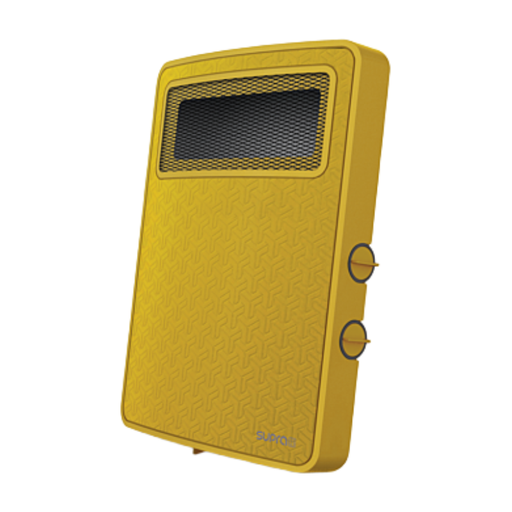
Why this choice suits this profile: its two heat settings of 1000 W and 2000 W let you start gently and save the maximum power for the coldest periods.
The power isn't fixed: the mechanical thermostat and two settings stop you from always using the full 2000 W.
Ultra-slim design, washable filter, tip-over switch, overheat protection and frost-protection mode.
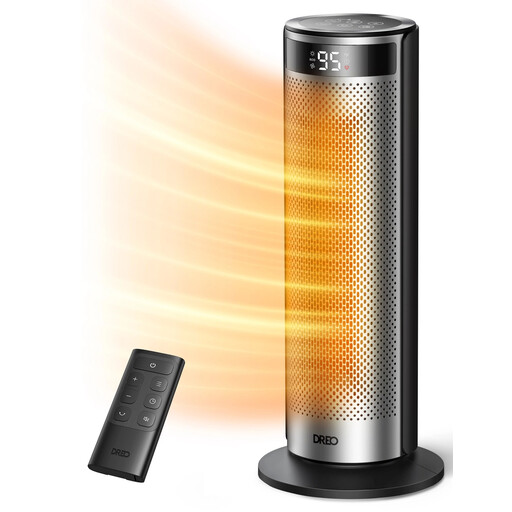
Why this choice suits this profile: it combines a remote control, timer, oscillation and an adjustable thermostat from 5 to 35 °C for more precise control in a room of 15 to 25 m².
The product page states a noise level of 25 to 42 dB and several safety features, rather than just a vague promise of silence.
PTC element measuring 250 × 44 mm, 70° oscillation, 12-hour timer and CE certification stated.
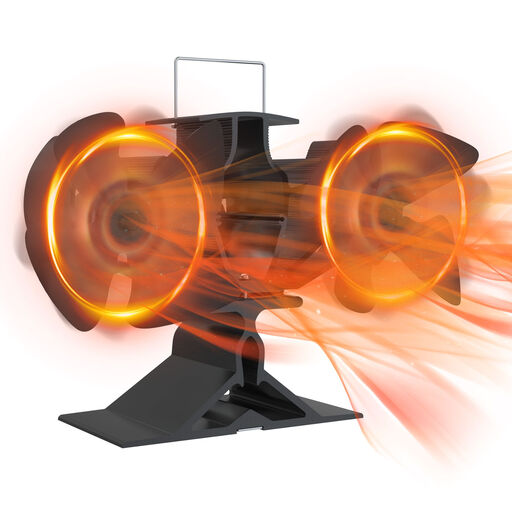
Why this choice suits this profile: this accessory is for homes with a wood-burning stove or fireplace that want to distribute warm air better, without adding an electrical connection.
Be careful not to confuse it with an electric fan heater: it works using the heat from the stove and does not replace a standalone appliance.
Operates without electricity and designed for stoves, fireplaces and warm air distribution.
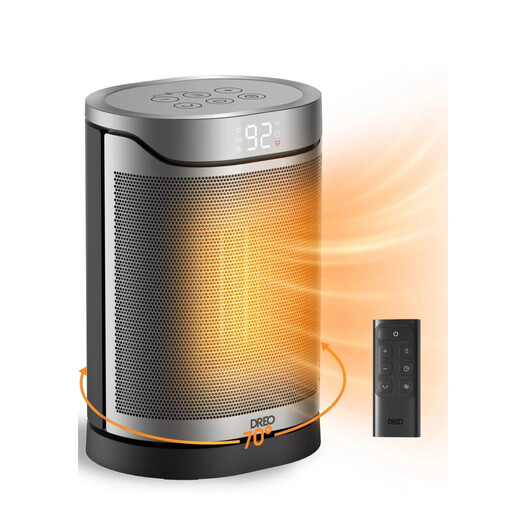
Why this choice suits this profile: its compact design, adjustable thermostat from 5 to 35 °C and stated noise level of 25 to 42 dB make it suitable for a room of 10 to 20 m².
The product page provides a measured noise range and several power levels — 900, 1300 and 1500 W — which is more concrete than a simple marketing claim.
70° oscillation, remote control, 12-hour timer, tip-over switch and overheat protection stated.
We have put together a comprehensive, real-time updated selection of products that meet these strict criteria, as well as European safety requirements.
A 1500 W appliance uses 1.5 kWh per hour when running at full power. Under the same conditions, a 2000 W model uses 2 kWh. The cost then depends on your electricity tariff and how long you use it. A thermostat, a lower power setting and a timer can help limit the running time.
It's best to follow the manual carefully and not leave the appliance running unattended. Keep it away from fabrics, never cover its grilles and place it on a stable surface. Tip-over and overheat protection reduce some risks, but they don't replace careful use.
A fireplace fan or a stove fan without electricity uses the heat produced by the stove to help circulate warm air. An electric fan heater generates its own heat using a heating element, often PTC ceramic. The first complements a wood-burning appliance; the second is used as a standalone supplementary heater.