
Livraison le jour même ou le lendemain

Qualité garantie

Débloquez vos offres de bienvenue: Livraison GRATUITE | Jusqu'à -80 % | 30 jours d'essai gratuits à JoyPlus
Téléchargez l'application
Whether you're heading out for a long camping weekend, spending the day at the beach, or outfitting your work van, one thing is certain: keeping food and drinks cool is non-negotiable. The electric cooler market is a real jungle where it's easy to get lost between marketing promises and technical reality. One wrong choice guarantees disappointment: lukewarm drinks, spoiled food, and in the worst-case scenario, a dead car battery. To avoid these setbacks, let's review the pitfalls to avoid and the criteria that truly matter.
The initial excitement of a purchase can quickly fade if you overlook a few crucial technical details. Here are the two most common mistakes:
To see things more clearly and make the right choice, three fundamental criteria should guide your decision.
This is the most important criterion. It determines the performance, price, and intended use of your device.
The power source defines where and how you can use your cooler.
The volume, expressed in litres, should match your actual needs.
Rather than an endless list, here are options that meet specific needs, taking into account the criteria we've just discussed.
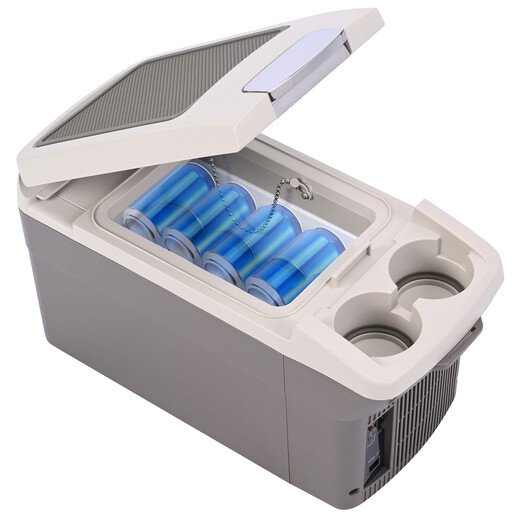
Why this model? Perfect for keeping a lunch and drinks cool during daily commutes or an impromptu outing. Its compact size fits easily on a passenger seat, and its carrying strap makes it convenient for picnics.
This thermoelectric model is upfront about its purpose: it's made to maintain coolness, not to freeze. Its use case is therefore perfectly targeted, which avoids the disappointment of expecting performance it can't deliver.
Its dual hot/cold function and compatibility with a 220V adapter (sold separately) make it versatile for use in the office as well as in the car.
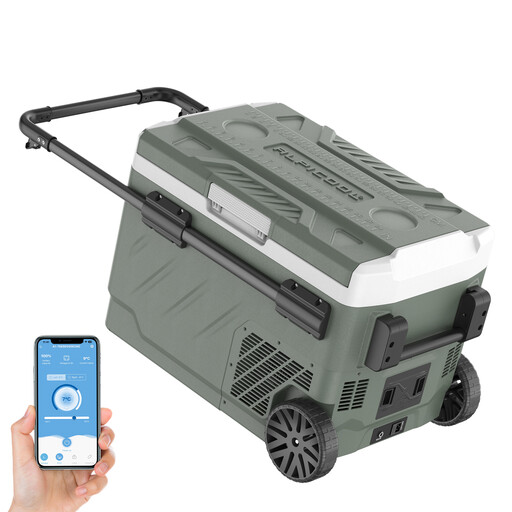
Why this model? For those going away for several days, its 40L capacity, compressor technology, and two independent temperature zones are major assets. It allows you to freeze meat on one side and keep drinks cool on the other.
It sidesteps both main pitfalls: its compressor technology ensures powerful and consistent cooling, and its 3-stage battery protection system prevents any nasty surprises when starting the vehicle.
Remote management via a smartphone app, wheels and a telescopic handle for easy transport, and the included 12V/24V and 220V adapters make it a complete, out-of-the-box solution.
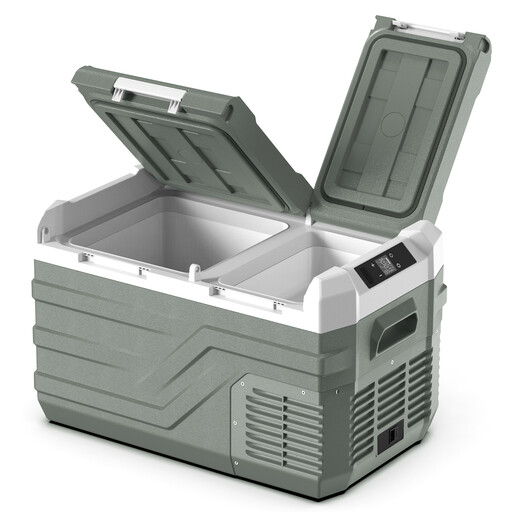
Why this model? Built for performance and reliability, this truck fridge or RV cooler is a true workhorse. Its robust design, efficient compressor, and dual-zone with dual-door access make it a pragmatic choice for those who live on the road.
Its compressor technology is designed for low power consumption (ECO mode) and stable performance, while battery protection is a prerequisite for intensive professional use, ensuring vehicle reliability.
The clever dual-door design allows for easy access even in a confined space like a truck cab. The built-in USB port is a welcome bonus for charging a device when needed.
Our selection doesn't stop here. Discover other models that meet our rigorous selection criteria and current safety standards.
Yes, this is a real risk, especially with models that lack a protection system. A thermoelectric cooler can continuously draw between 40 and 60 watts. A compressor cooler, while more powerful at startup, only runs in cycles and consumes less over a 24-hour period. To avoid this problem, you must choose a model with multi-level battery protection. This feature cuts power to the cooler before the battery voltage drops below the critical threshold for starting the engine.
The difference is fundamental. A thermoelectric cooler cools the internal air by a fixed amount relative to the outside (e.g., -20°C compared to ambient). Its performance therefore drops drastically when it's very hot. A compressor cooler works like a real refrigerator: you set a target temperature (e.g., 4°C), and the compressor activates to reach and maintain it, regardless of the outside temperature. It can even freeze.
Only compressor coolers can function as a portable freezer. They are capable of reaching sub-zero temperatures, typically down to -18°C or -20°C, which is sufficient for freezing food and keeping frozen goods. Thermoelectric models can under no circumstances freeze; they only cool things down. Always check the temperature range specified by the manufacturer.