
Livraison le jour même ou le lendemain

Qualité garantie

Débloquez vos offres de bienvenue: Livraison GRATUITE | Jusqu'à -80 % | 30 jours d'essai gratuits à JoyPlus
Téléchargez l'application
Whether for a van road trip, a day of fishing, or simply keeping drinks cold during long summer drives, the electric car cooler has established itself as an all-but-essential accessory. The problem is, the market is flooded with models making tempting promises that often hide deal-breaking flaws. Before you pull out your credit card, it's crucial to know how to navigate the marketing pitfalls to find the perfect model that will truly meet your needs.
Buying an electric cooler can quickly turn into a nightmare if you only judge by appearances. Here are the most common mistakes that end up costing you dearly (in both money and frustration).
This is the number one trap. Most entry-level models rely on thermoelectric technology (or the Peltier effect). Often marketed as "mini-fridges," their performance is actually very limited: they can only lower the temperature by 15 to 20°C relative to the ambient air.
What does this mean in practice? On a 35°C summer day inside your car, your cooler will struggle to get below 15°C. The result: your drinks will be lukewarm, and storing sensitive foods (meat, dairy) will be simply impossible. It's not a portable refrigerator, but a simple cooler.
Displaying a large litre number on the packaging is an easy selling point. But be warned, an advertised capacity of 30 litres doesn't guarantee you can fit everything you want inside. A bulky motor, overly thick walls, or poorly designed dividers can drastically reduce the usable space and make it impractical for tall bottles or containers.
The nightmare scenario: you wake up, ready to hit the road, and... the car won't start. This is the risk you run with a cooler that lacks a battery protection system. A low-end model, plugged into the cigarette lighter with the engine off, can drain your battery in a few hours and leave you stranded.
To ensure cool refreshments and peace of mind, focus on these three key points before making your choice.
This is THE deciding factor. Unlike thermoelectric models, a compressor cooler works exactly like your kitchen refrigerator.
Simply put: if you want to do more than keep a few cans cool for a picnic, a compressor model is the only serious choice for a 12v campervan fridge or a van fridge.
A good portable refrigerator must be a true chameleon. Check the power options:
The second, non-negotiable point to check is vehicle battery protection. A system adjustable to three levels (High, Medium, Low) is the standard today. It automatically cuts power to the cooler before the battery voltage drops to a critical level, ensuring you can always start your engine.
Beyond the gross volume in litres, scrutinise the internal layout.
Some models, like those from the Alpicool brand, offer features that are game-changers on the road:
Rather than an endless list, we've matched specific models to clear user profiles. All of them meet our criteria for performance and reliability.
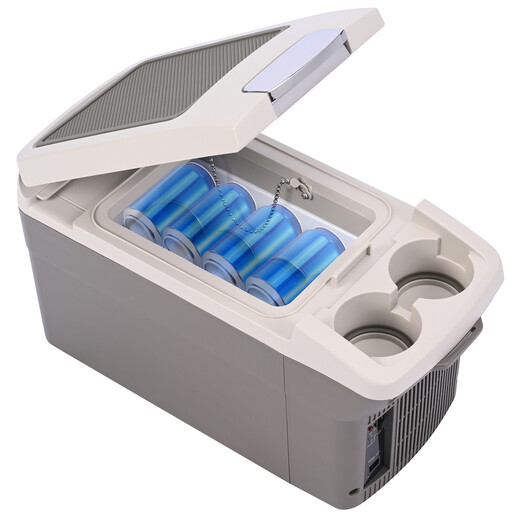
Why this model: Perfect for keeping a meal warm or a few drinks cool for a drive or a picnic. Its ultra-compact design and carrying strap make it very convenient for occasional use.
This thermoelectric model is refreshingly honest: it's sold as a supplementary cooler, not a fridge. It doesn't overpromise, thus avoiding the disappointment of its necessarily limited cooling performance.
Dual warm/cool function and an ultra-compact design, ideal for fitting on a passenger seat. Quiet operation.
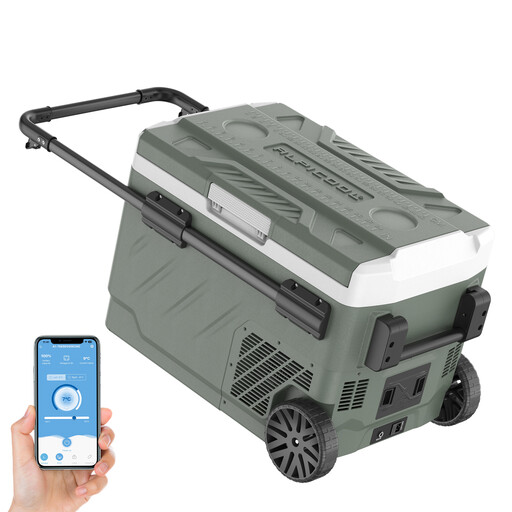
Why this model: This is the all-in-one solution for nomads. Its 40L capacity, dual-zone functionality, and compressor technology make it a true van fridge, capable of keeping frozen goods and fresh produce preserved for several days, completely off-grid.
It features a high-performance compressor (-20°C to 20°C) and 3-stage battery protection. It ticks both essential safety boxes: effective refrigeration and no chance of a dead battery.
Independent dual-zone for refrigerating and freezing simultaneously. App control, telescopic handle, and wheels for perfect portability.

Why this model: With its XXL 55-litre volume, this model is for those who don't want to compromise on space. Perfect for large families on long trips or road professionals aiming for food self-sufficiency.
Its generous volume is genuine and perfectly optimised. The compressor technology ensures reliable freezing (down to -20°C), and the ECO mode manages power consumption to avoid draining the battery, even during long stops.
XXL Capacity (55L) for maximum self-sufficiency. Compatible with multiple power sources (including solar panels) and can be remotely controlled via its Bluetooth app.
We've curated a complete selection of models that meet our performance and safety criteria.
Yes, provided the model is equipped with a battery protection system. Simply set it to the "High" (H) or "Medium" (M) level, and the cooler will automatically shut off long before the vehicle's battery reaches a critical level for restarting. This is THE essential safety feature to help you rest easy.
It depends on the size, insulation, and chosen temperature. A 40-50 litre model in ECO mode consumes an average of 45 to 60 watts, but only when the compressor is running. Since it doesn't run continuously, the actual consumption over 24 hours remains very reasonable, especially if the insulation is high quality.
It can be a budget-friendly option if your one and only need is to keep drinks and sandwiches cool for a short trip. However, don't count on it to preserve perishable goods, reach a truly low temperature in high heat, or for use over several days. For any even remotely serious nomadic use, compressor technology remains the only gold standard.