
Livraison le jour même ou le lendemain

Qualité garantie

Débloquez vos offres de bienvenue: Livraison GRATUITE | Jusqu'à -80 % | 30 jours d'essai gratuits à JoyPlus
Téléchargez l'application
For long holiday road trips, camping weekends, or simply keeping drinks chilled at the office, the electric cooler seems like a game-changer. Yet, disappointment is often just around the corner: the unit doesn't cool enough, it drains the car battery, or it gives out after just a few uses. To save you from a bad surprise, our editorial team has broken down the classic pitfalls and the technical criteria you should never underestimate.
Marketing can often be misleading. Before you pull out your credit card, keep an eye on these three points that separate a successful purchase from a bitter regret.
To make the right choice, focus on these technical specifications. They will determine whether a model is truly suited to your needs.
This is THE number one criterion.
Flexibility is king. A 12V/230V cooler model offers you the best of both worlds:
The advertised volume in litres can be misleading. Instead, rely on the internal dimensions and layout. A 6-litre mini-fridge will hold 8 cans but won't fit a 1.5-litre bottle. For a family-sized camping cooler, aim for at least 20 litres. Don't forget to measure the external footprint: the unit must be able to fit in your trunk or between two seats.
Rather than a simple list of features, we've matched specific models to user profiles. The goal: to help you envision your needs and find the model that's truly right for you.
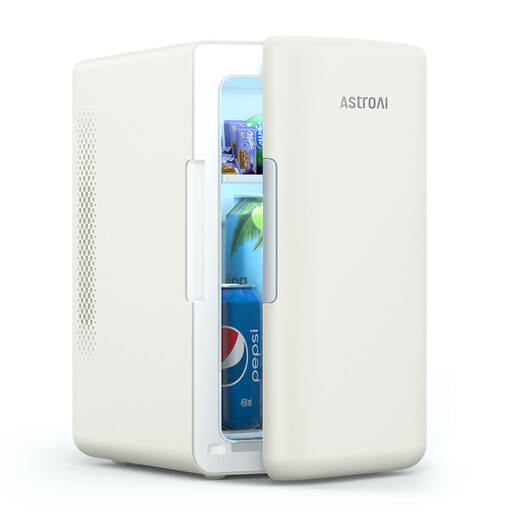
The ideal user: Perfect for keeping a few drinks cool at the office, snacks in a dorm room, or storing beauty products. Its compact size and dual power (12V/230V) make it an ultra-versatile ally for daily life and short trips.
This model is upfront about its capabilities: it's a thermoelectric cooler/warmer. Expectations are clear: it keeps things cool (down to 18-22 °C below ambient temperature) but doesn't freeze. No risk of being disappointed with its performance.
Power Versatility: Comes with both cables (230V AC and 12V cigarette lighter) for immediate use at home or in the car. Smart Design: Secure door latch and a small tray to collect condensation.
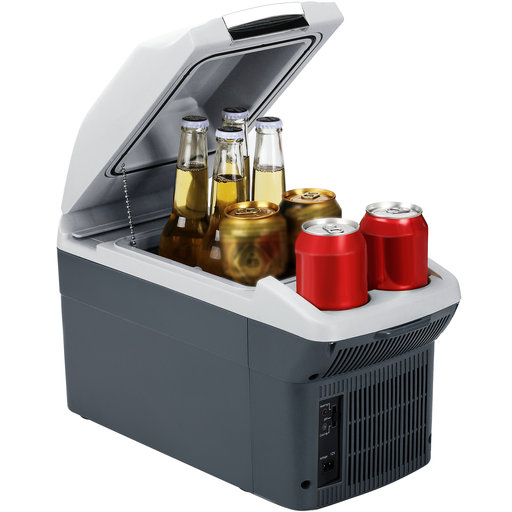
The ideal user: Specifically designed for the car cabin, it fits on a seat and can even double as an armrest. Its 9L volume is perfect for long drives, professional drivers, or small families on the go.
Its form factor is optimized for the car, solving the problem of bulky coolers that you never know where to put. Designed primarily for 12V use, its role as a road trip companion is crystal clear.
Space Optimization: The two integrated cup holders are a real bonus on the road. Easy to Carry: Its adjustable strap allows you to take it effortlessly for an impromptu picnic.

The ideal user: For those who refuse to compromise. Van or RV owners, fishing enthusiasts, or families heading out on long holidays, this compressor model provides proper refrigeration and freezing, no matter the weather.
Its compressor technology shatters the main limitation of thermoelectric models: it actively cools down to -18 °C, even in a heatwave. It also includes battery protection to prevent starting issues.
True Freezing: This is a genuine portable freezer. Generous Capacity: Its 22 litres can store provisions for several days. Dual Power: Compatible with 12V/24V (DC) and 100-240V (AC).
We have compiled a complete and up-to-date selection of products that meet our selection criteria and current safety standards.
Yes, absolutely, if it remains plugged in for a long time with the engine off. Thermoelectric models are particularly power-hungry. To eliminate this risk, opt for a compressor cooler equipped with multi-level battery protection. This safety feature cuts power to the cooler if the battery voltage drops too low, ensuring you can start your car without any issues.
The difference is huge. A thermoelectric cooler simply cools relative to the ambient temperature (usually 15 to 20?°C lower). It's effective for keeping drinks cool in mild weather. In contrast, a compressor cooler is a real fridge: it reaches and maintains the temperature you set (e.g., 4?°C, or even -18?°C), whether it's 20?°C or 40?°C outside.
Only with a compressor model. They are the only ones capable of producing the sub-zero temperatures required for freezing. A thermoelectric cooler is not designed for this; at best, it can keep an already frozen product frozen for a few hours, but it can never freeze fresh food.