
Livraison le jour même ou le lendemain

Qualité garantie

Débloquez vos offres de bienvenue: Livraison GRATUITE | Jusqu'à -80 % | 30 jours d'essai gratuits à JoyPlus
Téléchargez l'application
Grinding your beans just before making coffee fits easily into a daily routine, whether at home or in the office. But you still need to choose an electric coffee grinder that suits your brewing method, the quantity you want and the space you have available.
With machines marketed as all-purpose, settings that aren't very intuitive and models where the mechanism isn't clearly stated, there are plenty of pitfalls to watch out for. Here are the criteria to consider to avoid an impractical purchase.
A coffee grinder offering 30 settings gives you more positions than a model limited to 14. But this number alone isn't enough to judge its precision or ease of use. You also need to check that the range covers your everyday needs: fine grind for espresso, medium for filter coffee and coarser for a cafetière.
A large number of positions can even make the choice more complicated when no clear markings are provided. In daily use, a legible scale and a setting that's easy to find again are often more practical than a multitude of clicks that are hard to replicate.
A compact, stylish grinder might seem ideal in a small kitchen. However, the actual space needed also includes the hopper, the cable and the area for handling it. So check its dimensions, its capacity and the amount of coffee you usually make.
A machine designed for two to twelve cups won't meet the same needs as a model made for a single cup. In a small office, capacity and ease of filling can quickly become decisive factors.
A pepper, salt or spice grinder isn't automatically suitable for coffee beans. The mechanism, the chamber volume and the motor design can be very different. The Pepper Mill Lotus Wood, for example, uses a ceramic mechanism and a stainless steel button for dry spices, but its product page doesn't list it as suitable for grinding coffee.
To preserve the aromas and avoid flavour cross-contamination, choose a machine explicitly designed as a coffee grinder for the home.
Conical burrs consist of two cone-shaped elements that crush the beans. This mechanism is common on grinders intended for domestic use and can be paired with several grind levels. The CHEFFANO BG710, for example, is listed with conical burrs and 30 settings.
Flat burrs, on the other hand, rely on two parallel surfaces. The Ollygrin BG705 model is listed with this type of mechanism and 14 settings. This difference is worth considering, but it alone isn't enough to determine which machine will suit everyone.
The adjustment needs to be consistent with your equipment and your brewing method:
However, the information on the product page should be cross-referenced with the manual and the markings on the grinder itself. The ideal setting also depends on the type of beans, the dose and the brew method.
For regular use, look at the hopper capacity, the button operation and how easy it is to collect the ground coffee. A compact model may be enough for one person, while a larger hopper will be better suited to several cups or a shared workspace.
Maintenance should stay simple: remove any coffee residue following the manufacturer's instructions and keep water away from the electrical parts. Don't use a coffee grinder for ingredients it isn't intended for, such as spices, unless the manual clearly allows it.
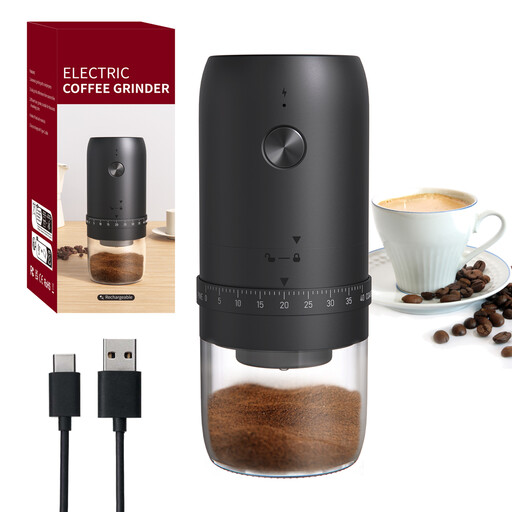
Why this choice suits this profile: This black electric grinder offers a simple way to start grinding your beans at home, when the detailed technical specifications aren't your first decision-making criterion.
It is listed as a dedicated coffee grinder, which avoids misusing a spice grinder for coffee beans. Check the manual for the settings and capacity before ordering.
An electric format with a black finish. The product page also provides information on the manufacturer's compliance and the responsible person within the European Union.
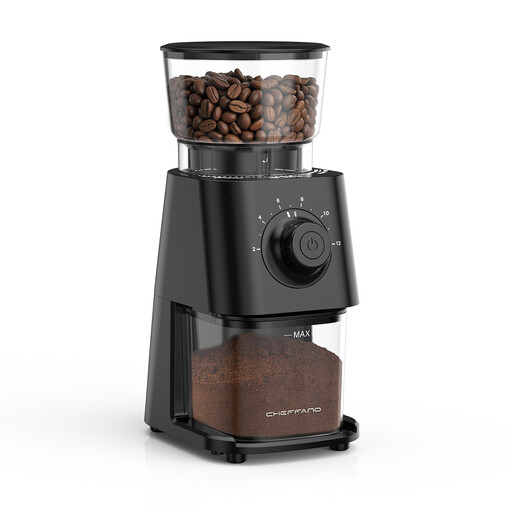
Why this choice suits this profile: Users who switch between espresso, filter coffee and a cafetière will be able to make the most of its 30 advertised positions and conical burrs.
Its scale allows you to refine the grind gradually, rather than having to choose between a fine and a coarse setting. You will still need to adjust the setting depending on the beans and the method used.
Conical burrs, 30 settings, one-touch operation and a pulse function are listed in the description.
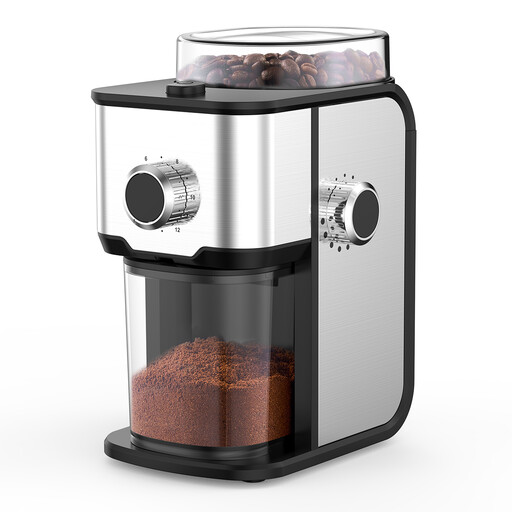
Why this choice suits this profile: Its advertised capacity of 2 to 12 cups makes it suitable for both a single serving and serving several people at home or in the office.
The quantity indications reduce the risk of choosing a machine that's too limited for shared use. Its 14 settings also allow you to move from a fine to a coarse grind.
Flat burrs, 14 settings, one-touch operation and a compact format are mentioned on the product page.
We've put together a comprehensive, real-time updated selection of products that meet these demanding criteria and European safety regulations.
Start by measuring the quantity that matches your brew and avoid leaving the beans exposed to air for too long. Once you get a grind you're happy with, make a note of the setting you used: this habit makes it easier to achieve the same result again.
After each use, remove any visible particles and clean the hopper according to the instructions. Never immerse an electrical appliance. If your model has burrs, check the manual to see whether partial disassembly is allowed and how often it should be done.
Go for a model with a wide enough adjustment range to cover both fine and coarse grinds. The CHEFFANO BG710 advertises 30 settings, compared to 14 for the Ollygrin BG705. The choice will depend on the precision you're after, how often you switch methods and the capacity you need.
The electricity consumption depends on the power and the running time, but grinding a dose of coffee usually only takes a few seconds. The cost of use mainly includes electricity, maintenance and the eventual replacement of parts specified by the manufacturer. Battery-operated grinders, like some designed for salt and pepper, aren't necessarily suitable for coffee beans.
It depends on the mechanism, the volume of coffee ground, the maintenance and how well you follow the usage instructions. Avoid overloading it, only use suitable beans and keep the appliance in a dry place. Before buying, check the information on spare parts, the warranty and the after-sales service available on the product page.