
Livraison le jour même ou le lendemain

Qualité garantie

Débloquez vos offres de bienvenue: Livraison GRATUITE | Jusqu'à -80 % | 30 jours d'essai gratuits à JoyPlus
Téléchargez l'application
An electric coffee grinder can make your daily coffee routine much simpler, but not all models are created equal depending on how you plan to use them. Espresso, filter coffee, moka pot or French press all require different grind sizes. A machine that looks great on paper can quickly disappoint if its settings are too limited, if its container retains too much ground coffee, or if the motor overheats after several uses.
Before you head to the checkout, it’s worth separating the genuinely useful features from the marketing claims that can be hard to verify.
A grinder with a high number of positions isn’t necessarily more precise. The real question is whether those settings cover your needs and allow you to move gradually from a fine grind to a coarse one.
For espresso, even a tiny variation can alter the extraction flow. With a French press, a grind that’s too fine will leave more particles in your cup. A good model should therefore offer a consistent and usable range, rather than just a high number of clicks that are marketed on their own.
Burrs crush the beans between two surfaces, whereas blade mechanisms chop them less evenly. If you want to switch between several extraction methods, a burr coffee grinder is generally the most sensible choice.
Conical burrs are often found in compact and portable machines. Flat burrs also work very well for home use, as seen on the Ollygrin BG705. In both cases, check the material, the diameter if it’s stated, and how easy it is to access the grinding chamber for cleaning.
A large capacity isn’t always an advantage. A big hopper can be handy for serving several people, but the beans may sit there for longer. On the other hand, a small container encourages a fresh brew every time.
The amount of residual coffee grounds, static electricity and access to the burrs also affect day-to-day convenience. A machine that’s a pain to clean can quickly lose its appeal after a few weeks of use.
For an espresso coffee grinder, go for a fine and stable setting. For filter coffee or pour-over, an even grind helps achieve a consistent flow. The French press generally needs a coarser grind.
Product specs sometimes mention the type of burrs, their diameter and the number of clicks. This information lets you compare models on concrete grounds, without guaranteeing the same result with every coffee. The roast level, the bean variety and the dose you use will also influence the setting.
A quantity selector or a timer can help reduce waste. The Ollygrin BG705, for example, offers 14 settings according to its spec sheet, with a capacity for 2 to 12 cups. The Cuisinart DBM8V2E boasts 18 settings, a 225 g hopper and a selector for 4 to 18 cups with automatic shut-off.
For even finer grind adjustment, some models offer 30, 36 or 48 positions. The HiBREW G5 mentions 36 levels, a 50 g hopper and two grinding speeds. The HiBREW G7 offers 48 settings, a touch control and claimed compatibility with 51, 54 and 58 mm portafilters.
A professional-level coffee grinder for home use needs to fit on your worktop and keep up with your brewing pace. Remember to check its dimensions, weight, voltage and the recommended duty cycle.
For the office, camping or on the go, a rechargeable portable coffee grinder can be more practical than a corded model. The STARESSO D6E PLUS runs on a 1,000 mAh battery and charges via USB Type-C, while the STARSEEKER EDGEmini claims a 2,600 mAh battery. Its spec sheet, however, notes a weight of around 1.1 kg: portable doesn’t necessarily mean lightweight.
The models below are presented based on the features stated in their product listings. Click on the image or name of a machine to see its details, price and availability information.
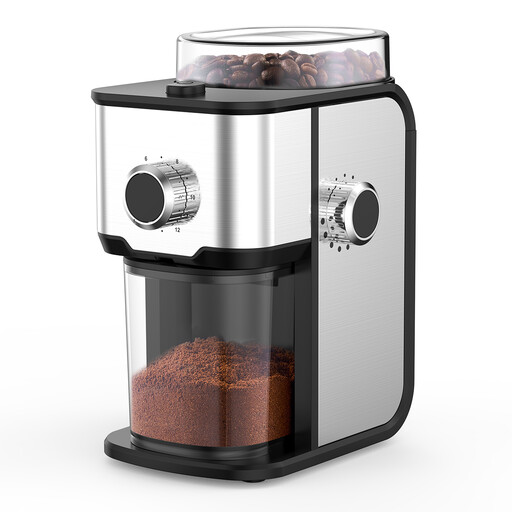
Why this choice suits this profile: Its compact size, one-touch control and claimed range of 2 to 12 cups make it a straightforward option for a first machine at home or in the office.
The spec sheet mentions flat burrs and 14 settings. This means you can realistically assess its capabilities, rather than relying on a simple promise of precision.
Flat burrs, 14 settings and claimed dosing for 2 to 12 cups.

Why this choice suits this profile: This corded model is aimed at enthusiasts who want to fine-tune their grind for espresso and pour-over, with a metal machine designed to stay on the worktop.
The spec sheet states a continuous adjustment of 0.01 mm and a plasma device designed to reduce static electricity. These features directly address the issues of grind setting and coffee dispersion.
55 mm conical burrs, continuous adjustment and removable magnetic receptacle.

Why this choice suits this profile: Its touch control, dosing buttons and holder compatible with several portafilter sizes fit neatly into a regular espresso routine at home.
The 48 claimed settings, the timer and the technology designed to reduce static electricity make it easy to identify the features on offer.
48 settings, stainless steel conical burrs and claimed compatibility with 51, 54 and 58 mm portafilters.
We’ve put together a full selection, updated in real time, of products that meet these strict criteria as well as European safety regulations.
Yes, as long as its adjustment range covers both extremes. A coffee grinder for French press needs to produce a coarse grind, while an espresso coffee grinder must be able to achieve a fine grind with close adjustments. Check the recommendations on the product spec sheet and start with the setting advised by the manufacturer.
It all depends on how often you use it, how well you maintain it and whether you stick to the recommended duty cycle. Only use dry roasted beans, unplug the machine before cleaning it and remove any residue with a suitable brush. Never pour water over the burrs or motor, unless the manufacturer explicitly allows it.
A manual coffee grinder doesn’t use electricity and is handy for travel or camping. However, it requires physical effort and takes longer when you need to grind several doses. A rechargeable electric model offers more convenience on the move, while a corded machine is better suited to frequent use at home.