
Livraison le jour même ou le lendemain

Qualité garantie

Débloquez vos offres de bienvenue: Livraison GRATUITE | Jusqu'à -80 % | 30 jours d'essai gratuits à JoyPlus
Téléchargez l'application
An electric coffee grinder can simplify your daily coffee preparation, but not all models are created equal depending on how you use them. Espresso, filter, cafetière, moka pot or coffee on the go: each method requires a specific grind size and a machine that is precise enough.
Before you buy, three common pitfalls keep cropping up:
A burr coffee grinder crushes the beans between two surfaces, rather than chopping them with a blade. This mechanism generally gives you better control over particle size and produces a more consistent grind.
Conical burrs are often found in domestic and compact models. They work well for frequent switching between espresso, moka and filter coffee. Flat burrs can also produce an even grind, but their design is often bulkier depending on the machine.
The material matters too: stainless steel, titanium alloy or other metals need to be paired with a suitable motor. Simply seeing the word 'professional' isn't enough to judge a grinder's durability.
An adjustable coffee grinder needs to cover a range that suits your brewing method. Espresso demands a fine grind, while filter coffee and pour-over work best with a medium grind. Coarse grind is generally reserved for cafetière and certain cold brews.
To choose a coffee grinder for espresso and filter, check:
A stepless adjustment lets you fine-tune an espresso more precisely, but it takes a bit of time to find your bearings.
For a one- or two-person household, a 50 g hopper can be enough if you dose the beans for each brew. A 225 g capacity is better suited to an office or a household that makes several cups in a row.
Noise levels depend on the motor, its speed and the housing design. Manufacturers rarely give a decibel measurement, so it's wise to be cautious about any promise of 'silent' operation that isn't backed by verifiable data.
Also think about maintenance: go for removable parts, an easily accessible chute and hassle-free cleaning. Always unplug the appliance before removing the burrs or clearing a jam of beans. Any washable parts must be completely dry before reassembly.
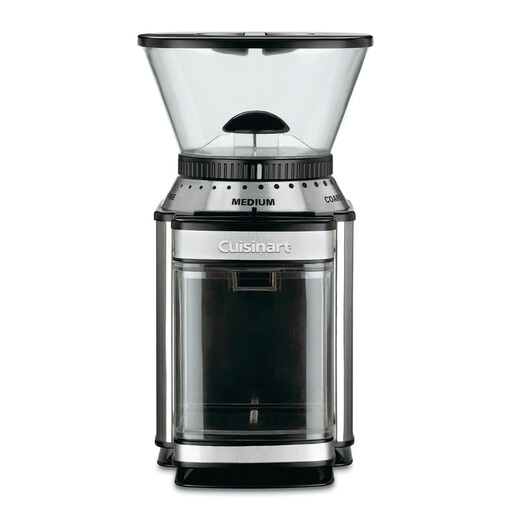
Why this choice suits this profile: Its 18 settings cover the most common brewing methods, while the selector for 4 to 18 cups lets you adjust the dose to the number of people.
The number of settings and the dose per cup are clearly stated, without relying on a vague promise about grind quality.
Burrs, 225 g hopper, automatic shut-off and removable parts that are dishwasher-safe according to the product sheet.

Why this choice suits this profile: Its stepless adjustment and 55 mm conical burrs are aimed at users who want to fine-tune both their espresso and filter coffee.
The stepless adjustment means you don't have to make do with a few fixed notches when you need to gradually tweak the extraction.
55 mm titanium alloy conical burrs, plasma anti-spatter system and magnetic assembly said to make cleaning easier.
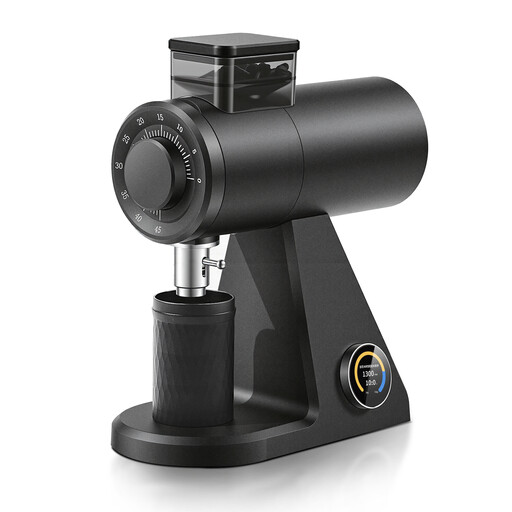
Why this choice suits this profile: Users who make coffee after coffee or need a wide adjustment range benefit from a 250 W motor and 74 mm flat burrs.
The grinding time, variable speed from 600 to 1,500 rpm and stepless adjustment are all detailed, making it easier to compare on concrete grounds.
Timer, plasma anti-static system, claimed residual amount between 0.1 and 0.5 g and removable burr block.
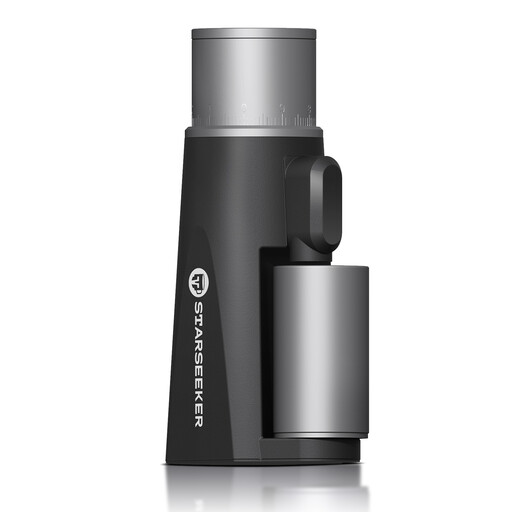
Why this choice suits this profile: This portable coffee grinder works without a plug when you're on the move, camping or at the office, thanks to its USB-C charging.
The product sheet states it doesn't have an anti-static system: so plan for regular cleaning and, if needed, a light misting of the beans.
2,600 mAh battery, 100 stepless adjustment levels and claimed dimensions of 100 × 67 × 195 mm.
We've put together a comprehensive list, updated in real time, of products that meet these demanding selection criteria and European safety standards.
For a more consistent grind, only use roasted coffee beans and remove any small foreign objects before grinding. Don't let the motor run empty for an extended period. If the model has sharp burrs, never put your fingers inside the hopper.
In the UK, check compatibility with a 220–240 V, 50 Hz power supply, that an English-language instruction manual is included, and that the manufacturer or its representative within the European Union has contact details provided. These checks don't replace carefully reading the instructions supplied with the appliance.
There's no universal number. To switch from one method to another, a range of around 18 to 48 settings generally offers good flexibility. The precision of the mechanism and the consistency of the grind matter at least as much as the number on the spec sheet.
Consumption mainly depends on the motor power and how long it runs. Since grinding usually only lasts a few seconds, the impact per cup is limited and depends mostly on how often you use it. A timer or automatic shut-off can also help avoid unnecessarily long cycles.
Unplug the appliance before each clean, regularly remove coffee residue and follow the duty cycle specified by the manufacturer. Avoid damp beans, spices and cereals if the grinder is designed exclusively for coffee. Any washable parts must be completely dry before reassembly.