
Livraison le jour même ou le lendemain

Qualité garantie

Débloquez vos offres de bienvenue: Livraison GRATUITE | Jusqu'à -80 % | 30 jours d'essai gratuits à JoyPlus
Téléchargez l'application
An electric chopper promises to be a colossal time-saver in the kitchen. From flavourful stuffings and homemade pesto to finely chopped vegetables in a flash, it quickly becomes an essential daily companion. The problem? The market is saturated with models whose marketing promises fall short once you get them home.
Buying an unsuitable appliance is a well-known source of frustration. To help you avoid the most common pitfalls, here are the 3 critical points that separate a sound investment from a gadget destined to gather dust in the back of a cupboard.
To make a clear-headed decision, focus on the features that truly matter for the performance and durability of your future electric chopper.
Wattage is just one indicator. The most important factors are the quality of the motor and, above all, the design of the blades. A good electric meat grinder, for example, isn't judged by its watts but by its motor's torque, which allows it to process chunks of meat without ever straining.
Prioritise models equipped with S-shaped stainless steel blades, ideally stacked on multiple levels. This design ensures a consistent chop throughout the entire bowl, without leaving large pieces on top. Overheat protection is also a real plus for motor longevity.
The bowl is central to the user experience. Three materials dominate the market?:
For a family of 3 to 4, a 1.5 to 2-litre bowl is the ideal compromise for preparing sufficient quantities in a single batch. For smaller needs (herbs, garlic, nuts), a 500?ml mini chopper will do the job perfectly.
A multi-function chopper goes far beyond simple chopping. Some models, often integrated into a more comprehensive food processor, come with attachments for emulsifying mayonnaise, whipping egg whites, or even crushing ice.
Finally, a non-negotiable criterion: ease of maintenance. Check that the bowl, lid, and blades are easily removable and dishwasher-safe. The motor block, however, should never come into contact with water; a simple wipe with a damp cloth is all it needs.
We have analysed several models based on these objective criteria to offer you options tailored to distinct user profiles.

Why It Stands Out : Perfect for families who cook daily. Its large 2 L bowl lets you prepare enough vegetables for a soup or meat for a lasagna in a single batch, a real time-saver.
Its thick glass bowl resists scratches and won't retain odours or stains, unlike low-quality plastics. Hygiene is impeccable, and cleaning is a breeze.
Its two speeds provide precise texture control, and its triple-stacked S-blades ensure a perfectly uniform chop.
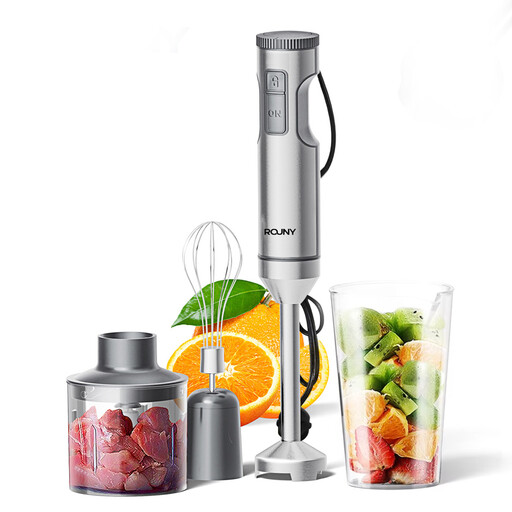
Why It Stands Out : The perfect tool for those who want maximum functionality without sacrificing counter space. In addition to its 500 ml mini chopper (perfect for garlic, onions, or herbs), it transforms into an immersion blender for soups and a whisk for emulsions.
Instead of investing in a bulky appliance that will see little use, this 4-in-1 set leverages one powerful motor for several targeted tasks. It's a much smarter, more rational purchase.
An ultra-complete kit (blender, chopper, whisk, beaker) with variable speed for total control over textures.
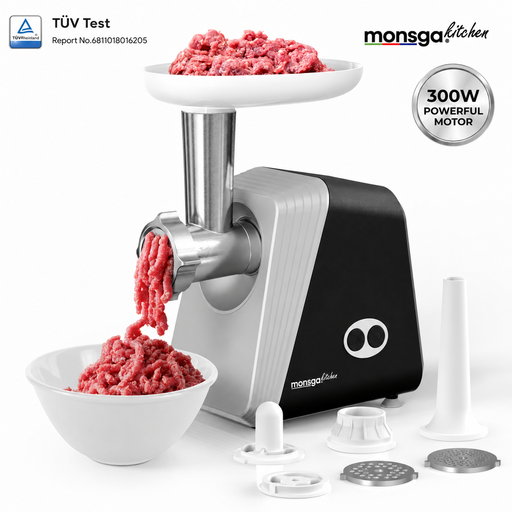
Why It Stands Out : Specially designed for those who want 100% control over the quality of their meat, from homemade sausages to freshly ground steaks. It's a true professional-grade electric meat grinder for home use.
Where all-purpose choppers tend to shred meat rather than grind it, this specialist uses an auger and professional grinding plates. The result: the texture is preserved, delivering a clean and effective grind.
Dedicated sausage and kibbeh attachments, an anti-clogging reverse function, and 3 grinding plates for greater variety.
If making homemade charcuterie is your priority, explore our complete selection of products that meet strict performance and safety standards.
For everyday use (vegetables, herbs, tender meat), a 300 to 500?W motor is more than enough, provided the blades are high quality. For a more heavily used electric meat grinder, aim for a higher nominal power and a high-torque motor. Be wary of the "Max Power" listed on the box, which is often misleading. Only the nominal power rating matters for real-world, continuous use.
It's a close call. The glass bowl is the champion of hygiene: it doesn't retain odours or stains, won't scratch, and remains transparent. Its weaknesses: it's heavy and can break. A quality BPA-free plastic bowl is lighter and more durable but will eventually scratch and become dull. It's a trade-off between maximum hygiene (glass) and lightweight convenience (plastic).
The secret is to act fast! Immediately after use, disassemble the removable parts (bowl, blades, lid) and wash them in hot, soapy water (or in the dishwasher if compatible). Lingering garlic odour? A quick soak for a few minutes in a vinegar-water solution works wonders. For the motor block, a simple damp cloth is sufficient (NEVER submerge it). Dry everything thoroughly before reassembling to prevent bacteria growth.