
Livraison le jour même ou le lendemain

Qualité garantie

Débloquez vos offres de bienvenue: Livraison GRATUITE | Jusqu'à -80 % | 30 jours d'essai gratuits à JoyPlus
Téléchargez l'application
The promise of cold drinks and a fresh picnic on your holiday road trip... it's an affordable little luxury. However, choosing an electric car cooler can quickly become a headache. Between the marketing jargon and technical realities, it's easy to end up with a disappointing device—or worse, one that drains your car battery in just a few hours. As a product expert at Joybuy, my mission is to help you navigate these pitfalls and make an informed, confident choice.
To start, here are the 3 classic mistakes you should absolutely avoid:
To avoid making a mistake, focus on the technical specifications that truly matter.
This is THE fundamental distinction. Your choice will depend entirely on how you plan to use it.
Thermoelectric (or Peltier effect) technology: These models are lighter and more affordable. They work by transferring heat from one side of a module to the other. Their cooling capacity is limited and depends on the outside temperature. They are perfect for keeping drinks or a picnic cool for the duration of a trip, but don't expect to freeze anything or achieve polar-level cold during a heatwave. The ICEROVER PN-06 is a good example of this technology, practical for occasional needs.
Compressor technology: Here, we're talking about a true portable mini-fridge for your car, van, or camper. It uses a compressor, just like your kitchen fridge, to actively generate cold. A compressor cooler can reach sub-zero temperatures (down to -20°C) regardless of the ambient heat. It's the only reliable technology for preserving perishable goods, frozen items, or simply enjoying ice-cold drinks even in the height of summer. This is the technology found in models like the BINGI 22L or Alpicool coolers.
Don't be fooled by the gross volume. Pay attention to the internal layout. Can you store 1.5L bottles upright? Is the space optimised, or is it sacrificed for the motor block?
For greater versatility, some models offer a dual-zone cooler. These devices have two compartments with independent temperature settings. This allows you to freeze meat in one section while keeping vegetables fresh in the other. This is a popular option for van life enthusiasts and families embarking on long journeys.
A good electric cooler must be compatible with a 12V cigarette lighter socket and often 24V for trucks. Most compressor models also come with a mains adapter (220V) for use at home or at a campsite.
The non-negotiable feature: battery protection. Prioritise models that offer three levels of protection (usually labelled H, M, L for High, Medium, and Low). This system automatically cuts power to the cooler if your vehicle's battery voltage drops below a certain threshold, ensuring you can start your engine without any trouble.
Here are a few options that meet specific needs, taking into account the criteria we've just discussed.
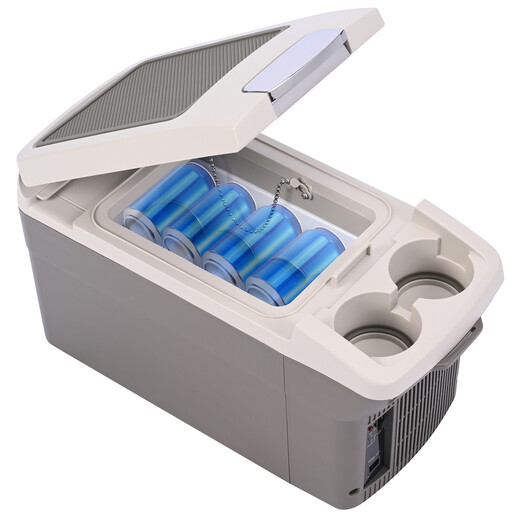
Why this model? Perfect for those who need a simple solution to keep a meal or a few cans cool during a trip. Its compact size fits easily between seats, and its warming function is a nice bonus in the winter.
This model has the merit of being honest: it's not a freezer. By embracing its thermoelectric technology, it meets a simple need without over-promising performance during a heatwave.
Compact, lightweight, dual-function (cool/warm), and quiet: it's designed to be unobtrusive in your car's cabin.
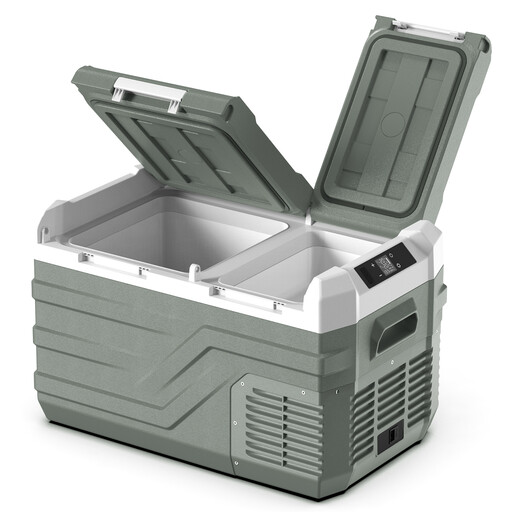
Why this model? For van life enthusiasts and discerning campers looking for a reliable and versatile cooling solution. Its compact form factor integrates easily into optimised spaces, while delivering true refrigeration and freezing performance.
Thanks to its compressor technology, it ensures stable cooling down to -20°C, regardless of the weather. No more yo-yo performance! Its dual-zone function means you no longer have to choose between refrigerating and freezing.
A true portable mini-fridge and freezer, with two independent temperature zones and foolproof battery protection.

Why this model? When volume is the number one criterion, this 49L model delivers. Perfect for families or long stays in a campervan, it can store enough provisions for several days. The wheels and telescopic handle make it as easy to move as a suitcase.
No more "phantom" capacity headaches: it offers a generous and well-designed volume. Its battery protection and ECO mode optimise power consumption to prevent any unpleasant surprises in the morning.
XXL volume, dual-zone, mobile app control... not to mention the details that make all the difference: wheels, an integrated cutting board, and LED lighting.
Discover our full selection of products that meet our strict selection criteria and safety standards.
No, as long as you choose a model equipped with battery discharge protection. This smart system constantly monitors your battery's voltage and cuts power to the cooler long before it reaches the critical threshold needed to start the engine.
The difference is huge. A thermoelectric cooler simply maintains coolness. Its performance is directly tied to the outside temperature: the hotter it gets, the less effective it is. In contrast, a compressor cooler is an active system, just like your home fridge. It actively produces cold and can reach down to -20°C, even if your car's cabin is a sweltering 40°C.
Absolutely. Most compressor models come with two adapters: one for the cigarette lighter socket (12V/24V) and another for a standard mains socket (220V). This is ideal for pre-cooling it at home before you leave, or for using it as a backup fridge once you've arrived at the campsite or even in the garage.