
Livraison le jour même ou le lendemain

Qualité garantie

Débloquez vos offres de bienvenue: Livraison GRATUITE | Jusqu'à -80 % | 30 jours d'essai gratuits à JoyPlus
Téléchargez l'application
Whether you're heading out on a road trip, going camping, or just spending a long day on the road, one thing is essential: keeping your food and drinks cold. The electric car cooler is the perfect solution, but the market is flooded with promises that melt away as soon as the temperature rises. Before you make a decision, it's wise to understand the common pitfalls that can turn a promising purchase into a costly disappointment.
Many are lured by tempting prices without understanding the technology inside, only to end up with a cooler that struggles to stay cold when the heat is on. Another common mistake is overlooking vehicle battery protection. A model without a reliable safety system can drain your battery, leaving you stranded in the middle of nowhere. Finally, a capacity listed in litres doesn't always guarantee a practical, well-designed storage space.
This guide is here to help you avoid these traps and identify the features that truly matter, so you can find the car fridge that will be your faithful companion on all your adventures.
To avoid unpleasant surprises, focus on these three points. They are what make all the difference in performance, safety, and user convenience.
This is the most technical point, but also the most crucial: it determines everything your cooler can (and cannot) do.
A good cooler must be versatile. Check its compatibility with multiple power sources?:
The non-negotiable feature: vehicle battery protection. A good model must offer at least three protection levels (High, Medium, Low). This system automatically cuts power to the cooler if the battery voltage drops below a certain threshold, ensuring you can always restart your vehicle.
The capacity in litres should obviously match your needs. But beyond the raw volume, the interior layout is just as crucial.
Some compressor coolers take the concept further with a dual zone feature with independent temperature controls. This allows you to use one compartment as a freezer and the other as a refrigerator simultaneously. The ultimate in flexibility.
Instead of an endless list, here are a few hand-picked models that meet specific needs, selected for their performance and reliability.
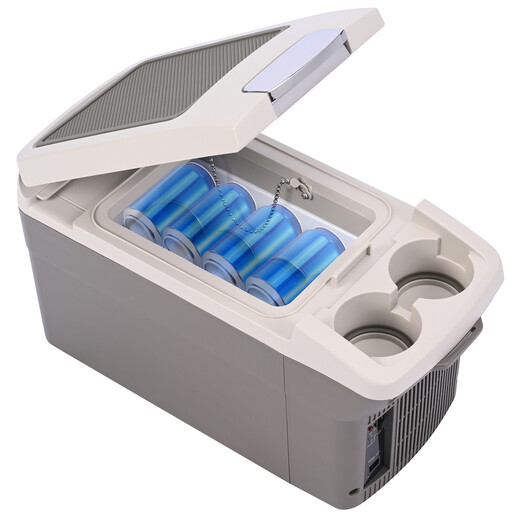
Why we recommend it: It's the simple, compact solution for keeping the day's drinks and lunch cool. Its small footprint allows it to fit easily on a passenger seat or between seats.
This thermoelectric model saves you from paying for features you don't need. It perfectly handles the basic job (keeping things cool) without the complexity or cost of a compressor.
Its hot/cold function makes it versatile. It's also quiet (around 40 dB) and its carrying strap makes it easy to take anywhere.
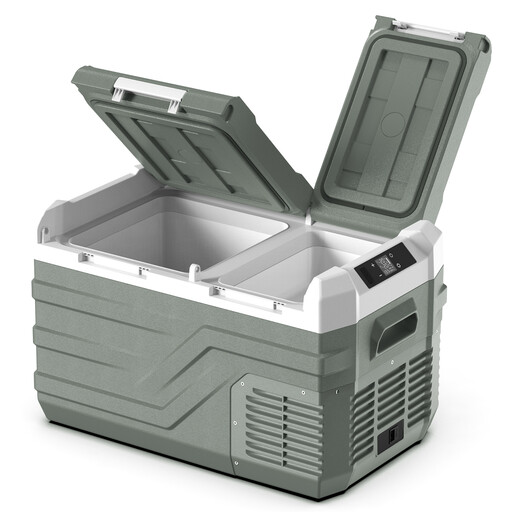
Why we recommend it: Perfect for couples or solo adventurers who want true refrigeration and freezing performance in a compact size. Its smart design makes it highly practical in tight spaces like a van or a 4x4.
It knocks out the "false cold" trap with its compressor technology. Its dual-zone, dual-door design brilliantly optimises its 20 L capacity, avoiding the common problem of a poorly arranged interior.
Its dual zone with independent controls allows you to freeze and refrigerate at the same time. It includes the essential 3-level battery protection and even has a USB port to charge your devices.

Why we recommend it: With its generous 45-litre capacity, wheels, and telescopic handle, this model is built for families or groups heading out on long holidays. It provides the space and power needed to store several days' worth of supplies.
It eliminates the risk of a dead battery with its low-consumption ECO mode (0.18 kWh/day according to the manufacturer) and its multi-source compatibility (including solar panels). Its compressor technology ensures stable and powerful cooling.
Remote control via the Bluetooth app lets you adjust the temperature at your fingertips. We also appreciate its smart design with integrated wheels and cup holders.
We've put together a complete selection of models that check all the boxes on our list for performance and safety.
This is a very real risk with entry-level models. To avoid it, you must choose a compressor cooler equipped with a multi-level battery protection system (usually 3?: High, Medium, Low). This feature monitors the voltage and cuts power to the cooler before the battery gets too low to start the engine.
The difference is night and day. In a car interior that can reach 50?°C in direct sunlight, a thermoelectric model will struggle to get below 30-35?°C—a temperature far too high to keep food safe. A compressor cooler, on the other hand, will effortlessly maintain your set temperature, whether it's 4?°C for drinks or -18?°C for frozen items, no matter how hot it gets outside.
Absolutely. That's the main advantage of compressor models, especially if they have a low-consumption "ECO" mode. For extended off-grid autonomy, the ideal setup is to pair it with a portable power source, like a portable power station (a large-capacity external battery) or solar panels—an increasingly common feature on recent models.