
Livraison le jour même ou le lendemain

Qualité garantie

Débloquez vos offres de bienvenue: Livraison GRATUITE | Jusqu'à -80 % | 30 jours d'essai gratuits à JoyPlus
Téléchargez l'application
Long holiday road trips, camping weekends, or workdays on the move all share a common challenge: keeping drinks and food cold. The traditional cooler filled with ice packs quickly shows its limits, all too often turning your provisions into a lukewarm soup. This is where a high-performance electric car cooler becomes a game-changer: it maintains a stable temperature, capable of refrigerating or even freezing your goods.
Faced with an overwhelming number of options and sometimes complex spec sheets, it's hard to know where to start. Our mission, as product experts, is to decode the market for you and guide you to the model that truly fits your needs, cutting through the marketing jargon. This guide reviews the essential buying criteria and presents our selection of the best models to accompany you on the road.
Before diving into our selection, it's crucial to understand the few features that will make all the difference in day-to-day use.
There are two main types of electric coolers: thermoelectric (Peltier effect) and compressor.
Expressed in litres, capacity simply defines the volume of provisions you can carry.
Also, consider the power options. A good 12v portable fridge must obviously be able to plug into the cigarette lighter socket (12V/24V), but dual 12v 220v cooler compatibility is a significant advantage, allowing you to use it at home before leaving, at a hotel, or at a campsite with mains electricity.
Certain features, far from being gimmicks, transform the daily experience:
We have selected three compressor models that cater to very different uses, whether you're a weekend warrior or a long-haul traveller.

Key features: With its XXL volume of 55 litres, this car refrigerator is aimed at those who don't want to compromise on storage space. Its high-performance compressor ensures a rapid temperature drop, over a range from -20°C to +20°C (-4°F to 68°F). Remote control via the Tuya Smart app provides real convenience for adjusting settings at your fingertips. Its ECO mode proves invaluable for long journeys, with controlled consumption (manufacturer data: 0.18 kWh/day).
Pros:
Who is it for? Families going on holiday, van or campervan owners, and generally anyone who needs a large storage volume for long trips.
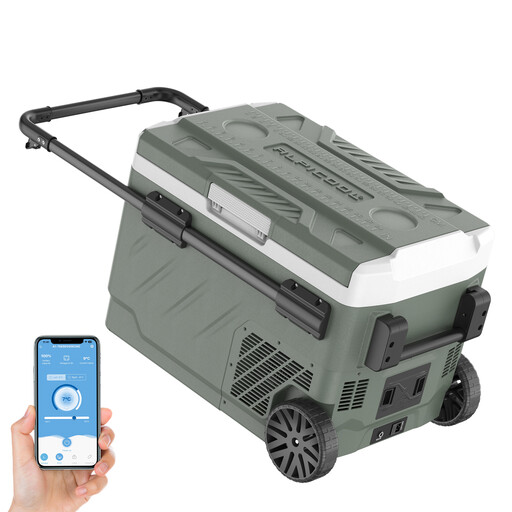
Key features: Versatility is the hallmark of this 40L cooler. Its dual zone technology allows you to manage two temperatures simultaneously, a feature particularly valued for camping. You can freeze the day's catch on one side and keep drinks cool on the other. Add to that app control, a telescopic handle, and sturdy wheels, and you have the ideal road companion, as practical as it is powerful. The finishing touches, like the interior LED lighting or the integrated cutting board, reflect a well-thought-out design for a nomadic lifestyle.
Pros:
Who is it for? Campers, anglers, and travellers looking for the versatility of a combined fridge/freezer in a mobile, easy-to-transport format.
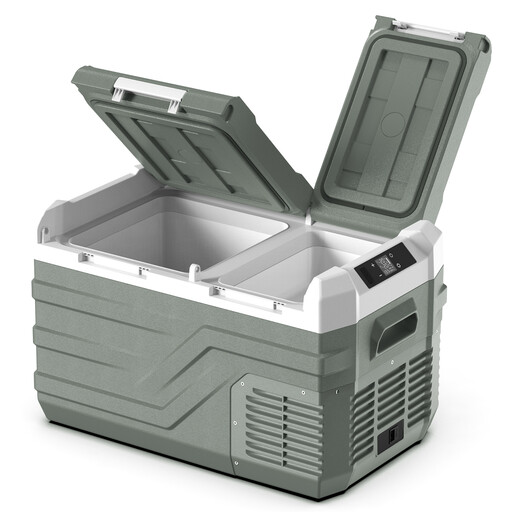
Key features: This compact 20L model (which actually offers 23L of usable space) has the unique feature of integrating dual zone technology, a rarity in this segment. Its main asset: two lids with opposite openings, ensuring easy access even in the confined space of a car or van. It's quiet, operating at around 45 dB, and its consumption in ECO mode is modest (45W), making it a particularly efficient choice. The icing on the cake: an integrated USB port for emergency charging of a smartphone.
Pros:
Who is it for? Solo travellers, couples, road professionals, or as an auxiliary 12v portable fridge in a larger vehicle.
If our selection doesn't perfectly match your needs in terms of volume or features, feel free to browse our complete buying guide for portable refrigerators to find the ideal companion for your next adventures.
Consumption obviously depends on the volume, insulation quality, and the set temperature. However, modern compressor models are very frugal. Most include an "ECO" mode that optimises the compressor cycles for minimal consumption, running at around 45-60W when active. Most importantly, the built-in protection system is there to prevent draining your car's battery.
Yes, as long as the vehicle's engine is running regularly to recharge the battery. With the engine off, the runtime will depend on the condition of your battery and the cooler's settings. Fortunately, all good models include battery protection (often with 3 levels) that cuts off the power long before the critical threshold for starting the engine is reached. For extended use when stationary (overnight camping, etc.), the ideal solution is to pair it with a portable power station or plug it into a 220V outlet if possible.
The difference is technical, but more importantly, practical. A thermoelectric (or Peltier effect) cooler simply moves heat: it struggles to cool more than 15-20°C (27-36°F) below the ambient temperature. In a heatwave, this is insufficient. A compressor cooler, on the other hand, works like your home fridge. It actively produces cold using a refrigerant gas, allowing it to reach true freezing temperatures (down to -20°C / -4°F) regardless of the outside heat, all with much better energy efficiency.