
Livraison le jour même ou le lendemain

Qualité garantie

Débloquez vos offres de bienvenue: Livraison GRATUITE | Jusqu'à -80 % | 30 jours d'essai gratuits à JoyPlus
Téléchargez l'application
Switching to an electric car is a decisive step, but the question of home charging quickly becomes a central issue. While a standard household socket can work in a pinch, it quickly shows its limits in terms of speed and safety. Investing in an electric car charging station, also known as a wallbox, is the ideal solution for fast, safe, and optimised daily charging.
Faced with a plethora of options, it can be hard to navigate the market. Power, connectivity, plug type, smart features… This guide breaks down the key points for you and helps you find the electric car charger that is perfectly suited to your vehicle, your electrical system, and your habits.
Before diving into our selection, here are the three essential criteria for making the right choice.
The power of the station determines the charging speed. This choice depends on two factors: your home's electricity plan and the capacity of your vehicle's onboard charger.
A connected charging station is a game-changer, offering decisive advantages. Thanks to a WiFi connection and a dedicated mobile app, you can:
A WiFi wallbox thus becomes a true ally for fine-tuned and cost-effective management of your charging.
Dynamic load balancing is a key, and particularly clever, feature. A charging station with load balancing measures your home's real-time electricity consumption. If you turn on several power-hungry appliances (oven, heater, etc.), the station automatically adjusts the vehicle's charging power to avoid tripping your circuit breaker. It's the guarantee of complete peace of mind and maximum energy optimisation.
As Joybuy's Head of Product Recommendations, I've scoured the market to bring you models that tick all the boxes: performance, features, and reliability.
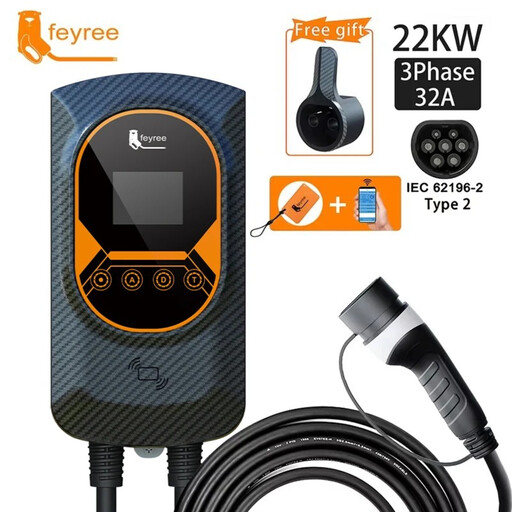
What sets it apart
This station offers a maximum power of 22 kW for three-phase installations, ensuring very short charging times. Its WiFi connectivity via the Tuya Smart app allows for complete remote control, from scheduling to adjusting the charging current.
Highlights
Who is it for?
For owners of electric vehicles compatible with 22 kW charging who have a three-phase electrical installation. It's the performance choice for those who demand total control and maximum smart features.
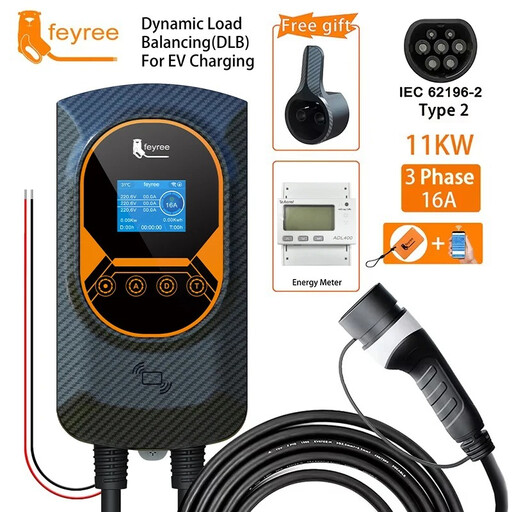
What sets it apart
Its key advantage: Dynamic Load Balancing (DLB). This smart station balances energy consumption between charging your car and other household appliances, thus preventing any overload of the domestic electrical grid.
Highlights
Who is it for?
For those who want absolute peace of mind regarding their electrical installation. It's the worry-free solution for households where many power-hungry appliances run simultaneously, ensuring an efficient charge without ever blowing a fuse.

What sets it apart
This station is a high-performance and versatile solution for single-phase installations, which are the most common. With 7.6 kW of power, it reduces charging time by a factor of three or four compared to a standard outlet, while integrating the smart features of its more powerful counterparts.
Highlights
Who is it for?
For the vast majority of electric vehicle owners living in a detached house with a single-phase electrical installation. It represents the next step up for home charging that is fast, smart, and safe.
Once you've chosen your charging station, don't overlook the longevity of your equipment. A cable lying on the ground can wear out prematurely or pose a hazard. To protect your gear and ensure its durability, take a look at our selection of EV charging cable protectors.
The power depends on your electrical installation (single-phase or three-phase) and your car's charging capacity. A 7 kW station is the most common and balanced choice for a single-phase installation. If you have a three-phase supply, an 11 kW or 22 kW station will offer faster charging, provided your vehicle can accept it.
Yes, absolutely. In many regions, including France, the installation of a charging station with a power greater than 3.7 kW must be carried out by a qualified electrician with an EV charging infrastructure certification. This is a legal requirement that guarantees the safety and compliance of your installation.
Nearly all electric vehicles sold in Europe use a Type 2 connector for alternating current (AC) charging, which is the case for the stations presented here. However, you should still check the maximum charging power accepted by your vehicle's onboard charger. This is the only way to harness the full potential of your wallbox.