
Livraison le jour même ou le lendemain

Qualité garantie

Débloquez vos offres de bienvenue: Livraison GRATUITE | Jusqu'à -80 % | 30 jours d'essai gratuits à JoyPlus
Téléchargez l'application
Switching to an electric car is a game-changer, but one question quickly arises: how do you charge it at home? Between the often-prohibitive prices of public stations and the frustratingly slow speed of a standard outlet, finding the right solution can become a headache. This guide is here to help. Our mission: to break down the essential technical features and present a selection of reliable products tailored to your needs, so you can make a truly informed decision.
Before diving into our selection, let's break down the three key criteria that will guide your choice.
The charger's power determines how fast your vehicle charges.
In any case, remember to check the maximum charging power your vehicle can accept before you decide.
Your lifestyle and housing situation will directly influence this choice.
A Wi-Fi connected charging station unlocks smart and cost-effective charging management. Through a smartphone app, you can:
Here are three options that cater to different user profiles, selected for their reliability and features.
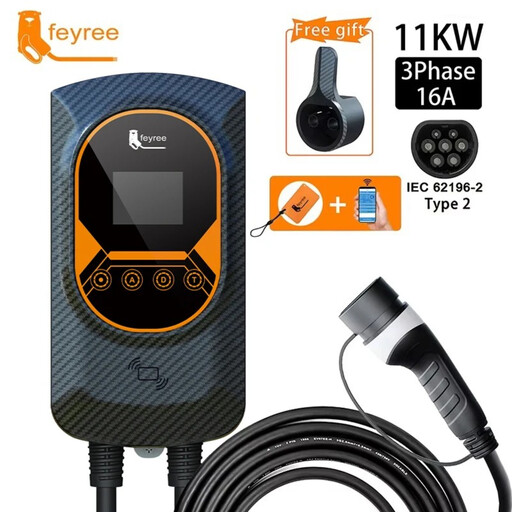
Why it stands out: This wallbox combines power with intelligence. Designed for a fixed installation, it delivers fast charging up to 11?kW for homes with a three-phase system. Its key advantage? Wi-Fi connectivity. Via the Tuya Smart app, it gives you full control over your charging sessions, from scheduling to consumption tracking.
Advantages:
Who is it for? For homeowners with a three-phase electrical system who are looking for a high-performance, secure, and optimised home charging solution enhanced by smart features.
See details for the feyree 11KW Wallbox
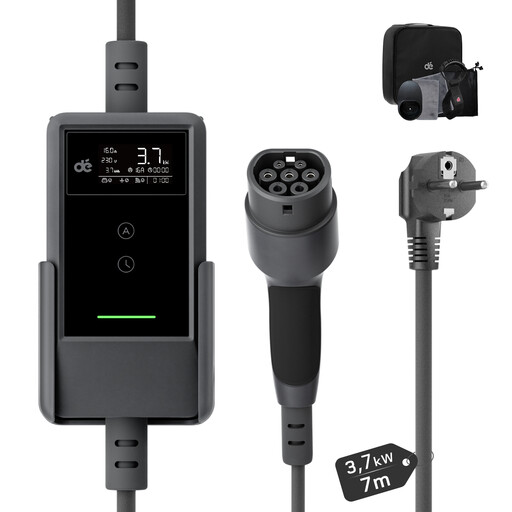
Why it stands out: This portable charger embodies simplicity and versatility. It plugs directly into a standard domestic socket and requires no complex installation. Its LCD screen clearly displays charging information (voltage, current, energy consumed), while the adjustable current (from 6A to 16A) allows you to use it safely on different outlets without risking an overload.
Advantages:
Who is it for? Ideal for drivers of plug-in hybrid vehicles (PHEVs) or electric cars with smaller batteries. It's also a perfect solution for renters or as a backup charger to keep in your boot.
Discover the 3.7?kW portable charger
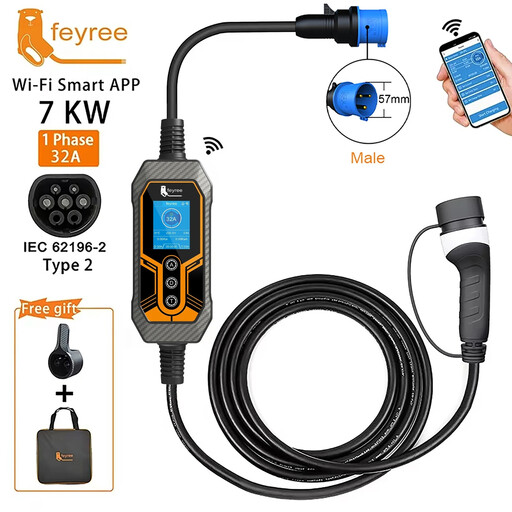
Why it stands out: This feyree portable charger brings together the best of both worlds: the power of a 7?kW charging station and the flexibility of a portable model. It features Wi-Fi and Bluetooth for app-based control, allowing you to schedule your charges and monitor data remotely. Its ability to deliver up to 32A (7?kW) makes it as fast as a wallbox, provided it's plugged into a suitable socket (like a CEE plug).
Advantages:
Who is it for? For demanding users who want a fast and smart primary charging solution without the permanent installation of a wallbox. It's perfect for high-performance home use and for travel that requires rapid charging.
Explore the feyree 7KW portable charger
The Type 2 connector is the standard in Europe, but some older or imported vehicles use other standards. If your car isn't compatible with the models in this selection, don't worry: our full catalogue offers a wide variety of options.
See Our Selection of Type A Charger Cables
A standard domestic socket is simply not designed to handle high current for long hours. Charging is slow (around 2.3?kW) and can pose an overheating risk. The Type 2 connector is the European standard specifically designed for charging electric vehicles. It allows for faster charging (from 3.7?kW to 22?kW and beyond) and integrates communication protocols between the charger and the car for optimal safety.
For a portable charger that plugs into an existing socket, professional installation is not mandatory. However, it is wise to have your socket's compliance checked by an electrician, especially if you plan to charge at 16A (3.7?kW). For the installation of a fixed wallbox (7?kW or 11?kW), using a qualified electrician is essential. This guarantees a safe installation that complies with all standards and is often a requirement to qualify for government grants.
Yes. Modern charging stations and connectors are designed for outdoor use in all weather conditions. They have Ingress Protection (IP) ratings that guarantee their resistance to water and dust. For example, an IP66 rating, like that of the feyree charger, means it is completely protected against dust and powerful water jets, making it perfectly safe to use in the rain.