
Livraison le jour même ou le lendemain

Qualité garantie

Débloquez vos offres de bienvenue: Livraison GRATUITE | Jusqu'à -80 % | 30 jours d'essai gratuits à JoyPlus
Téléchargez l'application
Made the switch to electric? Congratulations! Now comes an equally crucial step: choosing the right home charging solution. With all the different power levels, connectors, and features, it's easy to feel overwhelmed. This guide is here to help you make sense of it all and find the perfect electric car charging station for your vehicle, your home setup, and your driving habits.
We'll review the key points to check before you buy and present a selection of chargers suited for every need, from the simplicity of a portable charger to the intelligence of a smart wallbox.
Before making a purchase, it's essential to assess your needs. The ideal choice will depend on your daily usage, your electrical system, and the level of control you want.
Your vehicle's charging speed depends directly on the charger's power output.
Modern chargers do more than just deliver power. A smart charging station connected via Wi-Fi or Bluetooth unlocks a world of possibilities from an app on your smartphone:
Safety is non-negotiable. Ensure the charger has multiple protections (overvoltage, overheating, current leakage) and is CE certified.
For homes with limited electrical capacity or when multiple energy-hungry appliances are running simultaneously, the load balancing feature is a major asset. A charger with load balancing (or dynamic load balancing) measures the home's total energy consumption in real time and automatically adjusts the car's charging power. This prevents tripping the circuit breaker while maximising the available charging speed at any given moment.
We have selected three models that stand out from the crowd, each catering to a specific user profile.
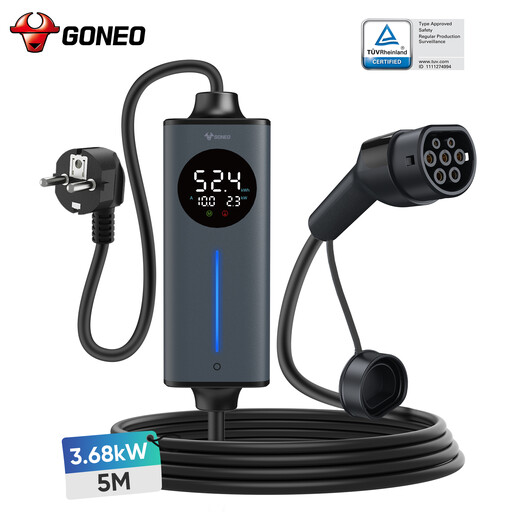
Why it stands out: This is the ultimate simple solution. No installation is required; just plug it into a standard household outlet to start charging.
Advantages:
Who is it for? Ideal for drivers who cannot or do not want to install a fixed station (especially renters), for those with moderate vehicle usage, or as a supplementary or travel charging solution.
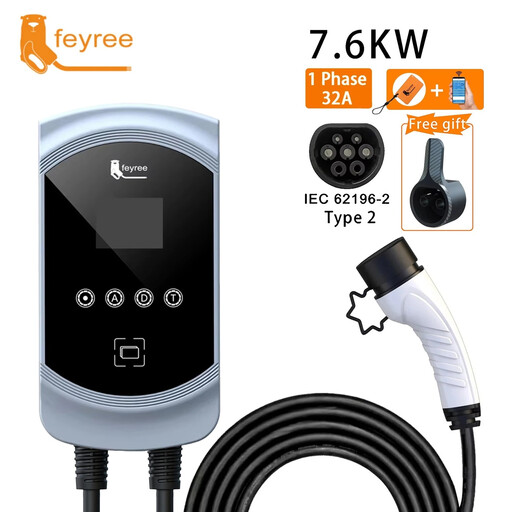
Why it stands out: This wall-mounted charger combines a comfortable charging speed with the benefits of smart remote management, all in a secure, fixed unit.
Advantages:
Who is it for? Homeowners looking for a primary charging solution that is both fast and smart. It's the perfect choice for optimising your energy bill by scheduling charges during off-peak hours via the app.
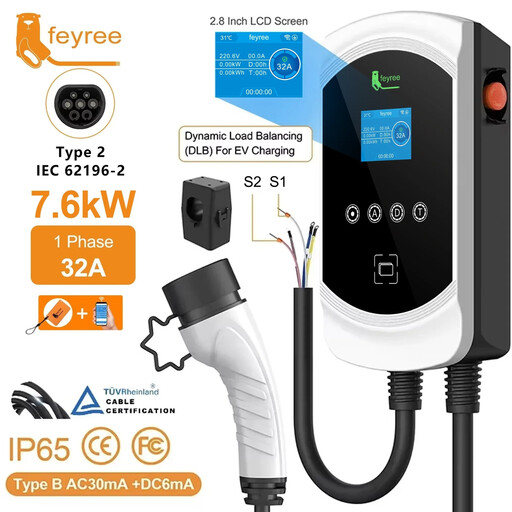
Why it stands out: This is the most advanced version, integrating a Dynamic Load Balancing (DLB) feature. It intelligently manages power to ensure it never overloads your home's electrical system.
Advantages:
Who is it for? Users with limited power capacity from their utility, or those who own many electrical appliances and want optimised charging without ever risking a power outage. It's the ultimate peace-of-mind solution for smart home energy management.
This selection is, of course, just a glimpse of the available solutions. Since every vehicle and home has its own specific requirements, you might need a different configuration (higher power, a specific cable length, etc.).
To explore a wider range of chargers, feel free to browse our complete category.
? Discover Our Full Range of Type 2 EV Chargers
For a single-phase home installation, a power level of 7.4 kW (32A) is an excellent balance between charging speed and installation requirements. It requires a dedicated, protected circuit installed by a qualified electrician. A 3.7 kW (16A) unit is simpler to install, but charging will be twice as slow. Higher power levels (11 kW or 22 kW) require a three-phase installation, which is less common in residential homes.
Yes, it's possible using a portable electric car charger designed for Schuko sockets. This is a convenient solution for occasional use or when travelling. However, for daily use, it is recommended to have your socket's condition checked by a professional and to avoid using an extension cord. Charging will be slow (expect to add about 10 to 15 km of range per hour).
Load balancing, or Dynamic Load Balancing (DLB), is a smart feature that allows the charging station to adjust its power output in real time. It communicates with a sensor placed in your electrical panel to know your home's total power consumption. If you turn on energy-intensive appliances, the charger with load balancing will reduce the power going to the car to prevent an overload and a power outage. This is a very useful feature for optimising charging without needing to upgrade your electricity plan to a higher power tier.