Charging your electric car at home: a promise of simplicity that often clashes with reality. Between the frustratingly slow original charger and the jungle of market offerings, choosing the right solution can feel like a real challenge. Do you want to reduce your charging time, lower your electricity bill, and, most importantly, regain your peace of mind? This guide is for you.
We'll break down the different options so you can choose the perfect electric car charging station for your needs, your vehicle, and your setup.
Buyer's Guide: 3 Criteria to Check Before You Choose
Before diving headfirst into a specific model, a quick technical check is in order. These few basics are crucial to ensure the compatibility and performance of your future installation.
1. Charging Power: 7 kW, 11 kW, or 22 kW?
Power, measured in kilowatts (kW), is the most critical factor: it determines how fast your vehicle will charge.
- Domestic Socket (approx. 2.3 kW): Plugging your car into a standard outlet with a domestic socket charger is the simplest solution, but also the slowest. Ideal for occasional use or for a plug-in hybrid, it will take a full night (or even longer) to provide enough range for a 100% electric vehicle.
- 7 kW Wallbox: This is the standard for most homes with a single-phase supply. A 7 kW wallbox can fully recharge most batteries in a single night (around 6 to 8 hours). Its installation requires a dedicated electrical line and the work of a qualified professional.
- 11 kW or 22 kW Station: These powerhouses are reserved for electrical systems with a three-phase supply. An 11 kW charging station or a 22 kW charging station slashes charging times. Be aware, not only does your home need a three-phase connection, but your car must also be able to handle such high power on alternating current (AC).
2. Fixed Station (Wallbox) or Portable Charger?
Here, it all comes down to your habits.
- The Wallbox (wall-mounted station): Mounted on your garage wall or in your parking space, it guarantees optimal comfort and safety for daily use. It's the gold standard for home charging.
- The portable EV charger: More mobile, it's easy to transport and plugs into various outlets (domestic or industrial, depending on the model). It's the perfect companion for travel, holidays, or if installing a fixed station is simply not an option.
3. Smart Features
Opting for a connected (or "smart") charging station is far from a gimmick. Thanks to Wi-Fi and a dedicated mobile app, you take control:
- Schedule Charging: Start charging during off-peak hours to lower your electricity bill.
- Track Your Consumption: Monitor power, cost, and the history of your charging sessions in real time.
- Manage Power: Adjust the current's intensity to match your electrical system and avoid tripping the circuit breaker.
Good to know: all modern charging stations in Europe are equipped with a Type 2 charger connector, the standard for alternating current (AC) charging.
Our Recommended Charging Stations
Now for our selection of models that tick all the boxes: safety, features, and value for money, catering to different user profiles.
feyree 11 kW Portable Charger with Touchscreen
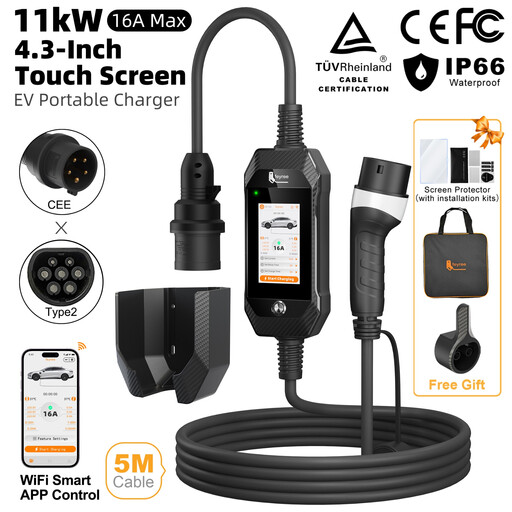
Its key advantage: This model successfully combines the power of an 11 kW station with the flexibility of a portable charger. Its large touchscreen and connection to the Tuya Smart ecosystem make it as modern as it is intuitive.
What we like:
- The Power: Fast 11 kW charging for three-phase systems.
- Total Control: Remote management via the app (start/stop, current adjustment from 8A to 16A, scheduling).
- Maximum Safety: Dual temperature sensors (plug and control box) and a full suite of protections (Type B leakage, overvoltage, lightning).
- The Clear Interface: An HD touchscreen to see everything at a glance.
Who is it for? For EV drivers with a three-phase supply who want power without the constraints of a fixed installation. A perfect choice for tech enthusiasts who love to control everything from their smartphone.
feyree 7.6 kW Single-Phase Wallbox
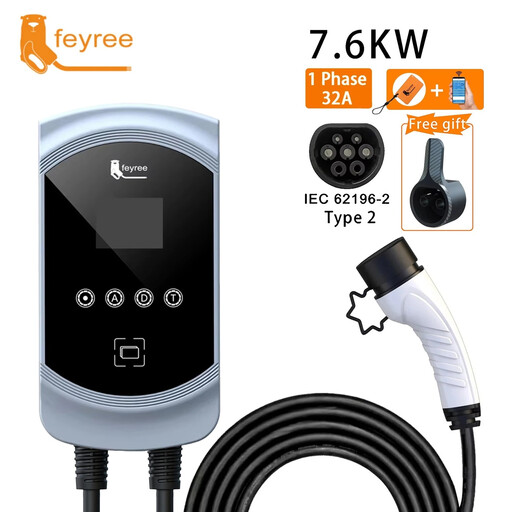
The Home Charging Benchmark: This 7 kW wallbox (up to 7.6 kW) is the ultimate home charging solution: comprehensive, reliable, and designed for single-phase systems.
What we like:
- The Right Amount of Power: Up to 7.6 kW (32A), ideal for a full overnight charge on a standard single-phase system.
- Smart Connectivity: Integrated Wi-Fi and control via the Tuya Smart app to schedule and track sessions.
- Flexibility: The current is adjustable from 8A to 32A to adapt to your home's power capacity.
- Robustness: IP65 certified (dust-tight and water-jet resistant), it includes all necessary protections (lightning, overvoltage, overheating).
Who is it for? For the vast majority of EV drivers living in a house with a single-phase supply. It's the sensible choice for a first fixed installation, combining performance with smart features.
feyree 22 kW Three-Phase Wallbox
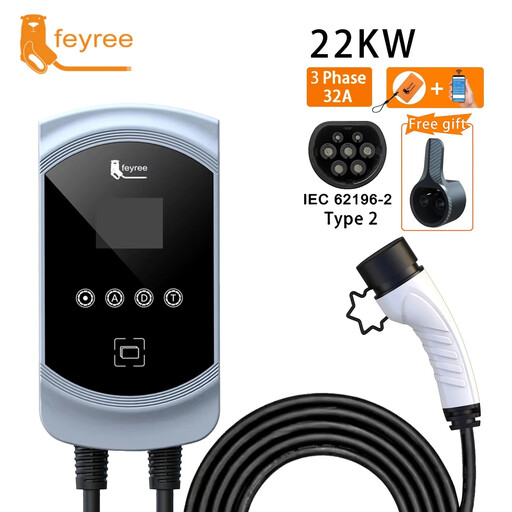
Pure Power: Built for speed, this 22 kW charging station is for those who want to make no compromises on charging time and have an electrical system that can handle it.
What we like:
- Maximum Speed: With 22 kW, you can regain hundreds of kilometres of range in just a few hours.
- Three-Phase Specific: It is exclusively designed for homes with a three-phase connection.
- Smart Control: It also features Wi-Fi connectivity and the Tuya app for complete remote management.
- Proven Reliability: It includes the same suite of protections as the 7.6 kW model for total peace of mind.
Who is it for? For lucky owners with a three-phase supply whose vehicle accepts a 22 kW AC charge. The ultimate solution for those for whom every minute counts.
GONEO Portable Type 2 Charger for Schuko Socket

Safety on the Go: This domestic socket charger focuses entirely on safety and simplicity. It plugs into any standard outlet (Schuko 16A) and includes protections worthy of much more expensive stations.
What we like:
- Plug & Play Convenience: No installation needed—just plug it in and it charges.
- Safety First: It integrates differential protection (30mA AC + 6mA DC), a temperature sensor, and ground fault detection.
- Smart Scheduling: A timer allows you to delay the start of the charge (up to 8 hours) to take advantage of off-peak hours.
- The Control Display: An LED screen to monitor voltage, current, and temperature in real time.
Who is it for? For drivers of plug-in hybrids, or as a secure portable charger for owners of 100% electric vehicles. Essential for travel or occasional charging.
Still Not Convinced?
Our selection covers the most common needs, but the market is full of other great options. If you're looking for a model with specific features or simply want to expand your comparison, explore our full catalogue.
? Discover our range of socket chargers
Frequently Asked Questions
1. In practical terms, what's the difference in charging time between 7 kW, 11 kW, and 22 kW?
To give you a rough idea, for a 50 kWh battery:
- Domestic Socket (2.3 kW): Approximately 22 hours.
- 7.4 kW Wallbox: Approximately 7 hours.
- 11 kW Station: Approximately 4 hours and 30 minutes.
- 22 kW Station: Approximately 2 hours and 15 minutes. These times are approximate and of course depend on the maximum charging capacity your vehicle can accept.
2. Is a professional electrician required to install a charging station?
For a portable charger that plugs into a domestic socket, the answer is no. No professional intervention is required. However, for a 7 kW or more powerful Wallbox, hiring a qualified electrician is not only highly recommended but often legally required to ensure safety, compliance, and eligibility for government grants.
3. Is a smart charging station really useful?
Absolutely, and for two main reasons. First, for your wallet: by scheduling charging during off-peak hours, you take advantage of the lowest electricity rates. Second, for convenience: managing everything from your smartphone (starting/stopping the charge, tracking consumption, receiving alerts) is a daily game-changer.


