
Livraison le jour même ou le lendemain

Qualité garantie

Débloquez vos offres de bienvenue: Livraison GRATUITE | Jusqu'à -80 % | 30 jours d'essai gratuits à JoyPlus
Téléchargez l'application
Making the switch to an electric car is a personal revolution. But once you've chosen your vehicle, a crucial question arises?: how do you charge it at home, safely and efficiently? Power, connectors, smart features... Faced with a jungle of options, it's easy to feel lost.
This guide is here to light the way. As the Head of Product Recommendations at Joybuy, my mission is to cut through the noise and present you with practical solutions tailored to real-world use, free from marketing jargon. Let's review the essential criteria for finding the perfect electric car charger for your needs, your setup, and your vehicle.
Before diving into our selection, here are the three key points to evaluate to guide your choice.
The first question to ask yourself is about the format.
Charging speed depends on three factors?: your car's onboard charger capacity, the station's power output, and your home's electrical capacity.
Modern chargers are much more than just power outlets. They integrate technologies to optimise your consumption and safety.
Here is a selection of products that meet different needs, from portable solutions to fixed and smart installations.
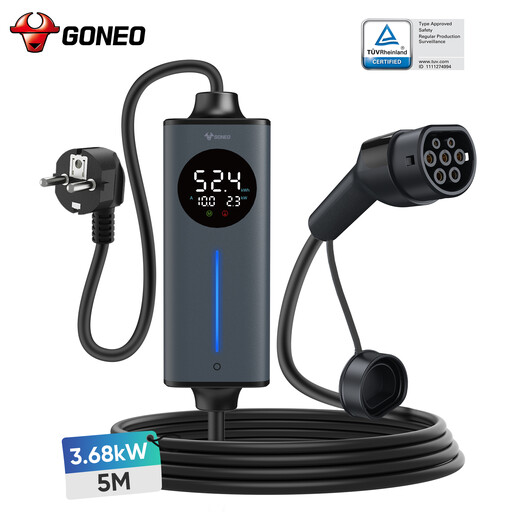
What sets it apart
This portable charger is the ultimate plug-and-play solution. It combines maximum flexibility with uncompromising safety. It features multiple protections, including an essential RCD (Residual Current Device) for protection against AC and DC current leaks.
Benefits
Who is it for??
The ideal travel companion for drivers who can't install a wallbox (e.g., renters), those looking for a backup solution on the go, or owners of plug-in hybrids.
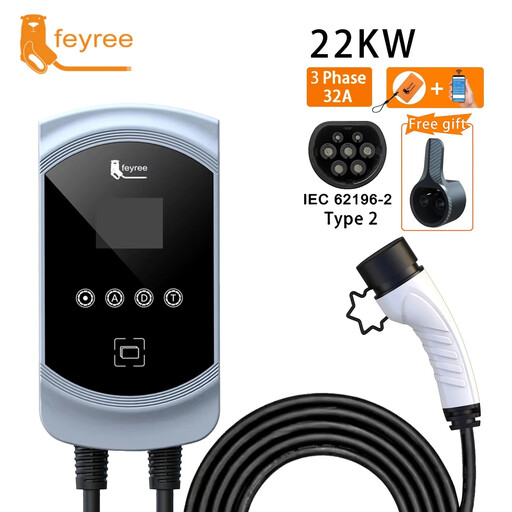
What sets it apart
This wallbox is built for performance. With its 22?kW capacity, it fully leverages the potential of three-phase installations to dramatically reduce charging times. Its Wi-Fi connectivity via the Tuya Smart app turns it into a true control centre for your charging.
Benefits
Who is it for??
For homeowners with a three-phase power supply and a vehicle that accepts 22?kW AC charging. It's the clear choice for high-mileage drivers who need to regain maximum range in record time.
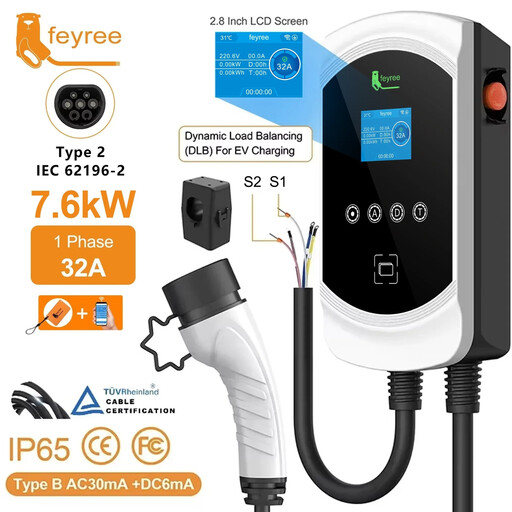
What sets it apart
This wallbox's standout feature is its Dynamic Load Balancing system. It constantly monitors your home's electrical consumption and adjusts the charging power to never exceed your supply's limit. Simply put, it's peace of mind.
Benefits
Who is it for??
The sensible choice for the vast majority of homeowners with a single-phase installation. It combines comfortable charging power, smart features to control your electricity bill, and, above all, top-tier safety with dynamic load balancing.
Our selection covers the most common needs, but of course, every situation is unique. If you're looking for a different power rating, another cable length, or specific features, feel free to explore our full catalogue.
? Discover Our Full Range of EV Chargers
A heavy-duty socket looks like a standard domestic socket but is designed to safely handle a continuous 16A load (around 3.7?kW) for several hours. A wallbox is a dedicated unit that offers higher power (7?kW or more), more comprehensive built-in protections, and often smart features. A wallbox must be installed by a certified professional.
In many countries, the installation of a charger with a power rating above 3.7?kW must be carried out by a qualified electrician certified for EV charger installations. This ensures the installation is safe and compliant with regulations, and is often a prerequisite for government grants or incentives.
A charger with dynamic load balancing comes with a current sensor (a clamp) that is installed at your home's main electrical panel. This sensor measures the household's total real-time power consumption. The charger receives this information and adjusts the power it delivers to the vehicle. If you turn on a high-demand appliance (like an oven), the charger will reduce its output to avoid exceeding your electrical supply's capacity and tripping the main breaker.