
Livraison le jour même ou le lendemain

Qualité garantie

Débloquez vos offres de bienvenue: Livraison GRATUITE | Jusqu'à -80 % | 30 jours d'essai gratuits à JoyPlus
Téléchargez l'application
By the Joybuy Editorial TeamPublished July 17, 2026
You've made the switch to electric. But the real revolution is being able to charge your car at home, stress-free and on your own terms. No more anxiety about finding an occupied or out-of-service public charger. The only catch: the market is flooded with models, and figuring out how to choose the right electric car charger can quickly become a headache.
Don't worry, this guide is here to help you make sense of it all. We'll break down the key points and present our selection of the best chargers for all needs and budgets. Our goal is to help you make the right choice with complete peace of mind.
Before taking the plunge, there are a few technical concepts to understand. They are the key to your daily convenience.
Your car's charging speed is directly linked to the charger's power output, but more importantly, to that of your home's electrical system.
The choice here will depend on your home and your habits.
A connected charger with Wi-Fi or Bluetooth guarantees a host of convenient features, all controllable from a mobile app:
Good to know: In Europe, the standard for the vehicle-side connector is the Type 2 charging cable. It is compatible with almost all electric and plug-in hybrid cars on the market, so you can't go wrong.
Here are three charging solutions that cater to distinct user profiles, from the backup portable charger to the ultra-powerful smart wallbox.
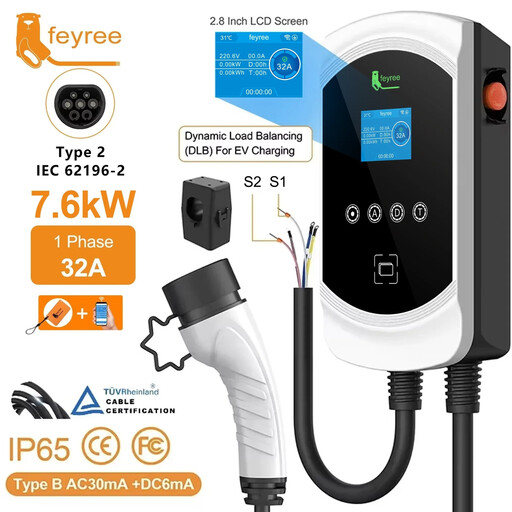
Its key feature: Without a doubt, its dynamic load balancing (DLB) function. The charger communicates with your electrical panel to continuously adjust the charging power based on what the rest of the house is using. Start a load of laundry and cook dinner while the car charges: there's no risk of tripping the breaker.
Highlights:
Who is it for? For homeowners who want a smart, "plug-and-play" wallbox that can manage charging without disrupting household life. The ideal solution for a detached house with a single-phase electrical system.
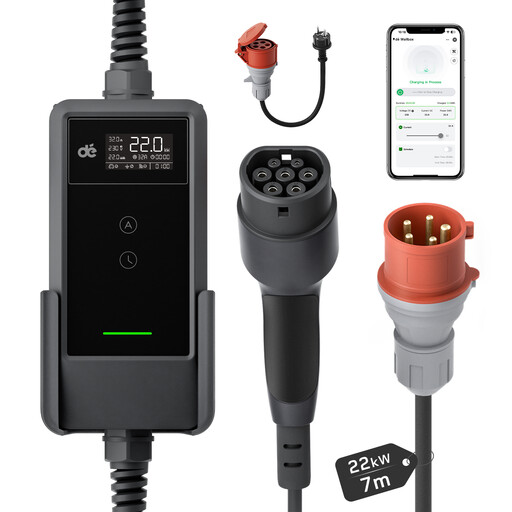
Its key feature: The best of both worlds. The power of a fixed station (a very high one!) in a portable format. It can serve as your main wallbox or as a powerful charger on the go, provided you have access to a CEE 32A industrial socket.
Highlights:
Who is it for? For high-mileage drivers with a three-phase setup whose vehicle can handle 11 or 22 kW. It's the ultimate performance choice for home charging, with the added flexibility of a charger you can take with you.
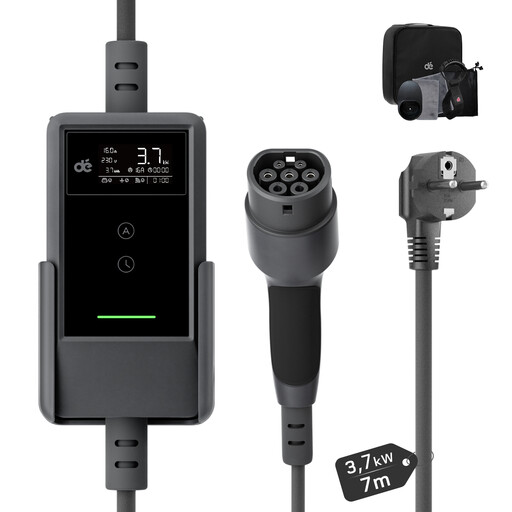
Its key feature: Simplicity above all. You plug it into a standard wall socket, and it charges. Its LCD screen and adjustable current make it a travel companion that is as practical as it is reassuring.
Highlights:
Who is it for? The ideal companion for plug-in hybrids, short daily commutes, and renters. It's also the perfect emergency charger to keep in the trunk "just in case."
Our selection covers the most common use cases, but the world of EV charging is much broader. Different power levels, cable holders, accessories... Discover all our solutions by exploring our dedicated category.
? Explore our full range for electric vehicles
For the majority of homes with single-phase power, a 7.4 kW charger is the best compromise. It ensures a full charge overnight, usually without needing to upgrade your electrical service plan. If you are fortunate enough to have a three-phase connection (and your car is compatible), an 11 kW or 22 kW charger will literally cut your waiting time.
For a portable charger that uses a standard socket, no intervention is required. However, the installation of a wall-mounted charger (Wallbox) of 7.4 kW or more must be carried out by a qualified electrician, ideally one certified for EV charger installation. This is not only a guarantee of safety and compliance but also an essential condition to be eligible for government incentives.
The Type 2 connector (sometimes called Mennekes) is simply the European standard for alternating current (AC) charging, the kind you use at home. Nearly all electric and plug-in hybrid cars sold on the continent are equipped with it. The result is maximum compatibility with both public and private charging stations.