
Livraison le jour même ou le lendemain

Qualité garantie

Débloquez vos offres de bienvenue: Livraison GRATUITE | Jusqu'à -80 % | 30 jours d'essai gratuits à JoyPlus
Téléchargez l'application
An electric burr coffee grinder can genuinely transform your daily espresso, filter coffee or French press routine. Yet product listings often focus solely on the number of settings or motor power, without explaining what these features actually mean in practice. To avoid disappointment, it is better to look at grind consistency, capacity, noise, maintenance and electrical compatibility.
An adjustable coffee grinder displaying 30 or 48 positions does not necessarily guarantee a grind fine enough for espresso. Some models cover a very broad range, while others offer much smaller increments. To fine-tune an extraction, a graduated dial, or even stepless adjustment, is often more useful than the simple figure stated in the specifications.
Some of the grounds may remain in the outlet chute or scatter around the container. This can lead to wasted coffee and the risk of mixing two different coffees. A coffee grinder with an anti-static system, whether that means a coating or a mechanism that reduces electrostatic charge, helps limit the problem. However, it will not eliminate all residue in every usage condition.
The burrs need to be brushed regularly. Removable parts make cleaning easier, but the motor unit must never be immersed in water. On some coffee bean grinders, the instructions also require breaks between several batches to prevent the motor from overheating. This is particularly important to check if you plan to use the grinder intensively or professionally.
Conical burrs are used in many versatile grinders. They are generally suitable for several brewing methods, from espresso to French press, while allowing the appliance to remain relatively compact. Flat burrs may appeal to enthusiasts looking for an even distribution and good stability, particularly for espresso or filter coffee. However, the result depends on the design as a whole: the motor, burr geometry and adjustment system.
Here are some useful guidelines:
A coffee grinder designed for espresso is therefore not necessarily a substitute for a model suited to filter coffee and French press. If you switch between brewing methods, choose a wide adjustment range and easily adjustable dosing.
For one person, a small hopper or rechargeable model may be more than sufficient. In a household or office, a larger capacity means you do not have to refill the appliance for every preparation. Also remember to check the following:
Wattage alone is not enough to predict grind quality. A more powerful motor can make it easier to grind dense beans, but noise levels, rotation speed and the recommended duty cycle deserve just as much attention.
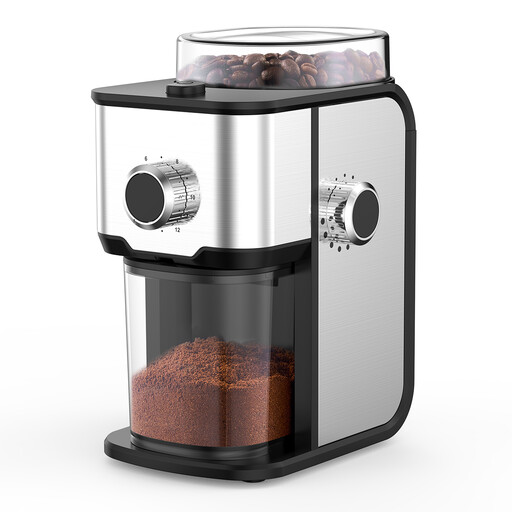
Why it suits this profile : Its compact design and 14 settings make it a straightforward choice for getting started at home or in the office. The stated quantity covers 2 to 12 cups.
Its flat-burr mechanism and clearly marked settings help you avoid ending up with a simple blade grinder that cannot control the grind properly.
Flat burrs, 14 settings and a stated capacity of 2 to 12 cups.
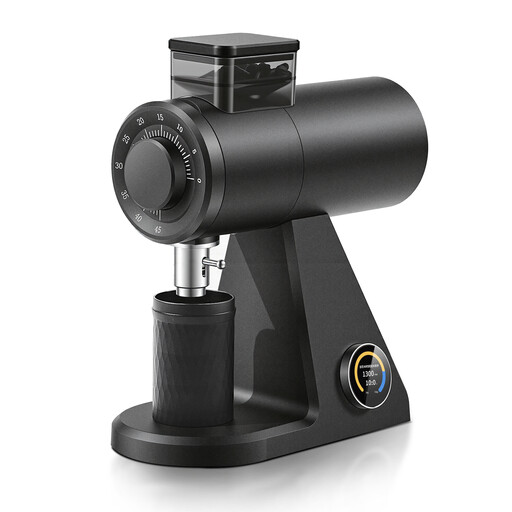
Why it suits this profile : Enthusiasts who frequently fine-tune their espresso and pour-over recipes can benefit from stepless adjustment, a timer and 74 mm flat burrs.
The product details specify variable speed, an anti-static system and stated retention of between 0.1 and 0.5 g, rather than relying on a vague promise of precision.
74 mm flat burrs, 250 W motor, stepless adjustment and timer.

Why it suits this profile : Its compatibility with 51, 54 and 58 mm portafilters, combined with its dosing functions, makes it suitable for an espresso station used regularly.
Its 48 settings, touchscreen and static-reduction system offer much clearer control than a simple on/off switch.
48 settings, stainless steel conical burrs and support for several portafilter diameters.
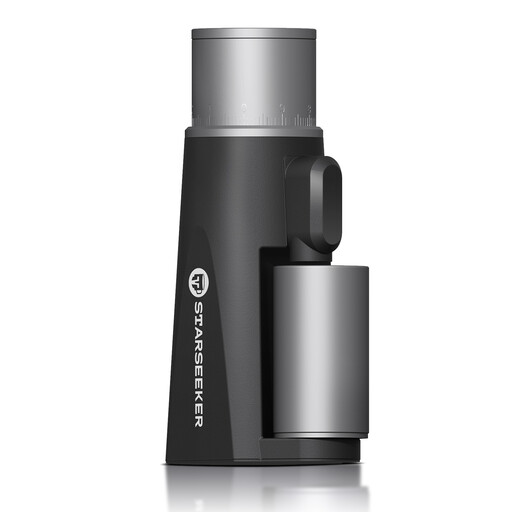
Why it suits this profile : This rechargeable portable coffee grinder works without a mains socket and features a 2,600 mAh battery, making it practical for the office, camping or travelling.
The product details clearly state that it has no anti-static system and recommend taking precautions to limit grounds clumping in dry weather.
38 mm conical burrs, USB-C charging, stepless adjustment and cordless design.
We have selected a complete, real-time updated list of products that meet these demanding criteria and European safety requirements.
An electric burr coffee grinder uses very little electricity: its motor generally runs for only a few seconds per dose. Daily costs depend more on burr replacement, cleaning frequency and wasted beans caused by retained grounds. To keep costs down, use only dry, roasted coffee beans, empty the container after every use and brush the outlet chute regularly.
Avoid grinding spices, cereals or unroasted beans unless the manufacturer explicitly allows it. Always unplug the appliance before clearing a blockage or accessing the burrs. On a rechargeable model, protect the USB-C port from moisture and use the recommended cable.
Choose a model offering an adjustment range from very fine to coarse. A versatile conical-burr coffee grinder may be perfectly suitable, while stepless adjustment allows you to fine-tune espresso more precisely. For French press, check above all that the coarsest setting limits the production of fine particles.
It depends on the motor, the amount of coffee being ground and the instructions provided in the manual. Follow the recommended duty cycle and allow the appliance to cool down after several doses. Domestic use in small quantities puts considerably less strain on the motor than continuous operation in a café.
Yes, provided its capacity and battery life match your consumption. A cordless model is practical in the office, when camping or while travelling. At home, however, a mains-powered appliance is generally more convenient when preparing several coffees in succession.