
Livraison le jour même ou le lendemain

Qualité garantie

Débloquez vos offres de bienvenue: Livraison GRATUITE | Jusqu'à -80 % | 30 jours d'essai gratuits à JoyPlus
Téléchargez l'application
An electric bike can make daily commutes, trips to work, or rides on country paths much easier. But with so many options on the market, it’s not always easy to know where to start. The advertised range doesn’t always reflect real-world use, and a powerful motor could make the bike unsuitable for riding on public roads.
So before you place an order, it’s worth separating the marketing claims from the features that really matter in the UK.
In the UK, an electric bike intended for use on public roads must generally have assistance limited to 250 W, cut out at 15.5 mph (25 km/h), and only work when you’re pedalling. A model boasting 500 W or more may fall into a different category, depending on its configuration and top speed.
An off-road electric bike or an electric dirt bike isn’t automatically allowed on the road. Before you take the handlebars, check the manufacturer’s spec sheet, make sure the required equipment is fitted, and confirm the vehicle’s classification.
Range varies depending on the weight carried, the terrain, the temperature, the level of assistance, tyre pressure, and how often you stop. A large-capacity battery is a good indicator, but it doesn’t guarantee the same distance for every rider.
To compare two models, look at their voltage and capacity in watt-hours. A 48 V, 18 Ah battery gives you around 864 Wh in theory, compared with roughly 1,104 Wh for a 48 V, 23 Ah battery. These figures are useful benchmarks, not a mileage guarantee.
A heavy electric bike can quickly become a hassle to carry up to a flat, lift into a car boot, or manoeuvre up stairs. Wide tyres improve stability on certain surfaces, but they also add bulk and, often, rolling resistance.
Also think about the availability of consumable parts: brake pads, tyres, chain, charger and battery. A removable battery makes charging easier and can be a real bonus if you don’t have a socket nearby at home.
For urban journeys, a 250 W electric bike with assistance limited to 15.5 mph (25 km/h) generally fits the standard electric bike format for public road use, provided all applicable rules are followed. A 500 W electric bike can offer better acceleration, but you must check its legal status before riding it on the road.
More powerful models, such as certain dirt bikes, are usually intended for private land or dedicated tracks. The VIPCOO H3 shown below clearly states that it is not approved for road use.
To choose an electric bike with long range, compare the capacity in Wh, the type of charging, and whether the battery can be removed. A removable battery is handy for charging at the office or in a flat. Also check the recommended storage conditions: moderate temperature, a dry place, and using the original charger.
The cost of ownership isn’t just about electricity. You also need to budget for brake, tyre and transmission maintenance, as well as the eventual replacement of the battery after several years.
Hydraulic brakes deliver powerful, progressive stopping – especially welcome on a heavy bike, a loaded bike, or when riding downhill. They do, however, require specific maintenance.
For a city electric bike, standard-diameter tyres and an upright riding position make regular journeys more enjoyable. On trails, suspension, off-road tyres and greater ground clearance can improve comfort. As for a folding electric bike, you should also assess it when folded: its dimensions, weight and how easy it is to lock matter just as much as its motor.
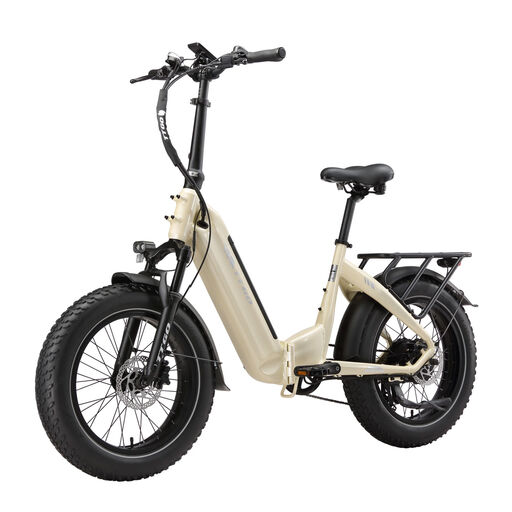
Why this choice suits this profile: With its advertised 250 W motor and 50.8 cm tyres, this model is ideal for adults looking for a versatile bike for daily commutes and easy paths.
The motor power and battery capacity are clearly stated, making it easy to compare with models that have vaguer spec sheets.
Advertised 250 W motor, 48 V 18 Ah battery and 50.8 cm wheels.
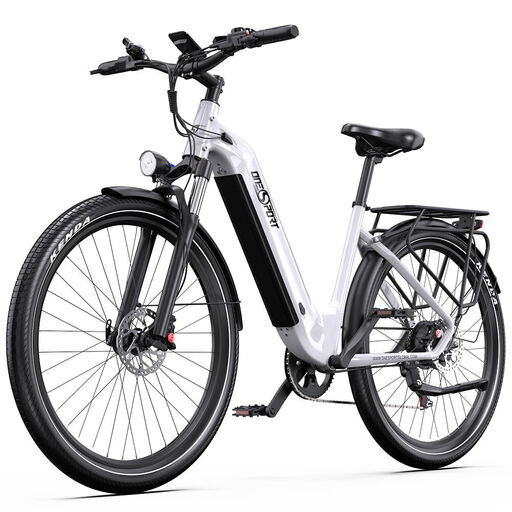
Why this choice suits this profile: This city electric bike combines a 655 Wh battery, seven gears and hydraulic brakes for regular commutes as well as hilly routes.
The advertised distance should be taken as an indicative maximum. However, the 655 Wh capacity gives you a concrete benchmark for comparing the bike with its competitors.
69.9 cm wheels, hydraulic brakes, seven gears and an advertised maximum range of 100 km.
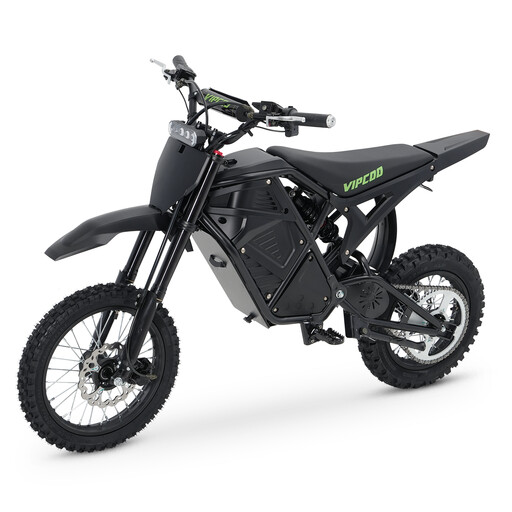
Why this choice suits this profile: This electric dirt bike is designed for private land and dedicated tracks. It features full suspension and a removable 48 V 23 Ah battery.
Its spec sheet clearly states that it is an off-road model not allowed on public roads. So there’s no risk of confusing it with a standard electric bike.
Advertised 3,500 W motor, dual hydraulic disc brakes, front and rear suspension, removable 48 V 23 Ah battery.
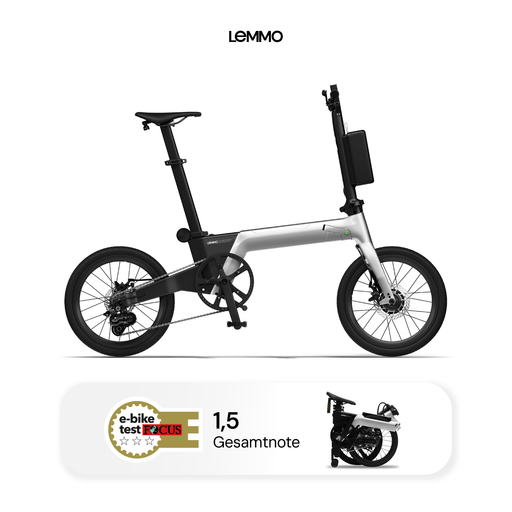
Why this choice suits this profile: This folding electric bike is ideal for those who combine cycling with the train, car, or simply lack storage space.
Its folded dimensions — 68 × 73 × 32.4 cm — are clearly stated. So you can check whether it will fit in your home or your chosen mode of transport.
Folding design with 40.6 cm wheels, advertised range of 30 km and maximum load of 120 kg.
We’ve put together a comprehensive, real-time updated selection of products that meet these demanding criteria and European safety standards.
For standard road use, check that the model meets the requirements of an electric bike: pedal assistance, cut-off at 15.5 mph (25 km/h) and a nominal power of 250 W. A more powerful motor isn’t necessarily better suited to urban riding.
Charging an electric bike uses relatively little electricity, but the cost depends on the battery capacity and your supplier’s rate. To estimate it, multiply the battery’s kWh by the price per kWh, then add a margin for charging losses. Over time, maintenance and replacement parts often account for the biggest expenses.
It all depends on the number of charge cycles, storage conditions, temperature and your charging habits. Avoid extreme temperatures, use the supplied charger and follow the manufacturer’s recommendations. A removable battery also makes it easier to store in good conditions.